
Refractory Material Science for Glass Furnaces: Key Properties That Drive Furnace Life




Refractory Material Science for Glass Furnaces: What Actually Governs Furnace Life
For technical evaluators, the phrase refractory material science for glass furnaces is easy to underestimate. It sounds like a narrow materials topic, but in plant reality it sits at the intersection of campaign life, pull stability, thermal efficiency, glass quality, and shutdown planning. A furnace rarely fails because one property on a datasheet looked weak in isolation. It fails, or starts to drift out of control, because the chosen refractory system could not hold up under the actual combination of temperature, glass chemistry, vapor attack, structural load, and transient operating events.
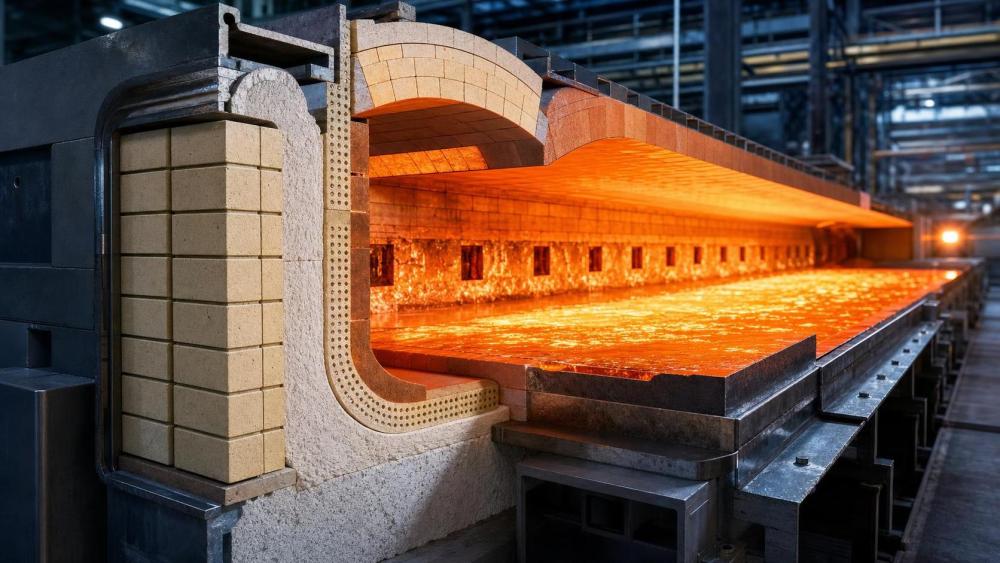
That distinction matters. In glass manufacturing, refractories are not simply passive heat-resistant blocks. They are process-facing materials exposed to molten glass, alkali vapors, batch carryover, flame or electric boosting effects, redox fluctuations, and repeated thermal gradients across thick walls and crowns. The useful question is not whether a material is “high temperature.” The useful question is whether its microstructure and chemistry remain stable long enough, in a defined furnace zone, to preserve geometry and avoid contaminating the melt.
This is why furnace life is usually discussed zone by zone. A crown, superstructure, breastwall, sidewall, bottom, throat, doghouse, regenerator checker setting, and forehearth do not ask the same things from a refractory. Evaluators who reduce selection to one headline metric such as maximum service temperature or apparent bulk density tend to miss the real failure mechanisms.
The First Misread: Heat Resistance Alone Does Not Predict Service Life
A refractory can survive a laboratory temperature rating and still be a poor choice for a glass furnace. Standard thermal classification tells you something about refractoriness under controlled conditions, but furnace life is usually limited by corrosion, creep under load, spalling, cracking from thermal stress, or structural distortion. In other words, the end of life is often mechanical or chemical long before it is purely thermal.
Take fused cast products and dense sintered products as an example. Both may be suitable in glass furnace construction, but not for the same reasons and not in the same locations. Fused cast AZS materials are widely associated with strong resistance to glass corrosion in severe contact zones, yet their behavior under thermal shock and their tendency toward specific defect mechanisms must still be evaluated in relation to placement and startup practice. A dense aluminosilicate brick may be easier to install or repair in another area, but that does not make it fit for direct exposure to aggressive molten glass or alkali-rich vapors. The service map matters more than the catalog category.
The properties that drive furnace life are best understood as an interacting set:
- resistance to chemical corrosion by molten glass and vapors
- thermal shock resistance during heat-up, cooling, and upset events
- creep resistance and load-bearing stability at sustained high temperature
- microstructural integrity, including porosity distribution and phase stability
- insulating behavior where heat loss and shell temperature must be controlled
- compatibility with glass quality targets, especially defect sensitivity
Corrosion Resistance Is Not a Single Number
When engineers say a refractory is “corrosion resistant,” they usually mean one of several different things. Molten glass can dissolve refractory constituents, penetrate open pores, react with grain boundary phases, or erode the hot face as flow patterns change. Vapors from alkalis, borates, sulfates, chlorides, or other volatile species can attack the superstructure even where there is no direct glass contact. The chemistry of container glass, float glass, borosilicate glass, fiberglass, and specialty compositions does not place the same burden on the lining.
That is why corrosion test results must be interpreted cautiously. A cup test or a static corrosion test may help compare candidates, but it cannot fully reproduce local velocity, bubbling, electric boosting, redox conditions, and temperature cycling inside a working furnace. Evaluators should ask what attack mode is expected in the target zone: dissolution, infiltration, vapor-phase reaction, or mechanical wash. The answer changes the selection logic.
There is also a quality dimension. Even if a refractory does not wear rapidly, it may still be unacceptable if it contributes stones, cords, blisters, or inclusions. In high-quality glass production, low wear rate and low contamination risk are related but not identical requirements.
Thermal Shock Resistance Decides How Much Abuse the Lining Can Absorb
Technical teams often pay serious attention to thermal shock only after a crack pattern has already appeared. In practice, this property shapes startup discipline, repair tolerance, and resilience during disturbances. A furnace does not always move smoothly from one stable state to another. Burners are adjusted, pull rates change, electric boosting alters local thermal fields, and emergency cooling may occur during incidents. Every one of those events can create gradients that put the lining into tension.
Thermal shock resistance is influenced by elastic modulus, thermal expansion behavior, fracture toughness, thermal conductivity, and microstructural features such as crack deflection paths. Materials with excellent corrosion resistance are not automatically forgiving under rapid temperature change. Some are inherently more brittle in service. This is why installation quality and heat-up schedule remain part of refractory science, not a separate housekeeping topic. A good material can be damaged by a poor thermal regime, and a marginal material can fail early if it sees repeated local shocks around ports, burner blocks, or crown transitions.
Load Strength and Creep: The Slow Failure Mode People Notice Late
Some of the most expensive refractory failures are not dramatic. They develop slowly as deformation. Under sustained high temperature, a refractory carrying structural load can creep. Dimensions shift, joints open, arches relax, crowns sag, and local stress redistributes into neighboring units. By the time the problem becomes visible from shell temperatures, hot-spot mapping, or glass behavior, a substantial amount of damage may already be locked in.
For this reason, cold crushing strength is a weak proxy for real furnace endurance. Evaluators need high-temperature load data, creep behavior, and service experience in comparable furnace geometries. Crown and superstructure applications are especially sensitive because mechanical stability under long campaigns is inseparable from safety and thermal efficiency. If a material holds chemistry but loses shape, the furnace still loses life.
Insulation Is Valuable, but Dense Hot-Face Materials Cannot Be Replaced by It
Another common misunderstanding is to treat insulation performance as a direct route to longer life everywhere in the furnace. Lower heat loss is desirable, and multi-layer lining design absolutely matters for energy management and shell control. But the hot face in a glass furnace must first survive chemical and structural exposure. Replacing a robust dense lining concept with a more insulating but less durable one can reduce external heat loss while shortening campaign life or increasing glass contamination risk.
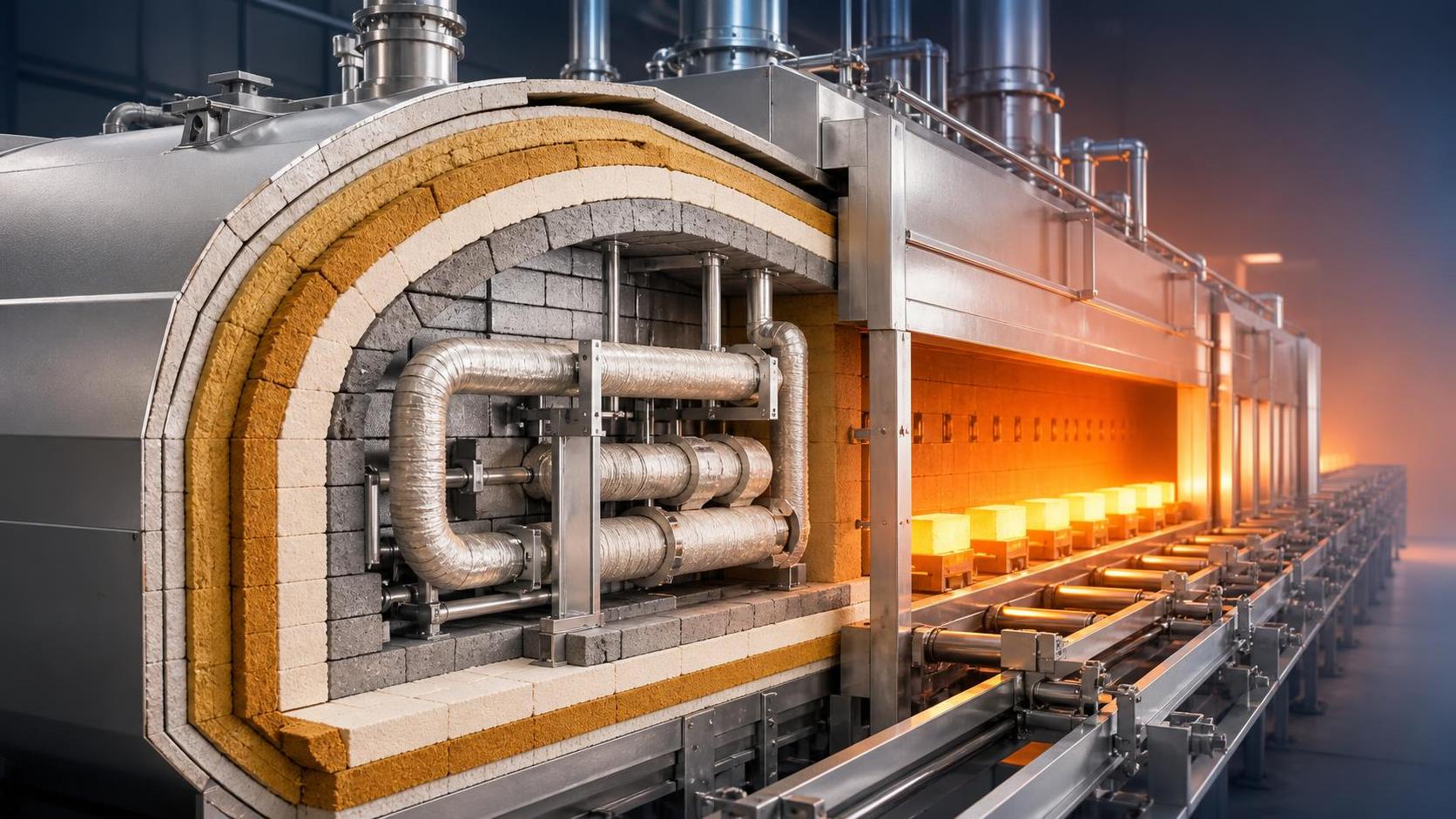
The more useful view is layered function. Dense contact refractories provide resistance to glass attack and load. Backup dense or semi-insulating layers help manage gradients and structural continuity. Insulating materials reduce heat flow where direct process attack is limited or shielded. The best design is rarely the one with the lowest thermal conductivity on paper. It is the one that balances inside-face survivability with acceptable heat flux through the wall.
Microstructure Tells You More Than the Product Name
Two refractories sold under the same broad category can behave differently because of microstructure. Grain size distribution, bond phase chemistry, closed versus open porosity, impurity level, and manufacturing route all shape service behavior. This matters in glass furnaces because penetration and reaction often begin along weak paths rather than through the idealized bulk composition shown on a data sheet.
For technical evaluation, that means composition percentages alone are not enough. An alumina-zirconia-silica product, a silica brick, a zircon material, or a mullite-based block should be reviewed through its actual production method and the defect modes historically associated with that family in the intended zone. Small differences in porosity and phase distribution can change spalling tendency, corrosion kinetics, or contamination behavior more than a headline chemistry table suggests.
A Practical Way to Judge Refractory Fitness
For a technical assessment, the most reliable approach is to frame the refractory around service conditions rather than around a generic “best material” idea. A useful review usually includes the following questions:
This style of review is closer to how experienced furnace teams actually work. They compare the lining concept with the process map, not just the product brochure.
Where Standards Help, and Where They Stop Helping
Standards and laboratory methods remain necessary. They provide common language for density, porosity, refractoriness, strength, permanent linear change, and certain corrosion or thermal properties. But evaluators should be careful not to confuse test comparability with service predictability. Standardized values are extremely useful for screening and quality control; they are less complete as stand-alone predictors of campaign life in a chemically active furnace.
That is why supplier claims should be read together with installation practice, joint design, anchoring or support details where relevant, and operating history from similar furnace types. In refractory material science for glass furnaces, service life comes from system behavior. Material choice is central, but it is still one part of a thermochemical structure that has to function as a whole.
What Technical Evaluators Should Keep in View
The strongest evaluations usually avoid two extremes. One is oversimplification: choosing by one property, one brand family, or one historical preference. The other is data overload without process context. A long refractory data pack is not automatically a better basis for decision if it does not answer where the material will sit, what it will face, and what failure mode is most likely to end the campaign.
In practical terms, the key properties that drive furnace life are the ones that preserve both shape and chemistry under real operating stress. Corrosion resistance protects against wear and contamination. Thermal shock resistance protects against cracking during transitions. Creep resistance preserves geometry over long high-temperature service. Insulation controls energy loss when placed in the right layer. Microstructure ties all of these behaviors together. Once those relationships are clear, the term stops being abstract. It becomes a disciplined way to judge whether a lining design is merely heat resistant, or truly fit for a modern glass furnace campaign.
Related News
 Optical Glass Tech FellowHow to Evaluate a Glass Annealing Equipment Manufacturer for Production StabilityChoose a glass annealing equipment manufacturer with proven thermal uniformity, reliable controls, lifecycle value, and responsive service for stable production.Sep 08, 2026
 Prof. Marcus ChenThermal Energy Architecture in North America: Strategies for Lower Building Energy UseThermal energy architecture North America helps project leaders cut building energy use through stronger envelopes, right-sized HVAC, storage, and smart commissioning.Sep 07, 2026
 Ms. Elena RodriguezHow Should Buyers Evaluate Building Material Industry Intelligence Pricing?Building material industry intelligence pricing: learn how to compare coverage, technical depth, and ROI to choose intelligence that reduces procurement risk.Sep 07, 2026
 Ms. Elena RodriguezHow to Use Building Material Intelligence Data for Market and Investment DecisionsBuilding material industry intelligence data helps leaders evaluate demand, costs, regulation, capacity, and technology to make smarter market and investment decisions.Sep 05, 2026
 Thermal Energy ArchitectHow PLC Control Improves Energy Efficiency and Temperature Stability in KilnsEnergy efficient kilns PLC control improves temperature stability, cuts fuel waste, and optimizes combustion, draft, and material flow. Explore proven strategies for smarter kiln modernization.Sep 04, 2026
 Optical Glass Tech FellowEuropean Glass Melting Processes: Furnace Choices, Energy Use, and Quality ControlGlass melting process Europe: explore furnace choices, energy efficiency, cullet strategy, and quality control to improve output, compliance, and long-term glass performance.Sep 03, 2026
 Thermal Energy ArchitectWhat Determines Refractory Lining Monitoring Price for Industrial Kilns?Refractory lining monitoring price depends on kiln size, sensor technology, installation, software, and support. Compare total lifecycle costs and choose the right solution.Sep 02, 2026
 Silicate Process EngineerCement Production System Costs: A Plant Buyer’s Guide to Budgeting and ROICement production systems cost planning made clear: compare CAPEX, operating costs, compliance, and ROI to build a resilient, profitable cement plant investment.Sep 01, 2026
 Dr. Alistair VaughnWhat Should a Process Technology Database Track for High-Temperature Plants?Process technology database essentials for high-temperature plants: track thermal profiles, feed chemistry, refractory wear, emissions, energy, and maintenance for safer, data-driven decisions.Aug 31, 2026
 Ms. Elena RodriguezHow to Evaluate a Silicate Processing Equipment Manufacturer for Plant ProjectsSilicate processing equipment manufacturer selection: assess process fit, guarantees, energy, compliance, delivery risk, and lifecycle support for dependable plant performance.Aug 30, 2026
 Dr. Alistair VaughnHow to Specify Custom Agricultural Processing Equipment for Throughput and HygieneEquipment customization services for agricultural processing: learn to specify hygienic, high-throughput lines that improve yield, reliability, and long-term efficiency.Aug 29, 2026
 Dr. Alistair VaughnHow to Select Process Plant Equipment for High-Temperature, Abrasive Production LinesProcess plant equipment selection for high-temperature, abrasive lines: reduce downtime, improve durability, and optimize lifecycle performance.Aug 28, 2026
 Silicate Process EngineerHow Kiln Heat Recovery Systems Cut Fuel Use in Cement and Lime ProductionKiln heat recovery helps cement and lime plants cut fuel use, improve thermal stability, and build practical, reliable decarbonization strategies.Aug 27, 2026
 Ms. Elena RodriguezProcess Equipment Comparison: Which Metrics Matter Most for Reliable Selection?Process equipment comparison made practical: discover which metrics truly drive reliable selection, from energy efficiency and control stability to wear life, maintainability, and uptime.Aug 26, 2026
 Ms. Elena RodriguezWhat Buyers Should Check Before Sourcing Precision Alloy Bars for Critical PartsPrecision Alloy Bars buyers should verify grade, chemistry, tolerances, surface quality, traceability, and lead time before sourcing for critical parts. Learn what prevents costly machining and reliability risks.Aug 27, 2026
 Ms. Elena RodriguezHow to Evaluate Thermal Management Solutions Insulation for High-Heat Industrial SystemsThermal management solutions insulation: learn how to assess high-heat industrial systems by thermal performance, durability, lifecycle cost, and supplier data for smarter decisions.Aug 25, 2026
 Ms. Elena RodriguezWhat Drives Waste Recycling Cost in Industrial Projects and How to Estimate It?Waste recycling cost in industrial projects depends on composition, moisture, transport, pre-treatment, and compliance. Learn how to estimate it accurately and compare suppliers with confidence.Aug 24, 2026
 Silicate Process EngineerHow to Evaluate Cement Production Plants in the Middle East for Capacity, Fuel Flexibility, and ROIcement production plants Middle East: Learn how to assess true capacity, fuel flexibility, and ROI risks to identify resilient assets and smarter investment opportunities.Aug 23, 2026
 Structural Material AnalystHow to Evaluate Lightweight Material Machinery for Output, Energy Use, and Product QualityLightweight material machinery evaluation guide: compare stable output, energy use, and product quality to choose equipment that cuts waste, lowers costs, and improves production confidence.Aug 22, 2026
 Material Heat-Resist ExpertWhat Determines Refractory Production Line Price in a Turnkey Plant Project?Refractory production line price depends on raw materials, forming method, kiln and drying design, automation, utilities, and scope. Learn what really drives turnkey plant cost before you invest.Aug 21, 2026

Related News
- 00
0000-00
How to Evaluate a Glass Annealing Equipment Manufacturer for Production Stability - 00
0000-00
European Glass Melting Processes: Furnace Choices, Energy Use, and Quality Control - 00
0000-00
How Glass Melting Furnace Design Impacts Energy Use and Glass Quality - 00
0000-00
How Can Glass Manufacturing Technology Improve Furnace Efficiency and Cut Energy Costs? - 00
0000-00
How to Evaluate Continuous Glass Annealing Equipment for Stable Throughput?
Weekly Insights
Stay ahead with our curated technology reports delivered every Monday.