
Specialty Ceramic Extrusion: How Material Properties Affect Forming




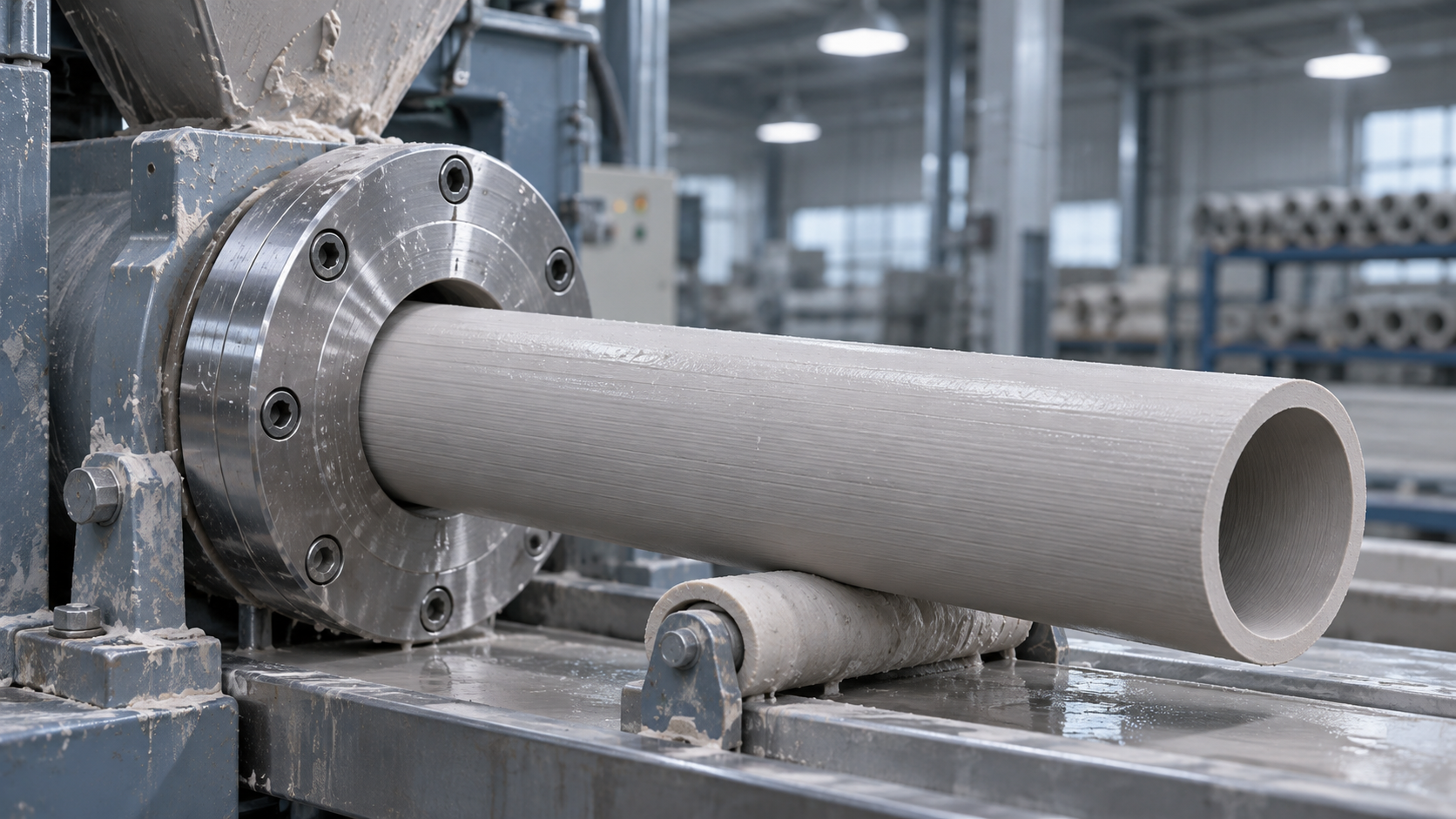
In ceramic specialized material extrusion, forming performance depends on more than extruder pressure or die design. Particle size distribution, solids loading, plasticity, liquid content, and binder chemistry determine whether a body can flow through a die, retain its shape, and survive drying and firing. A formulation that extrudes easily is not necessarily the one that produces an accurate, crack-free component.
The central technical challenge is balancing flow under pressure with strength after the material leaves the die. That balance changes with the ceramic powder, the liquid and organic system, and the geometry being formed. Equipment capability therefore cannot be assessed independently of the complete feedstock formulation.
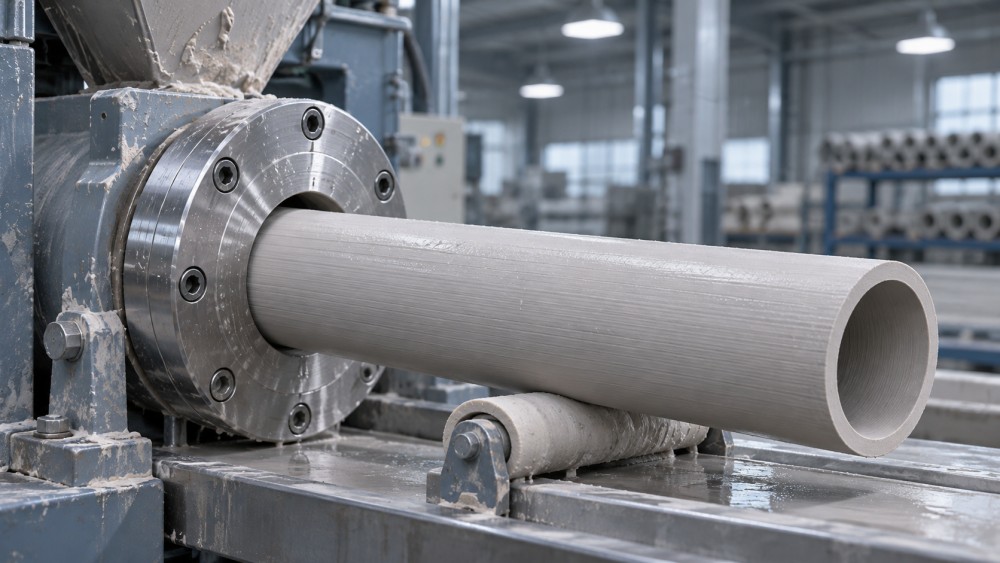
What the ceramic body must do during extrusion
An extrusion body has to deform without separating or fracturing as the screw or ram forces it through a die. Once discharged, it must support its own weight and resist distortion during cutting and handling. It must then release liquid and organic additives without developing stresses that exceed its green strength.
These requirements can conflict. Adding liquid can reduce the force needed for extrusion, but it can also weaken the emerging shape and increase drying shrinkage. Adding binder can improve green strength, yet an excessive or poorly dispersed binder system can make flow less predictable or complicate burnout.
Feedstocks range from water-based clay-containing bodies to highly loaded oxide or non-oxide powders formulated with organic binders and plasticizers. Their behavior should not be treated as interchangeable: a naturally plastic clay body derives part of its formability from fine plate-like particles and water, while a low-plasticity technical ceramic powder may depend much more heavily on the engineered binder system.
Particle size and shape govern packing and flow
Particle size distribution affects the amount of space between particles, the surface area that must be wetted, and the way a body moves through a die. A broader distribution can allow smaller particles to occupy gaps between larger ones, improving packing under suitable conditions. It does not automatically produce a better extrusion body: fine particles also increase surface area and can raise the liquid or dispersant demand.
A body with too little liquid for its powder surface area may behave as a stiff, poorly lubricated mass. Pressure rises, surface tearing can appear, and flow through narrow sections becomes difficult. Conversely, increasing liquid without controlling dispersion may leave the body too soft to hold a thin wall or maintain a straight profile.
Particle shape matters as well as size. Angular grains can increase interparticle friction and equipment wear. Plate-like or elongated particles can align during flow, changing shrinkage or mechanical properties with direction. For a precision profile, alignment and resulting directional shrinkage need to be evaluated alongside average particle size.
Agglomerates introduce another complication. A powder may have a fine primary particle size but still contain larger clusters that do not break down during mixing. These clusters can interrupt flow, produce surface defects, or create local density differences that become visible after firing. A particle-size specification is therefore more useful when it states the measurement method, dispersion conditions, and whether the result represents primary particles or agglomerates.
Plasticity and rheology are related, but not identical
Plasticity describes the ability of a body to deform and retain its new shape without cracking. Rheology describes how the material deforms and flows under applied stress or shear. Both matter, but a simple statement that a formulation is “highly plastic” does not establish whether it will flow uniformly through a complex die.
A practical extrusion body needs sufficient resistance to deformation at rest to preserve its shape, while yielding and flowing under the stresses generated inside the equipment. Many formulations also change behavior with shear and time. A material that becomes easier to flow under shear can pass through the die more readily, but it must recover enough structure afterward to avoid slumping.
Moisture content alone cannot establish that balance. Two bodies with the same water percentage can have different consistency because their particle surface areas, clay contents, soluble salts, dispersants, and mixing histories differ. Likewise, moisture values expressed on a wet-mass basis are not directly comparable with values expressed on a dry-solids basis.
Consistency measurements are most useful when sample preparation, temperature, conditioning time, and test procedure are controlled. Comparing pressure data from two trials without accounting for die geometry and extrusion rate can be misleading: higher pressure may reflect a finer die, faster throughput, a stiffer body, wall friction, or a combination of these factors.
Liquid and binder systems do more than make powders formable
In a water-based body, water wets particle surfaces, fills pores, and helps particles move relative to one another. The useful water range is bounded by competing defects. Below it, inadequate lubrication and poor consolidation can cause cracks or rough surfaces. Above it, the body can lose dimensional stability and require more drying, increasing the opportunity for differential shrinkage.
Liquid distribution matters as much as the average content. Insufficient mixing or inadequate conditioning can leave dry pockets beside wetter regions. Those regions may flow at different rates through the die and shrink differently during drying. A single moisture result from a bulk sample may not reveal that variability.
Binders provide cohesion and green strength; plasticizers modify the flexibility and deformation behavior of the binder phase; lubricants and dispersants can alter particle interactions and friction. Their effects overlap, and compatibility with the powder and liquid medium matters. Changing the ceramic surface chemistry or powder supplier can alter additive demand even when the nominal ceramic composition remains unchanged.
The organic system must also be removable. Strong green parts can still crack during heating if organics decompose or leave faster than gases can escape through the body. Thick sections and low-permeability microstructures can be more demanding than open, thin sections. The relevant judgment is not simply binder content, but the combination of binder chemistry, part geometry, permeability, and the specified thermal cycle.
Solids loading links extrusion to final dimensions
Solids loading is the proportion of solid material in the feedstock, expressed by volume or mass. Volume fraction is particularly useful when comparing packing and expected shrinkage, but it requires reliable density information for the constituent materials. Mass percentages should not be compared directly with volume percentages.
For a given powder system, higher solids loading can reduce the amount of liquid or organics that must be removed and can reduce forming-to-fired shrinkage. The trade-off is that particles interact more strongly as the mixture approaches its practical packing limit. Mixing becomes harder, pressure can rise sharply, and small changes in liquid content or particle distribution can have a larger effect on flow.
Lower solids loading may make extrusion easier while increasing drying or burnout burden and shrinkage. It can also compromise shape retention. The optimum is therefore not the highest achievable loading; it is the range that maintains stable flow, adequate green strength, and acceptable dimensional change for the intended geometry.
Green density uniformity is as important as its average value. If different sections of a profile leave the die with different packing states, they can shrink at different rates. A straight green extrusion may consequently warp during drying or firing even when the overall shrinkage falls within the expected range.
Die geometry exposes material limitations
A solid rod, a thin-wall tube, and a multi-channel honeycomb place different demands on the same body. Thin walls require controlled flow through narrow passages and sufficient green strength to prevent collapse. Multi-channel dies also require flow to be balanced across the cross-section; local differences in resistance can produce bowed profiles or uneven wall thickness.
Die design can compensate for some flow imbalance, but it cannot make an incompatible feedstock behave consistently. A material prone to separation, for example, may experience liquid migration under pressure. The resulting change in local solids concentration can cause unstable pressure, inconsistent flow, or a dry, stiff region near the die. Increasing pressure alone can intensify the problem rather than solve it.
Wall friction and die wear are also material-dependent. Abrasive or angular particles can change die dimensions and surface condition over time, affecting both pressure and profile accuracy. A successful short trial should therefore be interpreted separately from evidence of stable operation over a longer production run.
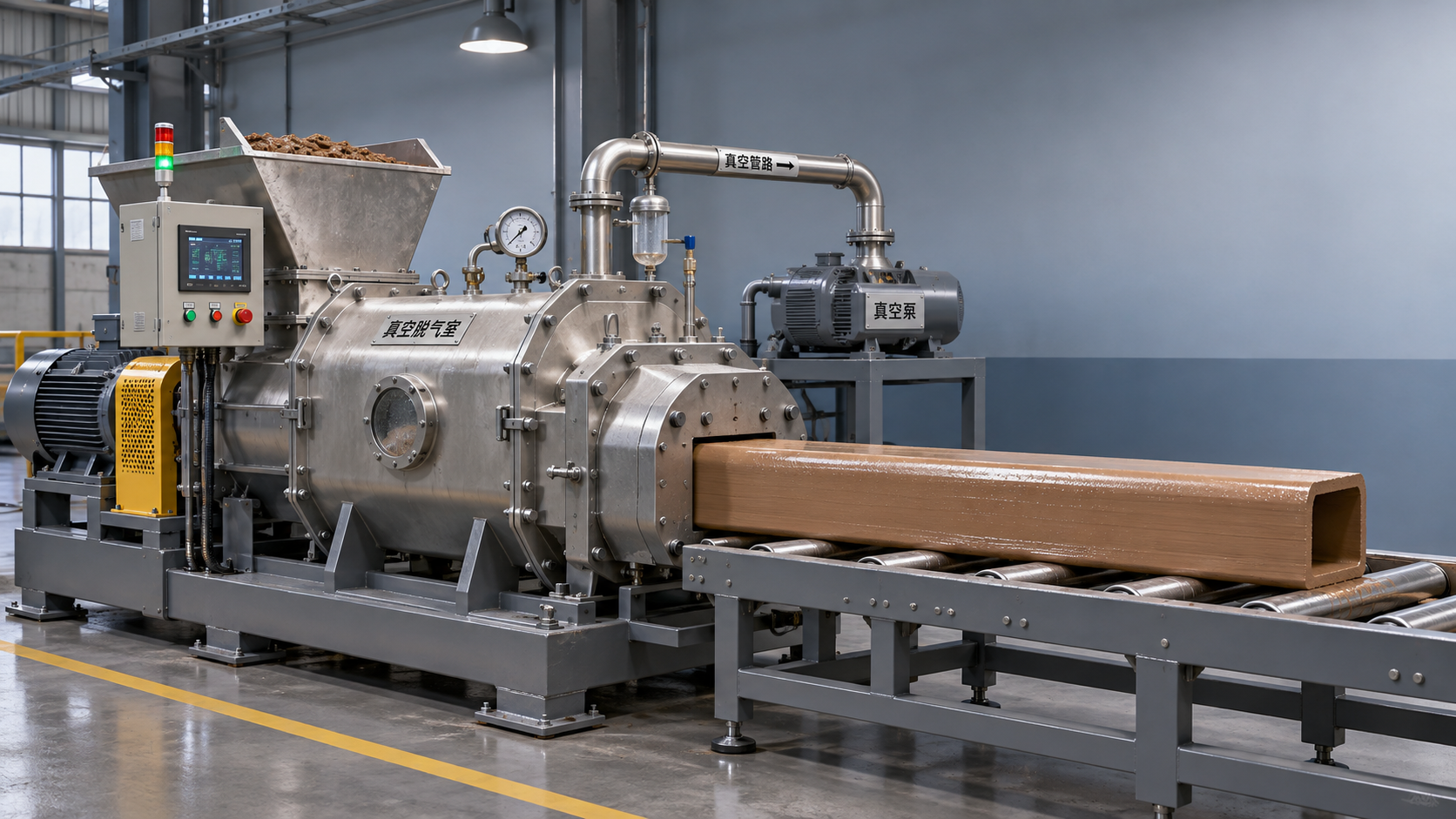
Entrained air is another source of discontinuity. Air pockets can produce laminations, voids, or defects that open during drying or firing. De-airing equipment can help, but it does not replace adequate powder wetting and mixing; poorly dispersed agglomerates can remain even when visible air has been removed.
Reading defects as evidence, not as a single-cause diagnosis
Extrusion defects rarely identify one root cause on their own. The point at which a defect first appears is often more informative than its appearance after firing.
- Surface tearing at the die exit: examine body consistency, particle lubrication, extrusion rate, die surface condition, and flow restriction. A stiffer body or excessive local deformation can contribute, but a damaged die can produce a similar symptom.
- Slumping or distorted green profiles: assess liquid content, binder response, temperature, and the time between extrusion and support or cutting. Die-exit deformation should be distinguished from distortion that develops later on the support surface.
- Longitudinal seams or internal laminations: consider entrained air, incomplete consolidation, and how streams of material rejoin inside the die. A smooth exterior does not rule out an internal defect.
- Drying cracks: check drying uniformity, section thickness, support, and green strength as well as liquid content. Rapid surface drying can create a moisture gradient and tensile stress even when the initial extrusion looks sound.
- Fired warpage or cracking: trace the defect back through green density, particle orientation, drying, binder removal, and firing support before attributing it solely to the kiln cycle.
Cutting representative green and dried sections can help distinguish a surface problem from an internal one. Comparing defects at the die exit, after drying, and after firing also prevents a downstream symptom from being mistaken for the original cause.
How to make a material and equipment assessment comparable
A meaningful forming trial starts with a defined feedstock and a defined part. The ceramic composition, powder characteristics, liquid basis, additive system, mixing sequence, and conditioning time should be recorded with the target profile dimensions and tolerances. If proprietary ingredients cannot be disclosed, their functional role and controlled range still need to be clear enough to reproduce the test.
Record extrusion rate and material temperature together with pressure, die configuration, and measurement location. Pressure is not an intrinsic material property: it is a process response to both the body and the flow path. A pressure reading without a corresponding throughput and die description is insufficient for comparing equipment or formulations.
Evaluation should extend beyond whether a profile emerges from the die. Relevant checks include dimensional variation along the extrusion, surface and internal defects, green handling strength, drying distortion, mass loss, and fired dimensions. For geometries with directional requirements, shrinkage should be measured in the relevant directions rather than assumed to be uniform.
Where standardized methods are used for powder characterization, moisture measurement, or ceramic property testing, the exact method and its edition should be identified. No single test standard establishes extrusion suitability for every specialty ceramic body. Internal methods can also support valid comparisons when sample preparation, equipment settings, and acceptance criteria are documented and repeatable.
The most useful result is a process window rather than a single successful run: a documented range of feedstock consistency, throughput, temperature, and pressure in which the specified geometry remains acceptable through drying and firing. If a small change in moisture or powder condition moves the process outside that window, the limitation belongs in the material and equipment assessment, even when the initial extrudate appears satisfactory.
Related News
 Ms. Elena RodriguezProcess Equipment Pricing: How to Compare Quotes and Total CostsMaster process equipment comparison pricing: compare supplier quotes, uncover hidden costs, and evaluate lifetime expenses to make a confident buying decision.Nov 17, 2026
 Prof. Marcus ChenGlobal Cement Industry Decarbonization: Key Technologies and Cost BarriersExplore global cement industry decarbonization technologies, cost barriers, and practical investment strategies to cut emissions while protecting competitiveness.Nov 16, 2026
 Structural Material AnalystChoosing Specification Preparation Support for North American ProjectsChoose specification preparation support North America projects can rely on. Compare technical expertise, compliance, interfaces, and supplier acceptance criteria.Nov 14, 2026
 Structural Material AnalystSpecialty Ceramic Extrusion: How Material Properties Affect FormingExplore how ceramic specialized material extrusion is shaped by particle size, binders, and solids loading—and learn to improve forming and reduce defects.Nov 13, 2026
 Ms. Elena RodriguezHigh-Pressure Molding Equipment Prices in Europe: What Affects the Total Cost?Explore high pressure molding equipment price Europe buyers can expect to assess, from tooling and installation to running costs. Compare quotes with confidence.Nov 12, 2026
 Structural Material AnalystChoosing a Vacuum Extrusion System: Capacity, Materials and Vacuum LevelsChoosing a vacuum extrusion system? Compare capacity, material behavior and vacuum levels to improve product quality and select the right equipment.Nov 11, 2026
 Optical Glass Tech FellowGlass Melting Innovations: Comparing Electric and Hybrid Furnace TechnologiesExplore glass melting innovations and compare electric and hybrid furnaces by energy use, emissions, glass quality and operating costs to find the right fit.Nov 10, 2026
 Thermal Energy ArchitectHow Thermal Barrier Technology for Kilns Reduces Heat LossDiscover how thermal barrier technology for kilns reduces heat loss, and learn how to select insulation and assess savings without compromising lining durability.Nov 09, 2026
 Prof. Marcus ChenGlobal Materials Trends: What North American Manufacturers Need to KnowExplore global material trends North America manufacturers need to know, from energy costs and supply chains to lower-carbon materials and smarter investment decisions.Nov 08, 2026
 Thermal Energy ArchitectSelecting Abrasion-Resistant Refractories for High-Wear Kiln LiningsExplore advanced refractory materials abrasion resistant enough for high-wear kiln linings. Compare wear mechanisms, thermal stability, installation and lifecycle costs.Nov 06, 2026
 Dr. Alistair VaughnIndustrial Energy Efficiency Certification: ISO 50001 Requirements for PlantsExplore industrial energy efficiency certification with ISO 50001. Learn how plants define scope, measure performance and prepare credible evidence for audits.Nov 05, 2026
 Ms. Elena RodriguezWhat Is an Industrial Intelligence Database and How Is It Used?Discover how an industrial intelligence database helps researchers map markets, track projects, compare technologies, and assess evidence with confidence.Nov 04, 2026
 Ms. Elena RodriguezIndustrial Material Pricing: How Freight and Order Volume Affect QuotesExplore industrial material pricing and learn how freight, order volume, and inventory costs affect quotes. Compare suppliers and make smarter purchasing decisions.Nov 03, 2026
 Structural Material AnalystSingle- vs. Twin-Screw Extrusion Systems: Which Suits Your Material?Choose the right specialized extrusion systems screw type for your material. Compare single- and twin-screw options to improve quality and control costs.Nov 02, 2026
 Thermal Energy ArchitectChoosing Thermal Barrier Materials for Kilns: Temperature and Heat LossExplore thermal barrier materials for kilns and learn how to balance temperature resistance, heat loss, durability and operating costs when selecting a lining.Nov 01, 2026
 Ms. Elena RodriguezSupplier Reference Platform Pricing: Fees and Contract Terms to CompareCompare supplier reference platform pricing, hidden fees, verification costs and contract terms to choose the right solution for your sourcing team.Oct 31, 2026
 Ms. Elena RodriguezSupplier Comparison Metrics: How to Score Cost, Quality, and DeliveryUse supplier comparison metrics to score cost, quality, and delivery with a practical weighted scorecard. Make more confident equipment sourcing decisions.Oct 30, 2026
 Ms. Elena RodriguezWhat Does Industrial Waste Heat Recovery Cost, and When Does It Pay Back?Understand industrial waste heat recovery cost, from equipment and installation to net savings. Learn how to compare quotes, assess risks, and calculate realistic payback before investing.Oct 29, 2026
 Thermal Energy ArchitectChoosing Industrial Waste-to-Energy Equipment by Waste Moisture and Heating ValueChoose industrial waste to energy equipment by moisture and heating value. Compare technologies, fuel needs, and supplier guarantees to make a confident investment.Oct 28, 2026
 Thermal Energy ArchitectChoosing Industrial Kiln Insulation for High Heat and Repeated Thermal CyclingExplore high temperature industry solutions for kiln insulation under repeated thermal cycling. Compare materials, reduce heat loss, and select the right lining for your operating conditions.Oct 27, 2026

Related News
- 00
0000-00
Choosing Specification Preparation Support for North American Projects - 00
0000-00
Specialty Ceramic Extrusion: How Material Properties Affect Forming - 00
0000-00
Choosing a Vacuum Extrusion System: Capacity, Materials and Vacuum Levels - 00
0000-00
Single- vs. Twin-Screw Extrusion Systems: Which Suits Your Material? - 00
0000-00
Bioprocessing Equipment Comparisons: Where to Find Reliable Performance Data
0000-00
Weekly Insights
Stay ahead with our curated technology reports delivered every Monday.