
Bioprocessing Equipment Comparisons: Where to Find Reliable Performance Data




Bioprocessing Equipment Comparisons: Where to Find Reliable Performance Data
Bioprocessing equipment comparisons are only as useful as the evidence behind them. Finding reliable technical comparison resources for bio processing means looking beyond vendor specifications to peer-reviewed studies, documented application trials, and qualification data generated under clearly defined conditions. The challenge is not finding another performance chart. It is deciding whether that chart predicts what will happen in your process.
A bioreactor can show excellent oxygen transfer in water yet behave differently in a viscous fermentation broth. A filtration system can deliver impressive initial flux while losing its advantage as fouling develops. Equipment selection therefore needs two judgments: whether the evidence is trustworthy, and whether it is relevant. Neither should substitute for the other.
Define the comparison before collecting the data
Start with the process constraint, not the equipment category. “Compare stirred-tank bioreactors” is too broad to guide a useful search. “Compare oxygen-transfer capability at the required working volume without exceeding acceptable cell damage or gas demand” gives the investigation a direction.
Write a short comparison brief covering the biological system, operating volume, fluid properties, process duration, containment needs, and required product-quality outcomes. Include facility limits such as available cooling, compressed gases, steam, floor space, and automation interfaces. These conditions determine which published results deserve attention.
Separate acceptance criteria from preferences. Sterility assurance, material compatibility, and necessary process capability may be non-negotiable. A smaller footprint or a more convenient operator interface may be desirable but cannot compensate for failing those requirements. This prevents a weighted scorecard from allowing several minor advantages to conceal one unacceptable risk.
Where credible performance evidence can be found
Peer-reviewed papers and their underlying datasets
PubMed, Europe PMC, and Google Scholar are practical starting points for locating bioreactor characterization, membrane performance, mixing, and scale-up studies. Search by the measured phenomenon as well as the equipment name. Phrases such as “dynamic gassing-out method,” “mixing time viscous media,” or “tangential flow filtration protein recovery” often surface more useful evidence than broad searches for equipment comparisons.
Read the methods and supplementary files before relying on the conclusion. Look for vessel geometry, operating conditions, sensor response, replicate counts, and the calculation method. Follow any dataset links to repositories such as Zenodo or an institutional archive. Raw measurements can reveal variability that a summary graph hides.
Peer review is a useful filter, not a guarantee of applicability. A well-designed laboratory study may still use a medium, operating range, or equipment configuration unlike yours. Check author affiliations and funding disclosures, but judge the experimental design rather than treating commercial involvement as automatic disqualification.
Vendor application studies and technical reports
Manufacturer application notes often contain configuration-specific information unavailable elsewhere. They can be particularly valuable for impeller options, disposable assemblies, control strategies, and operating envelopes. Their weakness is usually not that the measurements are necessarily wrong, but that the test conditions may favor the featured configuration.
Request the complete protocol, not just the brochure. Useful supporting material includes time-series data, calibration records, repeat runs, excluded results with explanations, and exact equipment revisions. For head-to-head comparisons, establish whether both systems were optimized fairly. Identical rotational speed does not necessarily mean equivalent mixing duty.
Standards, qualification records, and operating experience
Standards provide a framework for evaluating evidence, but they rarely identify the highest-performing machine. ASME BPE addresses relevant aspects of bioprocessing equipment design and construction. ASTM E2500 provides a framework for specification, design, and verification of pharmaceutical and biopharmaceutical manufacturing systems. Confirm the applicable edition and project scope; neither document is a universal equipment ranking.
Factory acceptance tests, site acceptance tests, qualification reports, and maintenance histories answer different questions. A factory test may demonstrate control functions without proving performance in your process fluid. Qualification records can show that defined requirements were met, but only within their stated scope. When available under confidentiality agreements, comparable operating records help expose issues such as sensor drift, seal replacement, disposable assembly failures, and cleaning-related downtime.
Normalize conditions before comparing headline numbers
A performance number without its test conditions is an incomplete claim. Before entering results into a comparison sheet, record what was measured, how it was measured, and which variables were held constant. Leave unmatched results visibly unmatched rather than forcing them into a ranking.
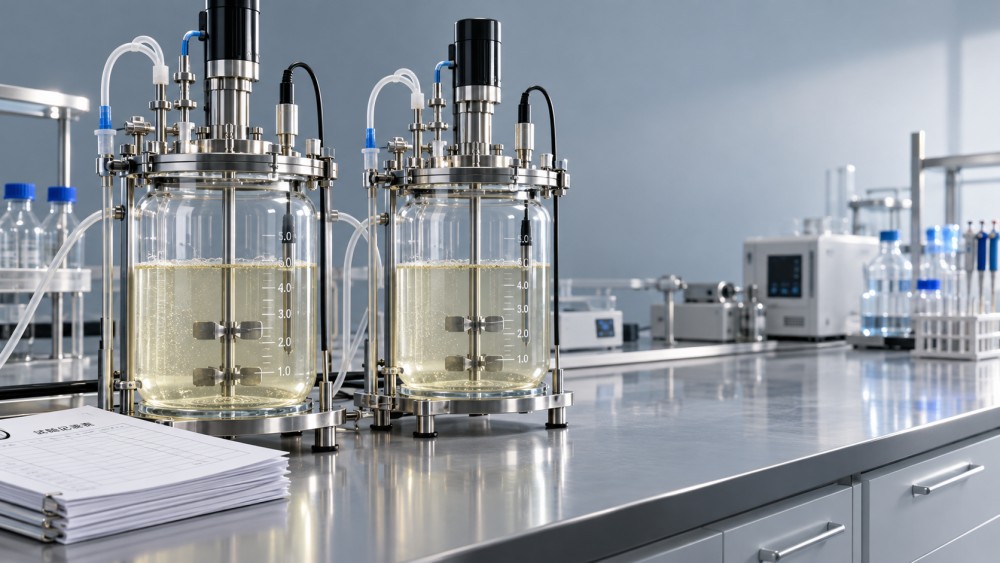
For oxygen transfer, distinguish kLa from oxygen transfer rate. The latter also depends on the oxygen concentration driving force. Pressure or oxygen enrichment may improve oxygen delivery while introducing different operating costs and process considerations. A higher kLa alone does not settle the selection.
Likewise, power per unit volume and impeller tip speed are useful engineering descriptors, not direct measurements of biological damage. Shear sensitivity depends on the organism or cell line, hydrodynamics, bubbles, exposure duration, and process conditions. Where this risk matters, biological outcomes should accompany physical characterization.
Scale-up claims need more than matching one parameter
Maintaining constant power per volume, tip speed, or kLa can each support a scale-up strategy, but they do not preserve every aspect of the process simultaneously. Larger vessels can develop different mixing times, gas behavior, heat-removal limitations, and concentration gradients. Ask which parameter was preserved and which compromises were accepted.
The strongest scale-up evidence links engineering measurements to process outcomes across relevant scales. Depending on the application, those outcomes might include growth, viability, productivity, impurity profiles, or product quality. A successful engineering water run cannot establish biological comparability by itself.
Computational fluid dynamics and digital twins can help explain observed differences and identify testing priorities. Their credibility depends on assumptions and validation against measurements. Ask which fluid properties, gas behavior, and boundary conditions were modeled, and whether validation covered the operating range you intend to use.
Close evidence gaps with a focused application trial
Published resources rarely answer every selection question. Once a shortlist exists, turn the unresolved issues into a trial protocol. The aim is not to recreate every possible operating condition; it is to test the uncertainties most likely to change the decision.
- Use representative feed or justify the surrogate, including its limitations.
- Agree on operating settings, allowable optimization, and acceptance criteria before testing.
- Capture trends, interventions, alarms, and deviations alongside final results.
- Include repeat testing proportionate to process risk and expected variability.
- Define data access, confidentiality, and ownership before the trial starts.
Test demanding but credible conditions: maximum working volume, challenging feed properties, extended holds, or end-of-run concentration where relevant. Avoid accepting a demonstration that only represents the easiest operating point. For reusable systems, assess cleaning and turnaround; for single-use systems, examine assembly integrity, material compatibility, supply continuity, and waste handling.
Record uncertainty explicitly. “Demonstrated,” “supported by comparable applications,” and “not yet verified” are more useful labels than a single confidence score with no explanation. Missing evidence is not proof of poor performance, but it is a risk that needs an owner and a resolution plan.
Turn the evidence into a defensible shortlist
Keep technical capability and evidence strength in separate columns. One system may appear stronger but rely on extrapolated vendor data; another may have narrower capability supported by representative trials. Showing both dimensions makes the trade-off visible instead of burying it in an average score.
Then evaluate the operating consequences. Compare utility demand at the required duty, batch turnaround, calibration burden, maintenance access, consumable availability, software integration, and service response arrangements. Energy comparisons should use a meaningful functional basis, such as an acceptable completed batch, rather than motor nameplate ratings alone.
This evidence-led approach also connects with CF-Elite’s industrial intelligence focus. The Global Cera-Forge Hub specializes in silicate production, thermal processing, refractory systems, and material extrusion—not bioprocess validation. The transferable discipline is relating equipment claims to operating conditions, energy demand, and lifecycle constraints. Biological performance, contamination control, and product-quality conclusions still require bioprocess-specific expertise and evidence.
Before committing, assemble a compact decision dossier: the process requirements, source documents, normalized comparison, unresolved gaps, and agreed verification steps. Each shortlisted supplier should be able to show where its claims were demonstrated and where your project still needs testing. That distinction is more valuable than another polished performance chart.
Related News
 Ms. Elena RodriguezProcess Equipment Pricing: How to Compare Quotes and Total CostsMaster process equipment comparison pricing: compare supplier quotes, uncover hidden costs, and evaluate lifetime expenses to make a confident buying decision.Nov 17, 2026
 Prof. Marcus ChenGlobal Cement Industry Decarbonization: Key Technologies and Cost BarriersExplore global cement industry decarbonization technologies, cost barriers, and practical investment strategies to cut emissions while protecting competitiveness.Nov 16, 2026
 Structural Material AnalystChoosing Specification Preparation Support for North American ProjectsChoose specification preparation support North America projects can rely on. Compare technical expertise, compliance, interfaces, and supplier acceptance criteria.Nov 14, 2026
 Structural Material AnalystSpecialty Ceramic Extrusion: How Material Properties Affect FormingExplore how ceramic specialized material extrusion is shaped by particle size, binders, and solids loading—and learn to improve forming and reduce defects.Nov 13, 2026
 Ms. Elena RodriguezHigh-Pressure Molding Equipment Prices in Europe: What Affects the Total Cost?Explore high pressure molding equipment price Europe buyers can expect to assess, from tooling and installation to running costs. Compare quotes with confidence.Nov 12, 2026
 Structural Material AnalystChoosing a Vacuum Extrusion System: Capacity, Materials and Vacuum LevelsChoosing a vacuum extrusion system? Compare capacity, material behavior and vacuum levels to improve product quality and select the right equipment.Nov 11, 2026
 Optical Glass Tech FellowGlass Melting Innovations: Comparing Electric and Hybrid Furnace TechnologiesExplore glass melting innovations and compare electric and hybrid furnaces by energy use, emissions, glass quality and operating costs to find the right fit.Nov 10, 2026
 Thermal Energy ArchitectHow Thermal Barrier Technology for Kilns Reduces Heat LossDiscover how thermal barrier technology for kilns reduces heat loss, and learn how to select insulation and assess savings without compromising lining durability.Nov 09, 2026
 Prof. Marcus ChenGlobal Materials Trends: What North American Manufacturers Need to KnowExplore global material trends North America manufacturers need to know, from energy costs and supply chains to lower-carbon materials and smarter investment decisions.Nov 08, 2026
 Thermal Energy ArchitectSelecting Abrasion-Resistant Refractories for High-Wear Kiln LiningsExplore advanced refractory materials abrasion resistant enough for high-wear kiln linings. Compare wear mechanisms, thermal stability, installation and lifecycle costs.Nov 06, 2026
 Dr. Alistair VaughnIndustrial Energy Efficiency Certification: ISO 50001 Requirements for PlantsExplore industrial energy efficiency certification with ISO 50001. Learn how plants define scope, measure performance and prepare credible evidence for audits.Nov 05, 2026
 Ms. Elena RodriguezWhat Is an Industrial Intelligence Database and How Is It Used?Discover how an industrial intelligence database helps researchers map markets, track projects, compare technologies, and assess evidence with confidence.Nov 04, 2026
 Ms. Elena RodriguezIndustrial Material Pricing: How Freight and Order Volume Affect QuotesExplore industrial material pricing and learn how freight, order volume, and inventory costs affect quotes. Compare suppliers and make smarter purchasing decisions.Nov 03, 2026
 Structural Material AnalystSingle- vs. Twin-Screw Extrusion Systems: Which Suits Your Material?Choose the right specialized extrusion systems screw type for your material. Compare single- and twin-screw options to improve quality and control costs.Nov 02, 2026
 Thermal Energy ArchitectChoosing Thermal Barrier Materials for Kilns: Temperature and Heat LossExplore thermal barrier materials for kilns and learn how to balance temperature resistance, heat loss, durability and operating costs when selecting a lining.Nov 01, 2026
 Ms. Elena RodriguezSupplier Reference Platform Pricing: Fees and Contract Terms to CompareCompare supplier reference platform pricing, hidden fees, verification costs and contract terms to choose the right solution for your sourcing team.Oct 31, 2026
 Ms. Elena RodriguezSupplier Comparison Metrics: How to Score Cost, Quality, and DeliveryUse supplier comparison metrics to score cost, quality, and delivery with a practical weighted scorecard. Make more confident equipment sourcing decisions.Oct 30, 2026
 Ms. Elena RodriguezWhat Does Industrial Waste Heat Recovery Cost, and When Does It Pay Back?Understand industrial waste heat recovery cost, from equipment and installation to net savings. Learn how to compare quotes, assess risks, and calculate realistic payback before investing.Oct 29, 2026
 Thermal Energy ArchitectChoosing Industrial Waste-to-Energy Equipment by Waste Moisture and Heating ValueChoose industrial waste to energy equipment by moisture and heating value. Compare technologies, fuel needs, and supplier guarantees to make a confident investment.Oct 28, 2026
 Thermal Energy ArchitectChoosing Industrial Kiln Insulation for High Heat and Repeated Thermal CyclingExplore high temperature industry solutions for kiln insulation under repeated thermal cycling. Compare materials, reduce heat loss, and select the right lining for your operating conditions.Oct 27, 2026



Related News
- 00
0000-00
Choosing Specification Preparation Support for North American Projects - 00
0000-00
Specialty Ceramic Extrusion: How Material Properties Affect Forming - 00
0000-00
Choosing a Vacuum Extrusion System: Capacity, Materials and Vacuum Levels - 00
0000-00
Single- vs. Twin-Screw Extrusion Systems: Which Suits Your Material? - 00
0000-00
Bioprocessing Equipment Comparisons: Where to Find Reliable Performance Data
0000-00
Weekly Insights
Stay ahead with our curated technology reports delivered every Monday.