
How to Choose a Glass Annealing Equipment Tempering Line for Stable Quality Output




How to Choose a Glass Annealing Equipment Tempering Line for Stable Quality Output
The difficult part of selecting a glass annealing equipment tempering line is that buyers often evaluate it as if it were a furnace purchase. It is not. A tempering line is a thermal control system, a glass handling system, and a stress-forming process combined into one production decision. If stable quality output is the target, the line has to do more than heat glass to a setpoint and cool it fast. It must create repeatable stress distribution across different thicknesses, coating types, dimensions, and loading patterns without introducing distortion that the next customer in the chain cannot accept.
That distinction matters because “good output” in glass processing is never judged by throughput alone. Technical evaluators usually have to reconcile several quality indicators at once: breakage rate in the furnace, anisotropy visibility, roller wave, edge stress balance, flatness, optical appearance, and downstream yield in laminating, insulating, coating, cutting, or installation. A line that looks productive on paper can still become expensive if it creates unstable stress patterns or demands constant operator intervention to keep quality within an acceptable band.
In practical terms, a glass annealing equipment tempering line should be assessed as a fit between process window and product mix. That is the center of the decision. If the actual production portfolio includes low-E architectural glass, appliance panels, furniture glass, solar cover glass, or thinner display-related substrates, then the useful question is not “How fast can the line run?” but “How wide is the stable operating window before quality starts to drift?”
Why stable quality is harder than it looks
Tempering and annealing are often discussed together in sourcing conversations, but they are not interchangeable ideas. Annealing is about controlled stress relief after forming or thermal processing. Tempering is about intentionally building a compressive surface layer through reheating and quenching. In many industrial discussions, the phrase “glass annealing equipment tempering line” appears because buyers are really looking at the broader thermal conditioning section of glass production rather than a narrow textbook definition. That is acceptable as long as the evaluation remains clear about what the line is expected to achieve: stress removal, stress creation, or both across different production stages.
The reason stable output is difficult is simple: glass does not respond only to peak temperature. It responds to temperature uniformity through thickness, edge-to-center balance, surface condition, coating absorption characteristics, residence time, and quench symmetry. Two sheets leaving the furnace at nearly the same average temperature can still behave differently if one has colder edges, coating-side absorption differences, or a quench pattern that exaggerates local stress. That is why experienced evaluators pay close attention to heating zoning, convection design, roller bed stability, quench adjustability, and recipe management rather than relying on nominal capacity figures.
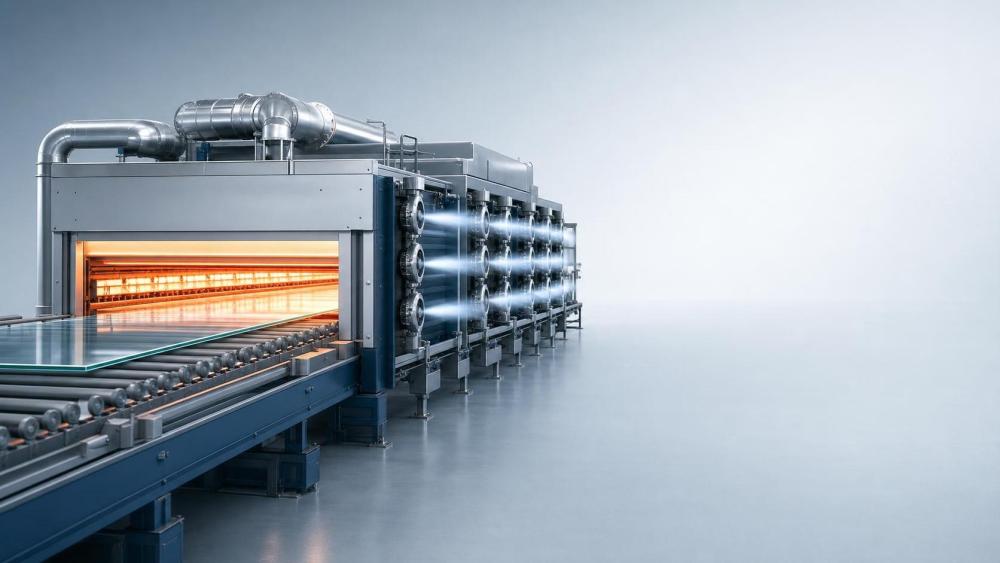
The furnace section is where process capability is decided
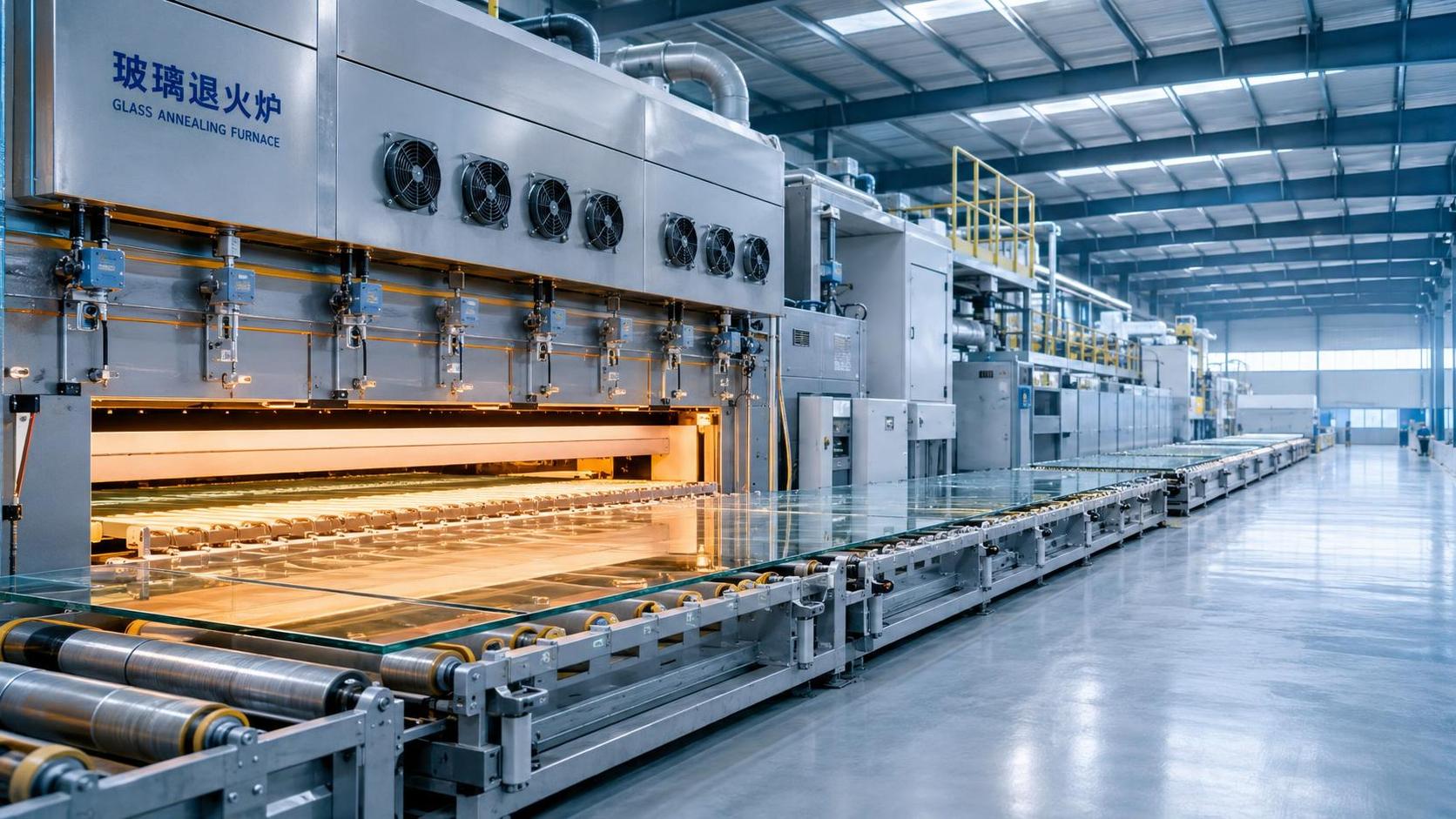
When buyers compare lines, they tend to focus first on installed power and chamber length. Those parameters matter, but they do not tell the whole story. A furnace with strong zoning logic and controllable heat transfer is usually more valuable than one that is simply larger. For mixed production, the real issue is whether the line can keep different glass formats inside a predictable thermal envelope without relying on excessive manual correction.
Look closely at the heating method. Convection-assisted systems are often preferred when coated glass or low-E products are part of the production mix, because radiative heating alone may not provide enough uniformity or responsiveness for difficult surfaces. The technical question is not whether convection exists, but how it is distributed, how it is controlled, and whether the design gives repeatable heating across width and length. Uneven top-bottom heat transfer can appear later as warp, edge curl, or optical defects that are blamed on quenching even when the root cause sits upstream in the furnace.
Roller system design deserves more attention than it usually gets. Roller quality, alignment stability, and resistance to thermal deformation directly affect wave formation and surface marking risk. If the target market includes architectural glazing with strict visual requirements, poor roller behavior can become a limiting factor even when the heating and quench systems look advanced in brochures. A line should be judged on how it preserves flatness over time, not just when it is freshly commissioned.
Quenching determines whether the furnace work survives
A tempering line can only be as stable as its quench system. This is where surface compression is formed, fragmentation performance is influenced, and many distortion problems are either controlled or amplified. Technical evaluations should examine air pressure range, nozzle arrangement, quench symmetry, section-wise adjustability, and recipe repeatability across product changes.
For a line that must handle variable thicknesses or multiple end uses, adjustable quench capacity is critical. An overpowered quench may help reach stress targets on one product but create excessive bow or optical distortion on another. An underpowered quench can leave glass below required tempering performance. This is why a line with a broad and controllable quench range is often a better decision than one optimized narrowly for maximum speed.
Some evaluators make the mistake of treating stress magnitude as the only output metric. In reality, stress uniformity is usually the more useful indicator for stable quality. Non-uniform stress can still pass limited internal checks and yet fail later in laminating, break unpredictably in service, or show visible optical patterns under polarized light. If the supplier cannot explain how the quench design manages edge zones, corner behavior, and width-wise consistency, that gap should be taken seriously.
Automation is not a convenience feature
In a modern line, automation is part of quality control. Recipe storage, heating zone coordination, glass tracking, fault logging, and interface clarity all affect whether the process remains stable across shifts and operators. A technically strong line should not depend on a single experienced operator “feeling” the furnace. It should make product changeovers traceable and reduce the number of hidden adjustments that drift over time.
This is especially important for plants that process mixed batches or serve several customer segments. If product recipes cannot be locked, compared, and restored with confidence, quality instability often gets misread as a hardware issue. In reality, many output problems come from uncontrolled parameter drift: blower settings changed for one urgent order, heating zones nudged to recover a coated product, transport speed adjusted without updating the full recipe. A line with strong control architecture reduces those risks.
Where available, integration with plant-level monitoring also matters. CF-Elite’s long observation of thermal industries points in the same direction across kilns, float lines, and refractory processes: lines that generate usable process data are easier to stabilize, diagnose, and improve. Digital visibility does not replace process engineering, but it shortens the distance between a defect and its cause.
Selection criteria that actually separate one line from another
A useful evaluation framework is to compare not only the machine specification, but the quality control logic behind it. The following points usually reveal more than headline capacity claims:
This kind of comparison is more useful than generic supplier language around “advanced technology.” Stable output comes from controllable process relationships. If those relationships are not visible during technical review, the proposal is still incomplete.
Energy efficiency should be read as a process indicator
Energy efficiency is often discussed as a cost topic, but for thermal equipment it is also a signal of design maturity. A tempering line with poor heat retention, weak control response, or oversized compensation behavior may consume more energy because it is fighting its own instability. For evaluators working under carbon and utility pressure, this matters beyond the electricity bill.
Still, this area needs caution. Energy claims are frequently presented without enough process context. Actual consumption depends on glass thickness, loading rate, coated versus clear product mix, standby frequency, ambient conditions, and operator discipline. The better approach is to ask how the line manages idle states, heat recovery if any, blower control, insulation quality, and production transitions. Those details reveal more than a single headline number ever will.
Common mistakes during technical evaluation
One frequent mistake is buying for today’s dominant product only. That can make sense in a highly fixed production model, but many glass processors eventually widen their mix. A line that has no thermal flexibility becomes a bottleneck the moment coated glass, thinner glass, or stricter optical requirements enter the order book.
Another is separating quality from maintenance. Stable output is not only about commissioning performance. Access to rollers, blowers, bearings, sensors, and calibration points affects how quickly the line degrades in daily production. Technical evaluators should ask what happens after months of heat cycling, not just what happens on acceptance day.
A third mistake is overvaluing nominal maximum capacity. In heavy thermal industries, the most expensive machine is often the one that cannot produce saleable output consistently at normal operating conditions. A slightly lower rated line with better process repeatability can deliver better commercial results because yield, claims, and rework are where hidden costs accumulate.
What a sound decision looks like
A sound selection process for a glass annealing equipment tempering line starts with the product matrix, not the equipment brochure. Define the actual glass types, sizes, thickness distribution, coating conditions, optical requirements, and downstream uses. Then test every equipment claim against that matrix. Can the line maintain thermal consistency across the portfolio? Can it switch products without large quality penalties? Can operators reproduce results shift after shift? Can maintenance keep the line within tolerance without excessive shutdowns?
For technical evaluators, that is the real standard. Stable quality output is not a feature that can be added at the end. It is built into the furnace physics, the quench behavior, the transport mechanics, and the control architecture from the start. If a supplier discussion remains limited to speed, power, and dimensions, the evaluation is still on the surface. The better decision usually comes from asking how the line behaves when production gets complicated, because that is where process equipment reveals its actual value.
Related News
 Thermal Energy ArchitectHow to Evaluate a Thermal Energy Optimization Company for High-Temperature PlantsChoose a thermal energy optimization company with proven process expertise, measurable savings, and reliable delivery for high-temperature plants. Learn what to assess.Sep 15, 2026
 Thermal Energy ArchitectRotary Kiln Efficiency: How Feed Rate, Fuel Use, and Heat Loss Affect OutputRotary kiln efficiency explained: discover how feed rate, fuel use, heat loss, combustion, and cooling performance shape output, quality, and energy costs.Sep 14, 2026
 Thermal Energy ArchitectHow to Select Heat-Resistant Materials That Maintain Abrasion Resistance in KilnsHeat-resistant materials abrasion resistance: learn how to select kiln linings that withstand heat, wear, thermal cycling, and chemical attack for longer service life.Sep 13, 2026
 Thermal Energy ArchitectHow Rotary Kiln Automation Improves Temperature Control and Fuel EfficiencyRotary kiln technology automation enhances temperature control, stabilizes combustion, and improves fuel efficiency with smarter data, predictive control, and safer operations.Sep 12, 2026
 Silicate Process EngineerCement Plant Emission Control: Selecting Systems for Dust, NOx, and SO2 LimitsCement plant emission control guide: compare dust collectors, NOx reduction, and SO2 systems for reliable compliance across kiln modes, fuel changes, and operating upsets.Sep 11, 2026
 Thermal Energy ArchitectSelecting Abrasion-Resistant High-Temperature Materials for Kiln and Conveyor Wear ZonesHigh-temp material engineering guide to abrasion-resistant kiln and conveyor solutions—match wear, heat, chemistry, and installation design for longer service life.Sep 10, 2026
 Dr. Alistair VaughnIndustrial Process Engineering: How to Map Processes for Safer, More Efficient PlantsIndustrial process engineering reveals bottlenecks, safety risks, and energy losses through practical process mapping for safer, more efficient plants.Sep 09, 2026
 Optical Glass Tech FellowHow to Evaluate a Glass Annealing Equipment Manufacturer for Production StabilityChoose a glass annealing equipment manufacturer with proven thermal uniformity, reliable controls, lifecycle value, and responsive service for stable production.Sep 08, 2026
 Prof. Marcus ChenThermal Energy Architecture in North America: Strategies for Lower Building Energy UseThermal energy architecture North America helps project leaders cut building energy use through stronger envelopes, right-sized HVAC, storage, and smart commissioning.Sep 07, 2026
 Ms. Elena RodriguezHow Should Buyers Evaluate Building Material Industry Intelligence Pricing?Building material industry intelligence pricing: learn how to compare coverage, technical depth, and ROI to choose intelligence that reduces procurement risk.Sep 07, 2026
 Ms. Elena RodriguezHow to Use Building Material Intelligence Data for Market and Investment DecisionsBuilding material industry intelligence data helps leaders evaluate demand, costs, regulation, capacity, and technology to make smarter market and investment decisions.Sep 05, 2026
 Thermal Energy ArchitectHow PLC Control Improves Energy Efficiency and Temperature Stability in KilnsEnergy efficient kilns PLC control improves temperature stability, cuts fuel waste, and optimizes combustion, draft, and material flow. Explore proven strategies for smarter kiln modernization.Sep 04, 2026
 Optical Glass Tech FellowEuropean Glass Melting Processes: Furnace Choices, Energy Use, and Quality ControlGlass melting process Europe: explore furnace choices, energy efficiency, cullet strategy, and quality control to improve output, compliance, and long-term glass performance.Sep 03, 2026
 Thermal Energy ArchitectWhat Determines Refractory Lining Monitoring Price for Industrial Kilns?Refractory lining monitoring price depends on kiln size, sensor technology, installation, software, and support. Compare total lifecycle costs and choose the right solution.Sep 02, 2026
 Silicate Process EngineerCement Production System Costs: A Plant Buyer’s Guide to Budgeting and ROICement production systems cost planning made clear: compare CAPEX, operating costs, compliance, and ROI to build a resilient, profitable cement plant investment.Sep 01, 2026
 Dr. Alistair VaughnWhat Should a Process Technology Database Track for High-Temperature Plants?Process technology database essentials for high-temperature plants: track thermal profiles, feed chemistry, refractory wear, emissions, energy, and maintenance for safer, data-driven decisions.Aug 31, 2026
 Ms. Elena RodriguezHow to Evaluate a Silicate Processing Equipment Manufacturer for Plant ProjectsSilicate processing equipment manufacturer selection: assess process fit, guarantees, energy, compliance, delivery risk, and lifecycle support for dependable plant performance.Aug 30, 2026
 Dr. Alistair VaughnHow to Specify Custom Agricultural Processing Equipment for Throughput and HygieneEquipment customization services for agricultural processing: learn to specify hygienic, high-throughput lines that improve yield, reliability, and long-term efficiency.Aug 29, 2026
 Dr. Alistair VaughnHow to Select Process Plant Equipment for High-Temperature, Abrasive Production LinesProcess plant equipment selection for high-temperature, abrasive lines: reduce downtime, improve durability, and optimize lifecycle performance.Aug 28, 2026
 Silicate Process EngineerHow Kiln Heat Recovery Systems Cut Fuel Use in Cement and Lime ProductionKiln heat recovery helps cement and lime plants cut fuel use, improve thermal stability, and build practical, reliable decarbonization strategies.Aug 27, 2026


Related News
- 00
0000-00
How to Evaluate a Glass Annealing Equipment Manufacturer for Production Stability - 00
0000-00
European Glass Melting Processes: Furnace Choices, Energy Use, and Quality Control - 00
0000-00
How Glass Melting Furnace Design Impacts Energy Use and Glass Quality - 00
0000-00
How Can Glass Manufacturing Technology Improve Furnace Efficiency and Cut Energy Costs? - 00
0000-00
How to Evaluate Continuous Glass Annealing Equipment for Stable Throughput?
Weekly Insights
Stay ahead with our curated technology reports delivered every Monday.