
How to Specify Glass Annealing Equipment for European Quality and Energy Requirements




For buyers evaluating glass annealing equipment in Europe, the wrong starting point is “How many square metres per hour can the furnace process?” Throughput matters, but it does not tell you whether the annealing lehr will control residual stress, maintain optical quality, fit the upstream and downstream line, or operate efficiently under local energy constraints.
A sound specification begins with the glass product and its quality window, then works backward through the thermal process, line integration, safety obligations, and lifetime energy use. Capacity should be the result of that exercise, not the only requirement sent to suppliers.
Start with the glass, not the furnace catalogue
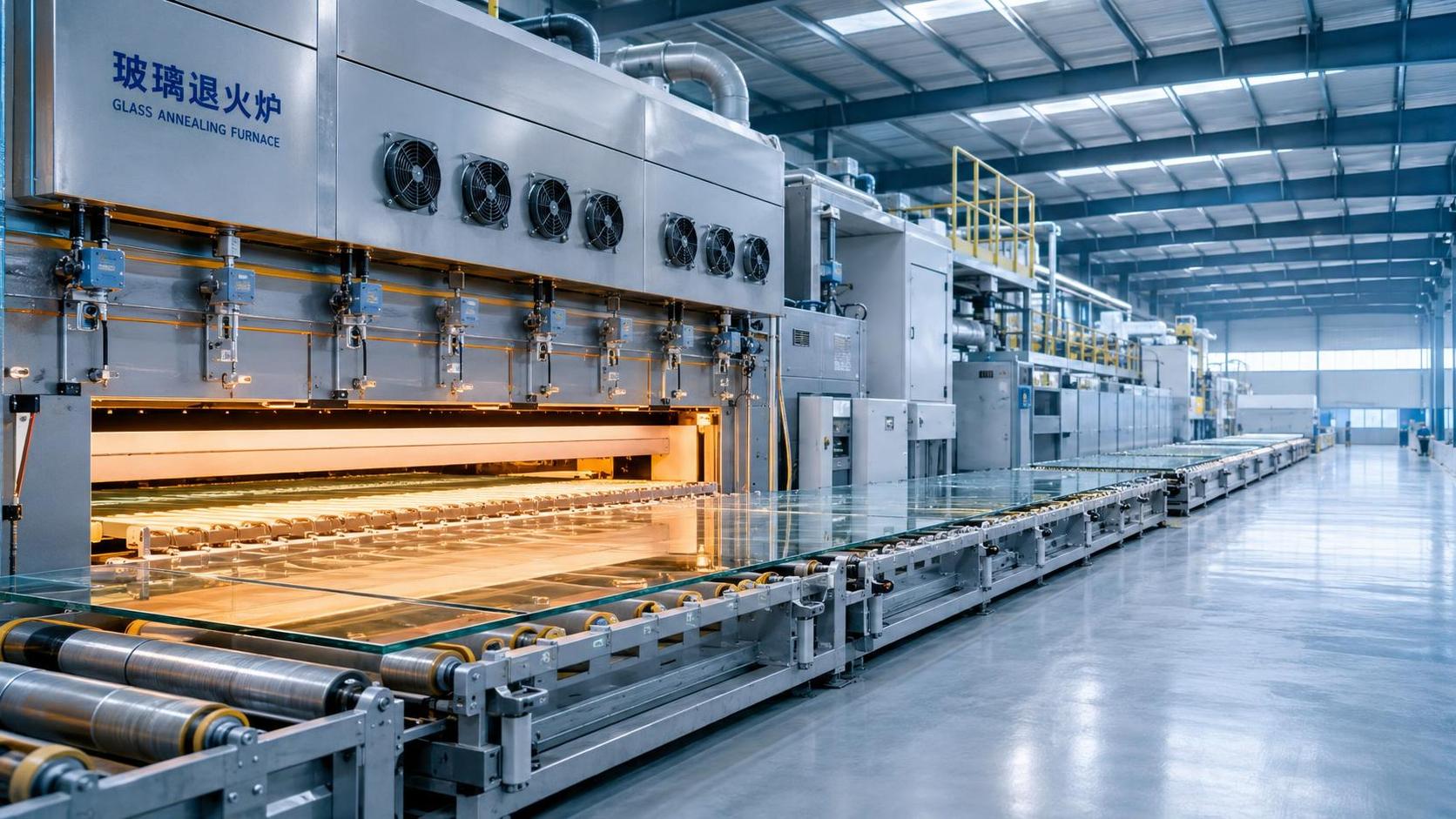
Glass annealing is a controlled cooling process. The glass must pass through its critical temperature range slowly and evenly enough to relieve internal stress. If cooling is uneven across the ribbon, sheet, container, or formed part, the finished product may look acceptable at the exit but later show breakage, distortion, poor cutting behaviour, or inconsistent performance in downstream processing.
Before comparing glass annealing equipment Europe suppliers, define the operating envelope in production terms:
- Glass composition and product family, including whether the line will run one stable recipe or frequent changes.
- Product geometry: ribbon width, sheet size, thickness range, edge condition, curvature, or container shape.
- Required output rate and the realistic mix of normal and peak production.
- Quality-critical characteristics, such as flatness, optical appearance, stress distribution, coating protection, or downstream cutting reliability.
- Expected furnace inlet conditions, including glass temperature variation and transfer stability.
- Planned changes over the equipment life, such as wider products, heavier glass, more coated products, or a different forming line.
These inputs determine the lehr length, zone arrangement, heating and cooling duty, belt or roller design, instrumentation, and control logic. A supplier can offer a technically credible design only when these variables are defined. Asking for “a furnace for 20 tonnes per day” without the product profile usually produces quotations that are difficult to compare and risky to accept.
Temperature uniformity is the core quality requirement
The most important performance discussion is not the setpoint temperature shown on the operator screen. It is the temperature history that each part of the glass experiences across its width, length, and thickness. Uniformity is influenced by burner or electric heater layout, recirculating-air design, insulation condition, zone separation, air balance, and the stability of material transport.
A wide ribbon may need active correction across the width. Thin, high-value glass can be particularly sensitive to local airflow and roller contact. Thicker sections have a slower thermal response and may require a longer, more gradual cooling profile. Formed products introduce another problem: different wall thicknesses cool at different rates, so an apparently uniform lehr environment may not create uniform stress relief in the product.
Ask suppliers to explain how the proposed system controls cross-width and cross-zone variation, how temperature is measured, and how the profile is validated during commissioning. The answer should include more than a generic claim of “high precision.” It should identify sensor locations, control zones, recirculation paths, adjustment methods, and the practical procedure used when production data indicates a stress or distortion issue.
It is also useful to separate two questions that are often mixed together. The first is whether the furnace can reach the required temperature. The second is whether it can hold a repeatable profile while production speed, glass thickness, ambient conditions, and inlet temperature change. The second question usually has more bearing on yield.
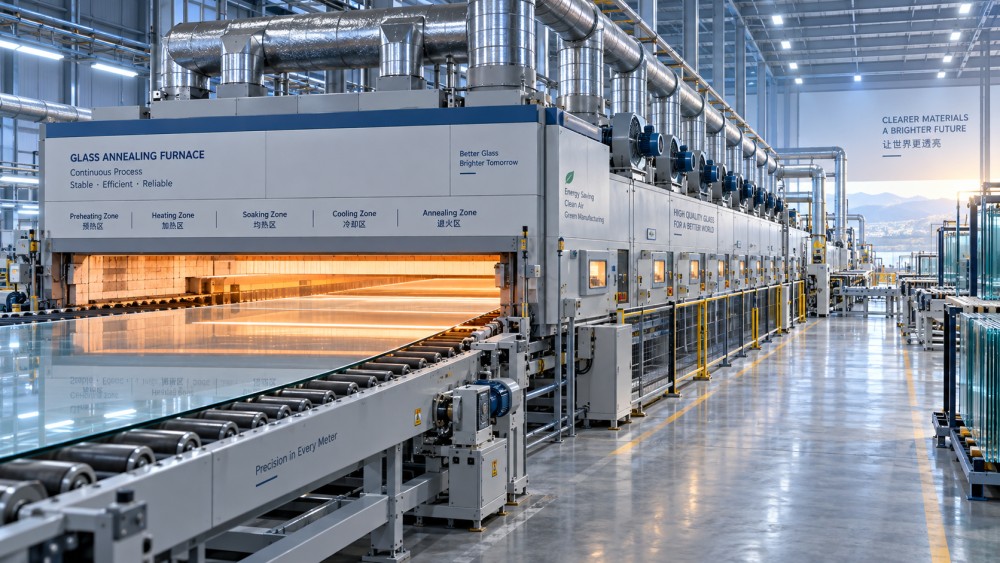
Specify the cooling section with the same care as the heating section
Annealing failures frequently originate in cooling rather than heating. The cooling section must remove heat at a controlled rate without creating large local gradients. This requires a coherent design of blowers, ducts, dampers, heat exchangers where used, cooling-air distribution, and exhaust management.
For a stable, single-product line, a fixed cooling arrangement may be adequate. A line that alternates between thicknesses, formats, or glass types benefits from independently controllable cooling zones and recipes that can be changed without extensive manual tuning. That flexibility has a cost, so it should be justified by the production schedule rather than treated as a universal upgrade.
Pay close attention to the interfaces at the hot end and cold end. An unstable transfer from the forming process can introduce temperature differences that the lehr cannot fully correct. At the exit, cold drafts, poor handling alignment, or an undersized downstream accumulator can undo otherwise good thermal control. The annealing lehr should be evaluated as part of the production line, not as an isolated thermal machine.
Energy performance should be assessed over operating modes
European energy requirements make furnace efficiency a purchasing issue, but “low energy consumption” is too vague for a meaningful comparison. Energy use depends on production load, idle periods, start-up and shutdown routines, product changes, heat losses, fan power, and the control strategy. A design that performs well at full load may be expensive when the line often runs below its nominal rate.
Require suppliers to describe the expected energy balance in the operating conditions that matter for your plant: normal production, reduced output, stand-by, and restart. The specification should address the main energy drivers:
- Insulation and structural heat loss: assess insulation design, refractory choices where applicable, thermal bridges, access doors, and the long-term maintainability of seals.
- Heating method: gas-fired, electric, or hybrid arrangements should be assessed against the site’s available utilities, control needs, emissions strategy, and local energy-cost exposure. There is no universally superior option.
- Air circulation: fan selection, variable-speed control, duct resistance, and leakage affect both uniformity and electrical demand.
- Heat recovery: recovery may be valuable where there is a practical use for recovered heat and a stable operating profile. It adds limited value when no usable heat sink exists or when maintenance access is poor.
- Operating discipline: automated reduction of heating and airflow during planned low-load periods can matter as much as the installed hardware.
Do not accept energy figures without knowing the reference conditions behind them. A more useful comparison is a documented set of assumptions: glass type, throughput, entry and exit conditions, target annealing curve, ambient environment, and included auxiliary loads. This makes it easier to identify whether two quotations describe comparable systems.
Compliance belongs in the technical specification
For equipment placed into a European manufacturing environment, compliance should not be treated as paperwork to request after the design is complete. It affects guarding, access, electrical architecture, emergency stops, burner or heater safety, control-system design, manuals, and the allocation of responsibilities between machine builder and line integrator.
The tender should clearly state the intended installation country, applicable site rules, utility characteristics, language requirements for documentation and operator interfaces, and the division of scope for connected machinery. Require a complete technical file package appropriate to the supplied equipment, including operating and maintenance documentation, electrical information, safety functions, drawings, and component records.
For a retrofit, the boundary is especially important. Replacing a lehr may change the hazards created by conveyors, controls, guarding, exhaust systems, or the upstream forming machine. A new furnace can be compliant as a standalone unit while the combined line still requires additional engineering. Define who assesses and delivers the integrated safety functions before issuing an order.
Automation should support process control, not merely remote operation
Modern annealing systems can generate large amounts of data, but technical value comes from connecting the right process variables to quality decisions. The control system should make it possible to see zone temperatures, airflow or pressure indicators, conveyor speed, heater demand, alarm history, and recipe status in a form that production and maintenance teams can use.
Recipe management is valuable where product changes are common. However, recipes must be protected against untracked edits and linked to a controlled process-development method. An operator should be able to select an approved product setting, while authorized process personnel retain the ability to adjust limits and investigate deviations.
Integration requirements should be explicit. Confirm the required interface with the line PLC, manufacturing systems, quality inspection, energy monitoring, and remote support environment. Include signal lists, ownership of interlocks, time synchronization, data retention expectations, cybersecurity access rules, and a clear fallback mode if communication with upstream equipment is lost.
A practical question for every supplier is: which faults can the operator diagnose from the HMI, and which require a specialist visit? Readable alarms, trend views, remote diagnostics, and accessible field devices reduce downtime only when they are designed around maintenance work rather than added as a sales feature.
Compare proposals by risk, not only by purchase price
Two quotations with similar dimensions and capacity may embody very different levels of delivery risk. One may include commissioning support, stress validation, spare parts, operator training, performance acceptance criteria, and line-interface engineering; another may leave those items to the buyer. The lower initial price can become less competitive once the missing scope is added.
Common specification errors that create avoidable problems
Oversizing for a theoretical future output. Reserve capacity is sensible when expansion is funded and credible. Buying a much larger lehr for an uncertain future volume can increase heat loss, footprint, and low-load energy waste. A modular extension path may be the better answer.
Using average throughput instead of the production envelope. The furnace must handle expected speed changes, start-up conditions, and product mix without sacrificing quality. Average output hides these realities.
Treating installation utilities as a late-stage detail. Electrical capacity, gas quality where relevant, compressed air, cooling water, extraction, building access, and foundation loading can materially alter the final project scope.
Buying advanced controls without process ownership. More sensors and screens do not compensate for undefined recipes, poor change control, or lack of responsibility for reviewing quality trends.
Making acceptance criteria purely mechanical. A lehr can be installed to drawing and still fail to deliver the required stress pattern or downstream behaviour. Performance acceptance should include the product outcome.
A practical order of work before requesting final quotations
- Collect representative production data, including product range, thicknesses, speeds, inlet conditions, rejects, and downstream quality concerns.
- Define the required annealing outcome and how it will be measured during factory and site acceptance.
- Map all mechanical, utility, control, safety, and building interfaces around the furnace.
- Decide which future changes are sufficiently likely to justify flexibility in the initial design.
- Issue one common technical data sheet and scope matrix to every bidder.
- Evaluate lifecycle implications alongside price: energy at realistic loads, maintenance access, spare parts, commissioning scope, and service support.
For technical teams tracking developments across thermal processing, the useful intelligence is often found at the boundary between furnace engineering, energy management, and product quality. CF-Elite’s coverage of glass manufacturing gear and thermal-management systems can help frame those cross-disciplinary questions, particularly when a lehr project is tied to wider line modernization or decarbonization work.
The final specification should make a supplier demonstrate fitness for your product, operating pattern, and installation conditions. When it does, the selected annealing system is more likely to protect glass quality while giving the plant a controllable path to lower energy waste and reliable long-term operation.
Related News
 Optical Glass Tech FellowHow to Specify Glass Annealing Equipment for European Quality and Energy RequirementsGlass annealing equipment Europe: learn how to specify lehrs for consistent glass quality, energy efficiency, compliance, automation, and reliable long-term performance.Sep 23, 2026
 Optical Glass Tech FellowSilicate Process Automation: Improving Batch Consistency and Energy ControlSilicate process automation improves batch consistency, energy control, traceability, and operator confidence across high-temperature manufacturing operations.Sep 22, 2026
 Optical Glass Tech FellowHow Silicate Industrial Processes Control Viscosity, Energy Use, and Product QualitySilicate industrial processes: learn how viscosity, chemistry, heat transfer, and atmosphere control reduce energy use, improve stability, and protect product quality.Sep 21, 2026
 Thermal Energy ArchitectHow European Plants Can Evaluate Energy Recovery Equipment for High-Temperature ProcessesIndustrial energy recovery equipment Europe: learn how high-temperature plants can assess waste-heat sources, integration risks, lifecycle value, and reliable recovery routes.Sep 20, 2026
 Thermal Energy ArchitectIndustrial Furnace Process Optimization: Reducing Fuel Use Without Sacrificing ThroughputIndustrial process optimization furnace strategies that cut fuel use while protecting throughput. Explore combustion control, heat recovery, refractory performance, and data-driven efficiency gains.Sep 19, 2026
 Ms. Elena RodriguezWhat Drives High-Pressure Extrusion Equipment Cost in Industrial Projects?High pressure extrusion equipment cost explained: compare pressure, die design, automation, wear, energy, and installation factors for smarter industrial investments.Sep 18, 2026
 Thermal Energy ArchitectHow to Size a Waste Heat Recovery Exchanger for High-Temperature Kiln Exhaust?Waste heat recovery exchanger sizing for high-temperature kiln exhaust: balance recoverable duty, fouling, corrosion limits, pressure drop, and reliable heat use.Sep 17, 2026
 Thermal Energy ArchitectWhy Heat-Resistant Materials Lose Abrasion Resistance at High TemperaturesHeat-resistant materials abrasion resistance can decline at high temperatures. Discover the thermal, chemical, and mechanical causes of wear—and how to choose longer-lasting linings.Sep 16, 2026
 Thermal Energy ArchitectHow to Evaluate a Thermal Energy Optimization Company for High-Temperature PlantsChoose a thermal energy optimization company with proven process expertise, measurable savings, and reliable delivery for high-temperature plants. Learn what to assess.Sep 15, 2026
 Thermal Energy ArchitectRotary Kiln Efficiency: How Feed Rate, Fuel Use, and Heat Loss Affect OutputRotary kiln efficiency explained: discover how feed rate, fuel use, heat loss, combustion, and cooling performance shape output, quality, and energy costs.Sep 14, 2026
 Thermal Energy ArchitectHow to Select Heat-Resistant Materials That Maintain Abrasion Resistance in KilnsHeat-resistant materials abrasion resistance: learn how to select kiln linings that withstand heat, wear, thermal cycling, and chemical attack for longer service life.Sep 13, 2026
 Thermal Energy ArchitectHow Rotary Kiln Automation Improves Temperature Control and Fuel EfficiencyRotary kiln technology automation enhances temperature control, stabilizes combustion, and improves fuel efficiency with smarter data, predictive control, and safer operations.Sep 12, 2026
 Silicate Process EngineerCement Plant Emission Control: Selecting Systems for Dust, NOx, and SO2 LimitsCement plant emission control guide: compare dust collectors, NOx reduction, and SO2 systems for reliable compliance across kiln modes, fuel changes, and operating upsets.Sep 11, 2026
 Thermal Energy ArchitectSelecting Abrasion-Resistant High-Temperature Materials for Kiln and Conveyor Wear ZonesHigh-temp material engineering guide to abrasion-resistant kiln and conveyor solutions—match wear, heat, chemistry, and installation design for longer service life.Sep 10, 2026
 Dr. Alistair VaughnIndustrial Process Engineering: How to Map Processes for Safer, More Efficient PlantsIndustrial process engineering reveals bottlenecks, safety risks, and energy losses through practical process mapping for safer, more efficient plants.Sep 09, 2026
 Optical Glass Tech FellowHow to Evaluate a Glass Annealing Equipment Manufacturer for Production StabilityChoose a glass annealing equipment manufacturer with proven thermal uniformity, reliable controls, lifecycle value, and responsive service for stable production.Sep 08, 2026
 Prof. Marcus ChenThermal Energy Architecture in North America: Strategies for Lower Building Energy UseThermal energy architecture North America helps project leaders cut building energy use through stronger envelopes, right-sized HVAC, storage, and smart commissioning.Sep 07, 2026
 Ms. Elena RodriguezHow Should Buyers Evaluate Building Material Industry Intelligence Pricing?Building material industry intelligence pricing: learn how to compare coverage, technical depth, and ROI to choose intelligence that reduces procurement risk.Sep 07, 2026
 Ms. Elena RodriguezHow to Use Building Material Intelligence Data for Market and Investment DecisionsBuilding material industry intelligence data helps leaders evaluate demand, costs, regulation, capacity, and technology to make smarter market and investment decisions.Sep 05, 2026
 Thermal Energy ArchitectHow PLC Control Improves Energy Efficiency and Temperature Stability in KilnsEnergy efficient kilns PLC control improves temperature stability, cuts fuel waste, and optimizes combustion, draft, and material flow. Explore proven strategies for smarter kiln modernization.Sep 04, 2026


Related News
- 00
0000-00
How to Specify Glass Annealing Equipment for European Quality and Energy Requirements - 00
0000-00
Silicate Process Automation: Improving Batch Consistency and Energy Control - 00
0000-00
How Silicate Industrial Processes Control Viscosity, Energy Use, and Product Quality - 00
0000-00
How to Evaluate a Glass Annealing Equipment Manufacturer for Production Stability - 00
0000-00
European Glass Melting Processes: Furnace Choices, Energy Use, and Quality Control
Weekly Insights
Stay ahead with our curated technology reports delivered every Monday.