
How to Evaluate a Glass Annealing Equipment Manufacturer for Production Stability




Production stability in glass annealing is not determined by furnace temperature alone. It depends on whether the equipment manufacturer can maintain a repeatable thermal history across the glass width, thickness range, production speed, and operating shifts that the line will actually face. A supplier may present an attractive maximum temperature, a low initial price, or a polished automation interface, yet still be unable to deliver stable stress relief, acceptable optical quality, predictable energy consumption, and fast recovery after process disturbances.
For a glass annealing equipment manufacturer, the real procurement question is therefore not “Can this supplier build a lehr or annealing furnace?” It is whether the supplier can engineer, manufacture, commission, and support a system that holds the required process window over years of production. That distinction has major consequences for rejection rates, downstream cutting or tempering performance, maintenance exposure, spare-parts planning, and total cost of ownership.
Start with the glass process, not the supplier’s standard configuration
Annealing requirements vary substantially between container glass, float glass, photovoltaic glass, architectural glass, borosilicate products, pressed ware, tubular glass, and specialty thin glass. A manufacturer that performs well on one product family is not automatically suitable for another. The thermal cycle must reflect the glass composition, thickness, geometry, loading pattern, edge condition, target residual stress level, and line speed.
A serious technical evaluation begins with a written process basis. It should define more than the nominal throughput. It should include the expected production range, start-up and shutdown conditions, glass dimensions, thickness tolerances, conveyor loading density, allowable product temperature variation at key zones, ambient conditions, available utilities, and downstream handling constraints.
Without this basis, supplier quotations are difficult to compare. One manufacturer may size the system for a nominal product and ideal loading pattern; another may include margin for thickness changes, speed transitions, and uneven distribution across the conveyor. The second offer can appear more expensive while offering materially lower operational risk.
The manufacturer should be able to explain how its thermal design responds to the actual process. Useful questions include:
- How are heating, annealing, and cooling zones determined for the proposed glass type and production speed?
- What assumptions are used for product spacing, conveyor coverage, and heat losses?
- How is transverse temperature uniformity managed across the effective width?
- How does the design accommodate production changes without forcing operation near the control limit?
- Which process variables are monitored to identify a developing annealing problem before defective output accumulates?
A supplier that answers only with a generic temperature profile or a catalogue drawing has not yet demonstrated process ownership. The useful response is a design rationale that connects thermal zones, heat-transfer method, circulation design, sensor placement, controls, and product movement to the required annealing result.
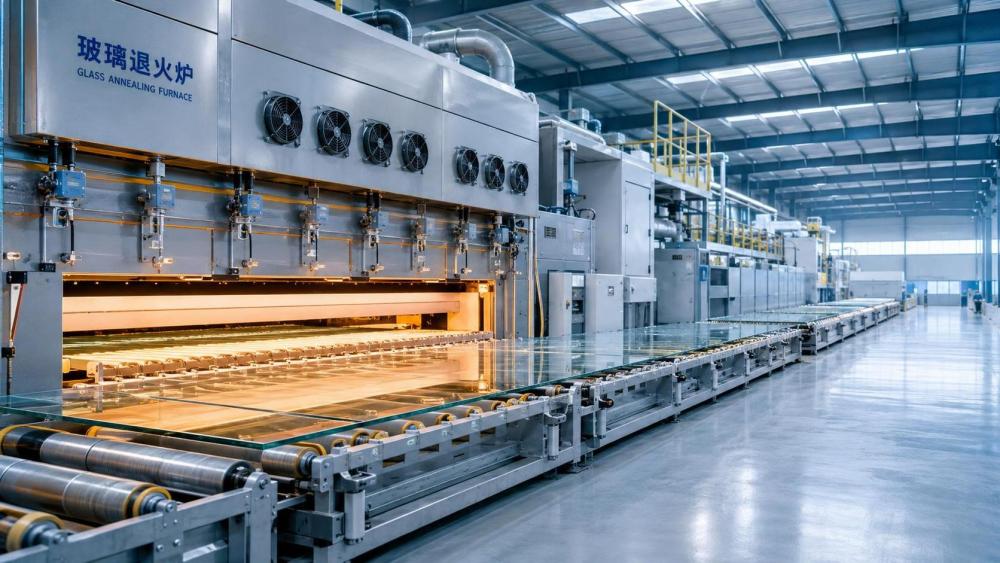
Thermal uniformity is a system capability, not a single specification
Temperature uniformity is often quoted as a headline value, but buyers should examine how that value is defined and verified. A zone-level air temperature reading does not necessarily represent the temperature history experienced by the glass. Differences can arise from recirculation patterns, radiation from refractory or heating elements, edge losses, conveyor contact, airflow imbalance, blocked ducts, and uneven loading.
The most important issue is not whether a supplier claims a tight uniformity figure under a limited test condition. It is whether the equipment design can preserve a stable thermal profile across the working width and through changing production conditions.
For electrically heated systems, evaluation should cover heating element zoning, element accessibility, power control resolution, insulation design, and how individual zones are protected against overheating. For gas-fired systems, combustion control, burner turndown, flame management, exhaust balance, air distribution, and local hot spots require equal scrutiny. Hybrid systems introduce additional coordination requirements between heating sources and control loops.
Cooling is equally important. Inadequate or poorly balanced cooling can create residual stress, distortion, or instability during speed changes. The manufacturer should identify the cooling medium, fan arrangement, airflow control method, damper or variable-frequency-drive strategy, and provisions for avoiding localized rapid cooling. A design that performs adequately at one stable speed but responds slowly to a production-rate change can become a source of recurring quality variation.
Thermal performance should also be considered after months of operation, not only at commissioning. Refractory degradation, insulation settling, fan wear, sensor drift, fouling, and conveyor changes can alter the furnace response. The supplier’s design should make inspection, calibration, and corrective action practical rather than requiring prolonged shutdowns or major dismantling.
Examine control architecture through the lens of disturbance recovery
Automation is valuable when it improves repeatability and makes abnormal conditions visible early. A large touchscreen or extensive trend display does not prove that the control system is suitable for stable annealing.
The key question is how the system behaves when conditions deviate from plan. Relevant disturbances include a line-speed adjustment, a temporary production gap, an upstream temperature fluctuation, an unbalanced loading pattern, a fan trip, a heater circuit fault, or a change in glass thickness. The proposed control architecture should show how it detects the disturbance, prevents unsafe action, records the event, and supports recovery to validated operating conditions.
Review the relationship between sensors, controllers, power devices, drives, alarms, historical data, and operator controls. The manufacturer should provide a clear control narrative rather than a general statement that the line is “fully automatic.” Important points include:
- Temperature sensor type, installation locations, calibration method, and replacement access;
- Control-zone segmentation and whether independent adjustments are possible across the width or along the line;
- Alarm priorities, interlocks, fault logging, and event history retention;
- Recipes for approved products and protection against unauthorized parameter changes;
- Remote diagnostic arrangements, cybersecurity boundaries, and responsibilities for access control;
- Availability of electrical drawings, PLC backups, software documentation, and editable program ownership terms.
Control-system dependence on proprietary hardware or inaccessible software deserves particular attention. A low-cost machine can create expensive dependence if routine troubleshooting requires the original supplier to intervene remotely or dispatch a specialist. Procurement documents should specify what software, passwords, drawings, parameter lists, and backup files are handed over at acceptance, while respecting legitimate intellectual-property boundaries.
Assess mechanical reliability where production interruptions actually occur
Annealing equipment is a thermal machine, but unplanned downtime frequently originates in mechanical and utility-related components. Conveyor systems, bearings, drive assemblies, rollers, belts or meshes, fans, expansion joints, doors, insulation panels, wiring, and cooling circuits need to be evaluated as part of the stability case.
The proposed transport system should be compatible with the glass product and process temperature. Its design must account for alignment, thermal expansion, vibration, wear, access for cleaning, and replacement time. For some products, contact marks, roller damage, or transfer instability can become quality defects even when furnace temperatures remain within target range. Ask the manufacturer how it controls belt tracking, roller straightness, drive synchronization, and edge support where applicable.
Fan selection should not be judged by motor rating alone. Bearing arrangement, impeller material, balancing, motor protection, vibration monitoring options, access for maintenance, and the consequences of a single fan failure all affect availability. The same applies to refractory and insulation choices. The appropriate material depends on maximum operating temperature, atmosphere, thermal cycling frequency, chemical exposure, structural loading, and expected maintenance approach.
A credible glass annealing equipment manufacturer can provide a preventive-maintenance schedule linked to the proposed design. It should identify inspection intervals, consumable parts, critical spares, lubrication requirements where relevant, expected wear points, and the work required to replace high-risk components. Generic manuals copied across different equipment models provide little assurance.
Compare quotations by lifecycle exposure, not purchase price
The delivered equipment price is only one component of the commercial decision. The more useful comparison is the cost of achieving stable output over the operating life of the line. This includes energy demand, installation work, utility upgrades, commissioning duration, operator training, maintenance labor, spare parts, product losses during instability, and the financial effect of downtime.
Energy claims require a defined basis. Suppliers should state the assumed production load, target thermal profile, ambient temperature, energy source, operating hours, and boundary of the calculation. A quoted consumption figure without those assumptions cannot be compared fairly. It is also prudent to distinguish between connected load, average operating demand, peak demand, and auxiliary consumption from fans, drives, cooling systems, and control cabinets.
Low initial cost can conceal omissions. Common examples include inadequate spare parts, limited instrumentation, excluded installation supervision, insufficient commissioning time, unsupported local electrical standards, incomplete safety guarding, or a control package with restricted diagnostics. Conversely, not every high-priced option improves stability. Buyers should ask the supplier to state the operational consequence of each option: reduced energy use, faster maintenance, greater redundancy, better traceability, improved quality control, or merely added convenience.
Validate engineering capacity before relying on references
References are useful, but they should be relevant rather than numerous. A list of installations does not establish that the manufacturer has solved the same process problem. The strongest evidence is a documented capability in comparable glass type, width, thermal duty, throughput range, and automation complexity.
Request information that reveals how the supplier manages engineering rather than simply how many machines it has sold. This may include design review procedures, manufacturing inspection plans, welding and fabrication controls where relevant, electrical-panel testing, instrument calibration practice, subcontractor management, and commissioning documentation. The aim is to establish whether the manufacturer has a repeatable method for converting a process requirement into working equipment.
Factory acceptance testing should be proportionate to the equipment and contract scope. For a complex system, a meaningful FAT can verify control-panel assembly, I/O checks, alarm logic, safety interlocks, communication interfaces, software version control, documentation completeness, and simulation of selected operating sequences. It cannot replace hot commissioning, but it can prevent avoidable site delays.
Site acceptance criteria need equal care. “Equipment runs successfully” is not an adequate acceptance condition. The contract should define the production conditions, test duration, measurement method, responsibilities for supplying acceptable glass and utilities, permitted stoppages, quality criteria, energy-test basis if included, and process for resolving nonconformities. If residual stress, optical distortion, breakage, or temperature uniformity are critical, the verification method must be agreed before shipment.
Service responsiveness is part of the equipment design
In cross-border equipment procurement, service risk is often underestimated. The supplier’s technical competence matters little during a production interruption if drawings are incomplete, remote support is unavailable, replacement parts cannot be identified, or local service arrangements are unclear.
Evaluate service by asking operational questions. Who provides first-line response? What information must be available for remote diagnosis? Which faults can be resolved by site personnel after training? Which components have long manufacturing lead times? Is there a defined escalation route for controls, thermal design, mechanical systems, and safety issues? Answers should be reflected in contractual commitments where practical, not left as informal assurances.
Parts availability requires more than a recommended spare-parts list. Critical components should be classified by failure impact and replenishment time. For example, sensors, drives, contactors, heating elements, fan bearings, gearboxes, PLC modules, and specialist refractory materials may have very different procurement risks. The equipment design should favor commercially supportable components where this does not compromise process performance or safety.
Use the procurement process to expose hidden assumptions
The most reliable comparison method is to issue a consistent technical and commercial data sheet to each shortlisted supplier, then require deviations to be stated explicitly. This reduces the risk that quotations appear comparable while covering different equipment boundaries or performance assumptions.
During technical clarification, ask each supplier to identify the three or four conditions most likely to compromise stable production on the proposed line and explain how the design mitigates them. The answer is revealing. A capable manufacturer will discuss process limits, thermal balance, utility quality, maintenance discipline, loading variation, and commissioning dependencies in specific terms. A weaker proposal is more likely to rely on broad claims of reliability.
The preferred supplier is not necessarily the one offering the most elaborate furnace or the lowest price. It is the manufacturer whose proposal makes the process assumptions visible, translates them into verifiable engineering features, accepts measurable obligations at commissioning, and provides a workable path for maintenance and support after handover. For glass annealing, that is the foundation of production stability—and the most defensible basis for a long-term procurement decision.
Related News
 Optical Glass Tech FellowHow to Evaluate a Glass Annealing Equipment Manufacturer for Production StabilityChoose a glass annealing equipment manufacturer with proven thermal uniformity, reliable controls, lifecycle value, and responsive service for stable production.Sep 08, 2026
 Prof. Marcus ChenThermal Energy Architecture in North America: Strategies for Lower Building Energy UseThermal energy architecture North America helps project leaders cut building energy use through stronger envelopes, right-sized HVAC, storage, and smart commissioning.Sep 07, 2026
 Ms. Elena RodriguezHow Should Buyers Evaluate Building Material Industry Intelligence Pricing?Building material industry intelligence pricing: learn how to compare coverage, technical depth, and ROI to choose intelligence that reduces procurement risk.Sep 07, 2026
 Ms. Elena RodriguezHow to Use Building Material Intelligence Data for Market and Investment DecisionsBuilding material industry intelligence data helps leaders evaluate demand, costs, regulation, capacity, and technology to make smarter market and investment decisions.Sep 05, 2026
 Thermal Energy ArchitectHow PLC Control Improves Energy Efficiency and Temperature Stability in KilnsEnergy efficient kilns PLC control improves temperature stability, cuts fuel waste, and optimizes combustion, draft, and material flow. Explore proven strategies for smarter kiln modernization.Sep 04, 2026
 Optical Glass Tech FellowEuropean Glass Melting Processes: Furnace Choices, Energy Use, and Quality ControlGlass melting process Europe: explore furnace choices, energy efficiency, cullet strategy, and quality control to improve output, compliance, and long-term glass performance.Sep 03, 2026
 Thermal Energy ArchitectWhat Determines Refractory Lining Monitoring Price for Industrial Kilns?Refractory lining monitoring price depends on kiln size, sensor technology, installation, software, and support. Compare total lifecycle costs and choose the right solution.Sep 02, 2026
 Silicate Process EngineerCement Production System Costs: A Plant Buyer’s Guide to Budgeting and ROICement production systems cost planning made clear: compare CAPEX, operating costs, compliance, and ROI to build a resilient, profitable cement plant investment.Sep 01, 2026
 Dr. Alistair VaughnWhat Should a Process Technology Database Track for High-Temperature Plants?Process technology database essentials for high-temperature plants: track thermal profiles, feed chemistry, refractory wear, emissions, energy, and maintenance for safer, data-driven decisions.Aug 31, 2026
 Ms. Elena RodriguezHow to Evaluate a Silicate Processing Equipment Manufacturer for Plant ProjectsSilicate processing equipment manufacturer selection: assess process fit, guarantees, energy, compliance, delivery risk, and lifecycle support for dependable plant performance.Aug 30, 2026
 Dr. Alistair VaughnHow to Specify Custom Agricultural Processing Equipment for Throughput and HygieneEquipment customization services for agricultural processing: learn to specify hygienic, high-throughput lines that improve yield, reliability, and long-term efficiency.Aug 29, 2026
 Dr. Alistair VaughnHow to Select Process Plant Equipment for High-Temperature, Abrasive Production LinesProcess plant equipment selection for high-temperature, abrasive lines: reduce downtime, improve durability, and optimize lifecycle performance.Aug 28, 2026
 Silicate Process EngineerHow Kiln Heat Recovery Systems Cut Fuel Use in Cement and Lime ProductionKiln heat recovery helps cement and lime plants cut fuel use, improve thermal stability, and build practical, reliable decarbonization strategies.Aug 27, 2026
 Ms. Elena RodriguezProcess Equipment Comparison: Which Metrics Matter Most for Reliable Selection?Process equipment comparison made practical: discover which metrics truly drive reliable selection, from energy efficiency and control stability to wear life, maintainability, and uptime.Aug 26, 2026
 Ms. Elena RodriguezWhat Buyers Should Check Before Sourcing Precision Alloy Bars for Critical PartsPrecision Alloy Bars buyers should verify grade, chemistry, tolerances, surface quality, traceability, and lead time before sourcing for critical parts. Learn what prevents costly machining and reliability risks.Aug 27, 2026
 Ms. Elena RodriguezHow to Evaluate Thermal Management Solutions Insulation for High-Heat Industrial SystemsThermal management solutions insulation: learn how to assess high-heat industrial systems by thermal performance, durability, lifecycle cost, and supplier data for smarter decisions.Aug 25, 2026
 Ms. Elena RodriguezWhat Drives Waste Recycling Cost in Industrial Projects and How to Estimate It?Waste recycling cost in industrial projects depends on composition, moisture, transport, pre-treatment, and compliance. Learn how to estimate it accurately and compare suppliers with confidence.Aug 24, 2026
 Silicate Process EngineerHow to Evaluate Cement Production Plants in the Middle East for Capacity, Fuel Flexibility, and ROIcement production plants Middle East: Learn how to assess true capacity, fuel flexibility, and ROI risks to identify resilient assets and smarter investment opportunities.Aug 23, 2026
 Structural Material AnalystHow to Evaluate Lightweight Material Machinery for Output, Energy Use, and Product QualityLightweight material machinery evaluation guide: compare stable output, energy use, and product quality to choose equipment that cuts waste, lowers costs, and improves production confidence.Aug 22, 2026
 Material Heat-Resist ExpertWhat Determines Refractory Production Line Price in a Turnkey Plant Project?Refractory production line price depends on raw materials, forming method, kiln and drying design, automation, utilities, and scope. Learn what really drives turnkey plant cost before you invest.Aug 21, 2026


Related News
- 00
0000-00
How to Evaluate a Glass Annealing Equipment Manufacturer for Production Stability - 00
0000-00
European Glass Melting Processes: Furnace Choices, Energy Use, and Quality Control - 00
0000-00
How Glass Melting Furnace Design Impacts Energy Use and Glass Quality - 00
0000-00
How Can Glass Manufacturing Technology Improve Furnace Efficiency and Cut Energy Costs? - 00
0000-00
How to Evaluate Continuous Glass Annealing Equipment for Stable Throughput?
Weekly Insights
Stay ahead with our curated technology reports delivered every Monday.