
How Glass Melting Furnace Design Impacts Energy Use and Glass Quality




In glass manufacturing, furnace design is never just an equipment choice. It is a process decision that determines how much energy is actually converted into usable melting work, how stable the melt remains under load changes, and how reliably the finished glass meets downstream quality targets. For technical evaluators, that means the right question is not whether a furnace can melt glass, but how its design behaves under real production conditions: batch variability, campaign length, fuel mix, pull-rate swings, and product-specific quality tolerances.
That is why glass melting process furnace design should be assessed as an integrated system rather than a single machine. Burner arrangement, regenerator performance, insulation strategy, refractory selection, batch charging geometry, and control logic all interact. A design that looks efficient on paper may still create high carryover losses, unstable temperature fields, excessive furnace wear, or quality defects such as stones, cords, bubbles, and fining instability. The practical task is to identify which design choices truly lower total energy intensity and which merely shift cost from fuel to maintenance, downtime, or scrap.
Energy use starts with heat distribution, not fuel nameplate efficiency
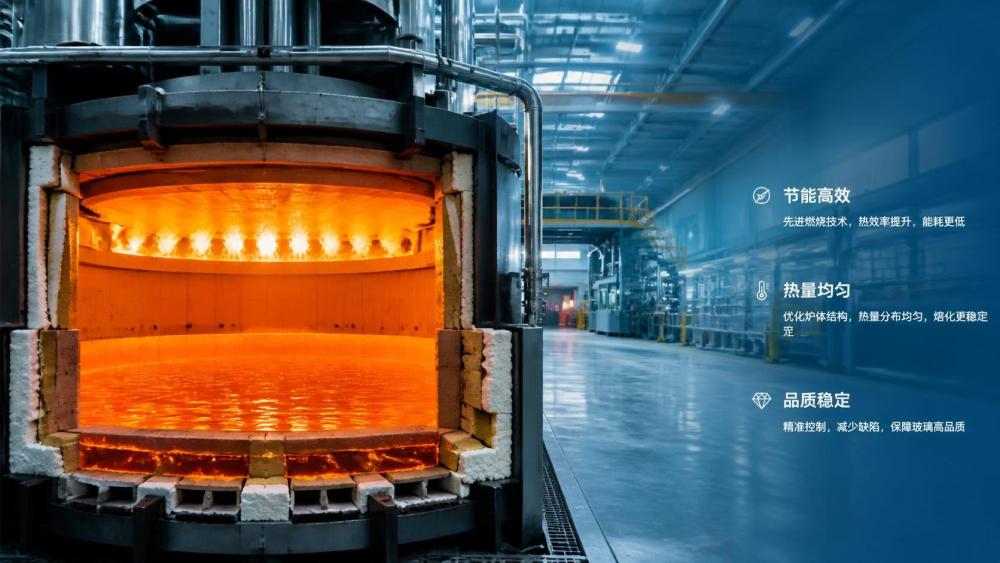
In many procurement discussions, energy performance is framed too narrowly around the burner or the quoted thermal efficiency. In reality, furnace energy use is dominated by how evenly heat is delivered into the melt and how much of that heat is retained long enough to do useful work. A furnace with strong combustion output but poor heat transfer can consume more fuel than a better-balanced design operating at a lower peak flame temperature.
Three design areas matter most. First is combustion chamber geometry, which affects flame length, impingement risk, and the share of heat transferred by radiation versus convection. Second is regenerator or recuperator effectiveness, which determines how much exhaust heat is recovered before leaving the system. Third is insulation and crown performance, which influence standby losses, shell temperatures, and the long-term energy penalty caused by refractory degradation.
These factors do not operate independently. A design with aggressive heat recovery but weak flow balance can create uneven temperature fields. A design with excellent insulation but poor batch coverage may still waste energy because cold batch islands slow melting and force higher firing rates. Technical evaluators should therefore look for evidence of system-level balance rather than isolated efficiency claims.
Batch charging and melt behavior shape the real efficiency curve
The batch charging zone is often where theoretical efficiency and operating reality diverge. If the batch blanket is too thick, poorly distributed, or exposed to uneven flame wash, the furnace spends more energy just reaching the initial melting stage. If charging is too sparse or poorly sequenced, heat losses rise and melt fining becomes less stable. In either case, the energy cost shows up later as longer residence time, higher pull-specific fuel consumption, or more corrective firing.
For this reason, the furnace design must be reviewed together with the expected batch chemistry and cullet ratio. High-cullet operation generally reduces melting energy demand, but only if the furnace can handle the changed thermal absorption behavior and maintain stable pull control. Similarly, batch materials with different particle size distributions or volatile content can alter dusting, foaming, and cold cap behavior. A design that looks well suited for one product family may underperform when feed variability increases.
Quality problems often begin as thermal design problems
Glass quality is affected by furnace design earlier than many operators expect. Temperature uniformity in the melt controls homogeneity, fining efficiency, and the likelihood of unmelted particles. Flow design influences residence time distribution, which in turn affects whether bubbles are removed consistently and whether composition remains stable across the pull width. Poorly managed thermal gradients can also encourage refractory corrosion and seed contamination, both of which become visible downstream as defects.
For technical evaluators, the relevant point is that quality defects are not always process-tuning issues. Sometimes they are structural. A furnace with dead zones, short-circuit flow, or asymmetric heat input may require constant operator intervention just to stay within acceptable product limits. That is a sign the design margin is too thin for the required product specification.
This matters even more for tighter-value glass applications, where optical quality, surface smoothness, or thickness consistency leave little room for thermal instability. In those cases, the cost of inferior furnace design is not limited to fuel consumption. It can include rejected lots, line interruptions, and reduced usable campaign life.
What design choices tend to matter most in practice
Different furnace architectures will suit different operating envelopes, but a few design decisions consistently deserve close scrutiny:
- Heat recovery system: regenerator or recuperator sizing, switching behavior, fouling resistance, and maintenance accessibility.
- Burner and flame management: flame shape, air-fuel mixing quality, staging capability, and sensitivity to load changes.
- Refractory package: thermal shock resistance, corrosion resistance, insulation value, and expected campaign life.
- Batch charging system: charging frequency, spread pattern, dust control, and compatibility with cullet or recycled input.
- Control and instrumentation: temperature zoning, oxygen/fuel ratio control, pressure stability, and data visibility for operators.
- Melt circulation and refining path: residence time, dead volume, and the furnace’s ability to support consistent fining.
None of these should be judged in isolation. For example, a highly insulated furnace may still struggle if poor burner zoning creates local overheating and accelerates crown wear. Likewise, a sophisticated control system cannot fully compensate for weak geometry or refractory choices that are mismatched to the production profile.
Why some efficiency claims do not hold up under production review
Marketing language often treats energy savings as a direct result of one upgrade. In operational terms, the picture is more conditional. A furnace may reduce specific fuel use in one product mix but lose that advantage when pull rate, batch formulation, or ambient conditions change. Some designs are efficient only within a narrow operating window. Outside that window, operators absorb the penalty through higher interventions, lower throughput, or quality drift.
Another common issue is that “efficiency” is measured over a short period while glass quality and refractory behavior require longer observation. A furnace that performs well during commissioning may show different economics after thermal equilibrium is established, or after refractory aging changes the thermal profile. That is why acceptance criteria should cover both immediate fuel performance and longer-cycle quality stability.
Evaluators should also distinguish between reduced fuel consumption and reduced total energy cost. A design that lowers direct fuel use but increases oxygen demand, electrical load, spare-part consumption, or downtime may not be the better business choice. The real metric is often the cost and stability of production per ton of saleable glass, not only the burner meter reading.
How to assess a furnace design before committing
A practical assessment should combine design review, operating data, and risk analysis. The most useful questions are usually the most specific:
Where possible, technical evaluators should request operating curves rather than only nominal specifications. Static performance numbers rarely capture the effect of turndown ratio, batch disruption, or recovery-system cycling. A well-designed furnace should retain acceptable performance across a realistic range of operating conditions, not only at the point of best efficiency.
Design tradeoffs are becoming harder to ignore
Recent pressure around energy cost, emissions, and production resilience is pushing glass producers to revisit furnace architecture more seriously than before. That shift is not only about carbon reporting. It reflects a broader realization that furnace design now affects competitiveness in multiple ways at once: fuel intensity, emissions compliance, asset life, and product consistency. In other words, the furnace is no longer a passive heat source; it is a core determinant of manufacturing quality control.
This also explains why digital monitoring, model-based optimization, and predictive maintenance are gaining relevance. These tools do not replace furnace design quality, but they do make design weaknesses more visible. If a furnace requires constant compensation from operators or control systems, that is usually a sign that the underlying geometry or thermal package needs review. Digital tools are most effective when they are used to stabilize a sound design, not to rescue a fragile one.
For decision-makers, the important conclusion is straightforward: energy use and glass quality are not separate outcomes. They are linked by the same design logic. When the furnace architecture supports uniform heat transfer, stable melt circulation, and refractory durability, both metrics improve together. When it does not, every gain in one area tends to show up as a cost in another. That is the real test of furnace design, and it is the standard technical evaluators should hold in view.
Related News
 Ms. Elena RodriguezHow to Structure Global Specification Data for Faster Industrial Product EvaluationGlobal specification-oriented product information helps industrial teams compare capacity, energy, emissions, automation, and lifecycle data on a like-for-like basis for faster, confident equipment decisions.Sep 29, 2026
 Thermal Energy ArchitectHow to Specify High-Temperature Process Systems for Continuous Thermal OperationsHigh-temperature process engineering systems: learn how to specify resilient continuous thermal operations for efficiency, compliance, reliable uptime, and long-term performance.Sep 28, 2026
 Thermal Energy ArchitectHow to Evaluate a Thermal Engineering Contractor for High-Temperature Plant ProjectsChoose a thermal engineering contractor with proven process expertise, lifecycle value, emissions control, and delivery discipline for reliable high-temperature plant performance.Sep 27, 2026
 Silicate Process EngineerHow Latin American Cement Plants Can Reduce Dust Emissions in Kilns and Transfer PointsCement plant dust control Latin America: reduce kiln and transfer-point emissions with practical airflow, filtration, monitoring, and maintenance strategies.Sep 26, 2026
 Material Heat-Resist ExpertHow to Evaluate Refractory Production Lines for Output, Quality, and Energy UseRefractory production lines: learn how to assess qualified output, consistent quality, and total energy use for smarter, lower-risk investment decisions.Sep 25, 2026
 Dr. Alistair VaughnHow Waste Recycling Technology Improves Material Recovery in Industrial PlantsWaste recycling technology improves material recovery through source segregation, smart separation, thermal treatment, and quality control for industrial plants.Sep 24, 2026
 Optical Glass Tech FellowHow to Specify Glass Annealing Equipment for European Quality and Energy RequirementsGlass annealing equipment Europe: learn how to specify lehrs for consistent glass quality, energy efficiency, compliance, automation, and reliable long-term performance.Sep 23, 2026
 Optical Glass Tech FellowSilicate Process Automation: Improving Batch Consistency and Energy ControlSilicate process automation improves batch consistency, energy control, traceability, and operator confidence across high-temperature manufacturing operations.Sep 22, 2026
 Optical Glass Tech FellowHow Silicate Industrial Processes Control Viscosity, Energy Use, and Product QualitySilicate industrial processes: learn how viscosity, chemistry, heat transfer, and atmosphere control reduce energy use, improve stability, and protect product quality.Sep 21, 2026
 Thermal Energy ArchitectHow European Plants Can Evaluate Energy Recovery Equipment for High-Temperature ProcessesIndustrial energy recovery equipment Europe: learn how high-temperature plants can assess waste-heat sources, integration risks, lifecycle value, and reliable recovery routes.Sep 20, 2026
 Thermal Energy ArchitectIndustrial Furnace Process Optimization: Reducing Fuel Use Without Sacrificing ThroughputIndustrial process optimization furnace strategies that cut fuel use while protecting throughput. Explore combustion control, heat recovery, refractory performance, and data-driven efficiency gains.Sep 19, 2026
 Ms. Elena RodriguezWhat Drives High-Pressure Extrusion Equipment Cost in Industrial Projects?High pressure extrusion equipment cost explained: compare pressure, die design, automation, wear, energy, and installation factors for smarter industrial investments.Sep 18, 2026
 Thermal Energy ArchitectHow to Size a Waste Heat Recovery Exchanger for High-Temperature Kiln Exhaust?Waste heat recovery exchanger sizing for high-temperature kiln exhaust: balance recoverable duty, fouling, corrosion limits, pressure drop, and reliable heat use.Sep 17, 2026
 Thermal Energy ArchitectWhy Heat-Resistant Materials Lose Abrasion Resistance at High TemperaturesHeat-resistant materials abrasion resistance can decline at high temperatures. Discover the thermal, chemical, and mechanical causes of wear—and how to choose longer-lasting linings.Sep 16, 2026
 Thermal Energy ArchitectHow to Evaluate a Thermal Energy Optimization Company for High-Temperature PlantsChoose a thermal energy optimization company with proven process expertise, measurable savings, and reliable delivery for high-temperature plants. Learn what to assess.Sep 15, 2026
 Thermal Energy ArchitectRotary Kiln Efficiency: How Feed Rate, Fuel Use, and Heat Loss Affect OutputRotary kiln efficiency explained: discover how feed rate, fuel use, heat loss, combustion, and cooling performance shape output, quality, and energy costs.Sep 14, 2026
 Thermal Energy ArchitectHow to Select Heat-Resistant Materials That Maintain Abrasion Resistance in KilnsHeat-resistant materials abrasion resistance: learn how to select kiln linings that withstand heat, wear, thermal cycling, and chemical attack for longer service life.Sep 13, 2026
 Thermal Energy ArchitectHow Rotary Kiln Automation Improves Temperature Control and Fuel EfficiencyRotary kiln technology automation enhances temperature control, stabilizes combustion, and improves fuel efficiency with smarter data, predictive control, and safer operations.Sep 12, 2026
 Silicate Process EngineerCement Plant Emission Control: Selecting Systems for Dust, NOx, and SO2 LimitsCement plant emission control guide: compare dust collectors, NOx reduction, and SO2 systems for reliable compliance across kiln modes, fuel changes, and operating upsets.Sep 11, 2026
 Thermal Energy ArchitectSelecting Abrasion-Resistant High-Temperature Materials for Kiln and Conveyor Wear ZonesHigh-temp material engineering guide to abrasion-resistant kiln and conveyor solutions—match wear, heat, chemistry, and installation design for longer service life.Sep 10, 2026


Related News
- 00
0000-00
How to Specify Glass Annealing Equipment for European Quality and Energy Requirements - 00
0000-00
Silicate Process Automation: Improving Batch Consistency and Energy Control - 00
0000-00
How Silicate Industrial Processes Control Viscosity, Energy Use, and Product Quality - 00
0000-00
How to Evaluate a Glass Annealing Equipment Manufacturer for Production Stability - 00
0000-00
European Glass Melting Processes: Furnace Choices, Energy Use, and Quality Control
Weekly Insights
Stay ahead with our curated technology reports delivered every Monday.