
How to Evaluate Green Building Materials for Commercial Projects: Cost, Compliance, and Lifespan




Choosing green building materials for commercial projects now affects far more than environmental positioning. It shapes budget control, approval timelines, operating stability, and the long-term value of the asset itself.
In practice, the harder question is not whether green building materials matter. It is how to evaluate them without being misled by marketing claims, incomplete test data, or short-term price comparisons.
That challenge is especially relevant across construction, heavy industry, and material-processing environments, where thermal performance, dust control, and service life can directly influence total project economics.
Insights from CF-Elite often highlight this broader view. When silicate production, refractory behavior, extrusion quality, and carbon compliance connect, material selection becomes a strategic decision rather than a simple item purchase.
What counts as green building materials in a commercial project?
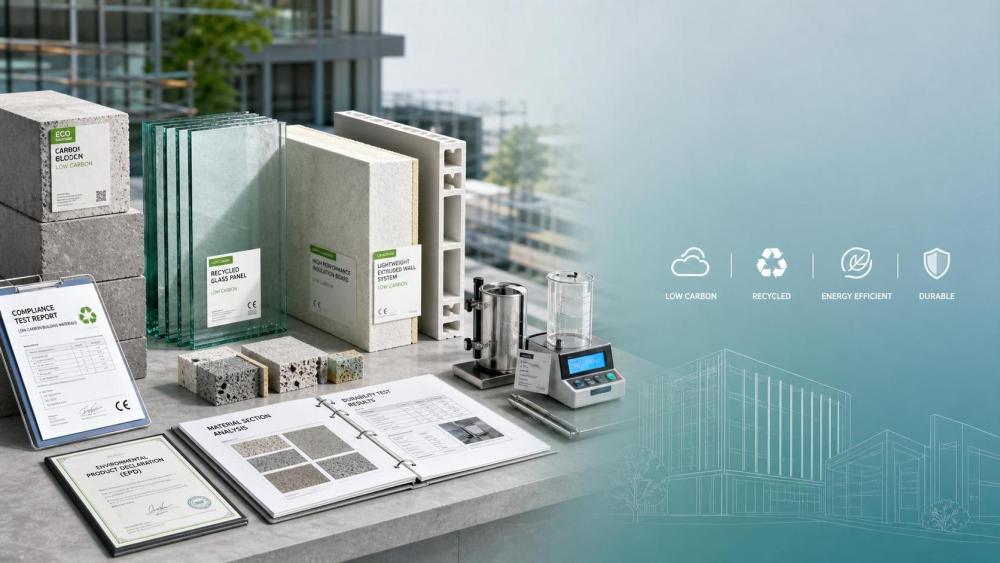
The term usually refers to materials that reduce environmental impact across sourcing, manufacturing, installation, use, and end-of-life handling. But a lower-carbon label alone is not enough.
For commercial work, green building materials should also support measurable project outcomes. That includes compliance readiness, durable performance, lower maintenance demand, and predictable lifecycle cost.
Typical examples include low-carbon cement blends, recycled-content glass, lightweight extruded wall systems, high-performance insulation, low-VOC finishes, and durable refractory-related materials in thermal zones.
A useful screening question is simple: does the material improve environmental performance while still meeting structural, thermal, safety, and service requirements under real operating conditions?
If the answer depends only on a brochure, the evaluation is still incomplete.
Why do upfront price comparisons often give the wrong answer?
Because commercial projects rarely pay only for materials. They pay for installation speed, inspection risk, replacement frequency, energy performance, and the cost of failure.
A lower purchase price may look attractive, yet create hidden costs through shorter lifespan, more site waste, heavier transport loads, or extra finishing work. Green building materials can sometimes reduce these indirect costs sharply.
This is common with lightweight panels, thermally efficient glazing, and engineered extrusion products. They may cost more per unit, but lower labor time, energy demand, and maintenance exposure.
The more reliable approach is to compare total installed cost and total ownership cost together. That means reviewing at least five dimensions before making a final call.
Seen this way, the best green building materials are not always the cheapest line item. They are the ones that hold cost down across the entire project timeline.
Which compliance documents actually matter before approval?
This is where many evaluations become risky. Teams often collect certificates, but fail to check whether those documents match the project location, application type, and latest code requirements.
For green building materials, the most useful documents usually include Environmental Product Declarations, fire classification reports, VOC emission test results, recycled content statements, and durability testing.
In some projects, embodied carbon reporting is becoming just as important as basic product compliance. That shift is visible across urban renewal programs, industrial retrofits, and public-sector developments.
CF-Elite’s market intelligence perspective is helpful here. Material performance is increasingly tied to regulation, especially where energy efficiency, decarbonization, and high-temperature processing influence the final construction product.
It is worth checking whether the supplier can provide:
- Current third-party test reports, not expired laboratory summaries
- Project-specific compliance mapping by use case
- Manufacturing origin details for traceability
- Declared limits for heat, moisture, load, or chemical exposure
- Consistency data between production batches
A material can look green on paper and still fail a real submittal review if documentation is incomplete or mismatched to the intended installation zone.
How should lifespan be judged when materials face real operating stress?
Service life is often oversimplified. Many product sheets assume ideal conditions, while commercial environments expose materials to moisture, thermal cycling, abrasion, UV load, chemicals, or mechanical vibration.
That is why green building materials should be reviewed in relation to the building zone, not in isolation. A facade panel, a roof insulation layer, and a kiln-adjacent partition do not age in the same way.
A stronger evaluation combines laboratory data with operational logic. If a product claims long life, ask what causes failure first, how that failure appears, and whether replacement can be done without major disruption.
For projects near thermal equipment or process-intensive areas, this matters even more. Knowledge from refractory systems and thermal management shows that minor mismatches in heat resistance can accelerate maintenance costs later.
A practical lifespan review should consider:
- Expected years in the actual operating environment
- Resistance to thermal shock, moisture ingress, or freeze-thaw cycling
- Likelihood of color fading, cracking, or dimensional change
- Availability of replacement units and matching batches
- Access difficulty for repair once the building is operational
When those answers are clear, lifecycle value becomes easier to compare than sticker price alone.
Where do buyers usually make mistakes with green building materials?
The first mistake is assuming every sustainable-looking option carries equal technical value. In reality, some materials perform well in certifications but poorly in demanding operating conditions.
Another common issue is comparing unlike categories. For example, one wall system may include structural, thermal, and finish functions, while another covers only one layer.
There is also a tendency to ignore production quality. In silicate-based materials, extrusion stability, firing control, and raw material consistency can affect dimensional accuracy and long-term behavior.
That is one reason industry observers follow manufacturing intelligence so closely. Process quality upstream often predicts field reliability downstream.
A quick warning table helps separate sound evaluation from avoidable mistakes.
What is a practical framework for making the final selection?
A useful decision framework starts by ranking project priorities. Some commercial builds are driven by carbon targets. Others are driven by fire safety, thermal performance, rapid installation, or maintenance reduction.
Once priorities are clear, green building materials can be scored more objectively. The process does not need to be complicated, but it should be disciplined.
A practical sequence often looks like this:
- Define performance needs by zone, not by product category alone
- Filter out options lacking current compliance evidence
- Compare installed cost, not just material quotations
- Review service life assumptions under actual exposure conditions
- Check whether supply capacity matches schedule and batch consistency
- Request references from similar commercial or industrial applications
For more technical materials, especially those tied to silicate processing, thermal barriers, or extruded lightweight systems, upstream manufacturing knowledge adds real value to the review.
That is where a broader intelligence source can help interpret not only product claims, but also process stability, market direction, and regulatory pressure shaping future material performance standards.
So, how do you move from shortlisting to confident commitment?
The strongest decisions come from combining three views at once: present cost, compliance certainty, and expected lifespan. If one of those is missing, the comparison remains fragile.
Green building materials should earn their place by proving performance in the exact conditions the project will face. That includes installation reality, regulatory scrutiny, and long-term operating exposure.
A sensible next step is to build a material review sheet around your most critical assemblies. Include approval documents, installed cost, maintenance assumptions, replacement risk, and carbon-related reporting needs.
If the project touches energy-intensive systems or advanced building products, it also helps to monitor how production technology is evolving. Better firing control, smarter extrusion, and stronger thermal management increasingly influence what qualifies as reliable green building materials.
That is the point where evaluation becomes more than a purchase exercise. It becomes a way to protect performance, compliance, and value over the full life of the commercial asset.
Related News
 Thermal Energy ArchitectRotary Kiln Efficiency: How Feed Rate, Fuel Use, and Heat Loss Affect OutputRotary kiln efficiency explained: discover how feed rate, fuel use, heat loss, combustion, and cooling performance shape output, quality, and energy costs.Sep 14, 2026
 Thermal Energy ArchitectHow to Select Heat-Resistant Materials That Maintain Abrasion Resistance in KilnsHeat-resistant materials abrasion resistance: learn how to select kiln linings that withstand heat, wear, thermal cycling, and chemical attack for longer service life.Sep 13, 2026
 Thermal Energy ArchitectHow Rotary Kiln Automation Improves Temperature Control and Fuel EfficiencyRotary kiln technology automation enhances temperature control, stabilizes combustion, and improves fuel efficiency with smarter data, predictive control, and safer operations.Sep 12, 2026
 Silicate Process EngineerCement Plant Emission Control: Selecting Systems for Dust, NOx, and SO2 LimitsCement plant emission control guide: compare dust collectors, NOx reduction, and SO2 systems for reliable compliance across kiln modes, fuel changes, and operating upsets.Sep 11, 2026
 Thermal Energy ArchitectSelecting Abrasion-Resistant High-Temperature Materials for Kiln and Conveyor Wear ZonesHigh-temp material engineering guide to abrasion-resistant kiln and conveyor solutions—match wear, heat, chemistry, and installation design for longer service life.Sep 10, 2026
 Dr. Alistair VaughnIndustrial Process Engineering: How to Map Processes for Safer, More Efficient PlantsIndustrial process engineering reveals bottlenecks, safety risks, and energy losses through practical process mapping for safer, more efficient plants.Sep 09, 2026
 Optical Glass Tech FellowHow to Evaluate a Glass Annealing Equipment Manufacturer for Production StabilityChoose a glass annealing equipment manufacturer with proven thermal uniformity, reliable controls, lifecycle value, and responsive service for stable production.Sep 08, 2026
 Prof. Marcus ChenThermal Energy Architecture in North America: Strategies for Lower Building Energy UseThermal energy architecture North America helps project leaders cut building energy use through stronger envelopes, right-sized HVAC, storage, and smart commissioning.Sep 07, 2026
 Ms. Elena RodriguezHow Should Buyers Evaluate Building Material Industry Intelligence Pricing?Building material industry intelligence pricing: learn how to compare coverage, technical depth, and ROI to choose intelligence that reduces procurement risk.Sep 07, 2026
 Ms. Elena RodriguezHow to Use Building Material Intelligence Data for Market and Investment DecisionsBuilding material industry intelligence data helps leaders evaluate demand, costs, regulation, capacity, and technology to make smarter market and investment decisions.Sep 05, 2026
 Thermal Energy ArchitectHow PLC Control Improves Energy Efficiency and Temperature Stability in KilnsEnergy efficient kilns PLC control improves temperature stability, cuts fuel waste, and optimizes combustion, draft, and material flow. Explore proven strategies for smarter kiln modernization.Sep 04, 2026
 Optical Glass Tech FellowEuropean Glass Melting Processes: Furnace Choices, Energy Use, and Quality ControlGlass melting process Europe: explore furnace choices, energy efficiency, cullet strategy, and quality control to improve output, compliance, and long-term glass performance.Sep 03, 2026
 Thermal Energy ArchitectWhat Determines Refractory Lining Monitoring Price for Industrial Kilns?Refractory lining monitoring price depends on kiln size, sensor technology, installation, software, and support. Compare total lifecycle costs and choose the right solution.Sep 02, 2026
 Silicate Process EngineerCement Production System Costs: A Plant Buyer’s Guide to Budgeting and ROICement production systems cost planning made clear: compare CAPEX, operating costs, compliance, and ROI to build a resilient, profitable cement plant investment.Sep 01, 2026
 Dr. Alistair VaughnWhat Should a Process Technology Database Track for High-Temperature Plants?Process technology database essentials for high-temperature plants: track thermal profiles, feed chemistry, refractory wear, emissions, energy, and maintenance for safer, data-driven decisions.Aug 31, 2026
 Ms. Elena RodriguezHow to Evaluate a Silicate Processing Equipment Manufacturer for Plant ProjectsSilicate processing equipment manufacturer selection: assess process fit, guarantees, energy, compliance, delivery risk, and lifecycle support for dependable plant performance.Aug 30, 2026
 Dr. Alistair VaughnHow to Specify Custom Agricultural Processing Equipment for Throughput and HygieneEquipment customization services for agricultural processing: learn to specify hygienic, high-throughput lines that improve yield, reliability, and long-term efficiency.Aug 29, 2026
 Dr. Alistair VaughnHow to Select Process Plant Equipment for High-Temperature, Abrasive Production LinesProcess plant equipment selection for high-temperature, abrasive lines: reduce downtime, improve durability, and optimize lifecycle performance.Aug 28, 2026
 Silicate Process EngineerHow Kiln Heat Recovery Systems Cut Fuel Use in Cement and Lime ProductionKiln heat recovery helps cement and lime plants cut fuel use, improve thermal stability, and build practical, reliable decarbonization strategies.Aug 27, 2026
 Ms. Elena RodriguezProcess Equipment Comparison: Which Metrics Matter Most for Reliable Selection?Process equipment comparison made practical: discover which metrics truly drive reliable selection, from energy efficiency and control stability to wear life, maintainability, and uptime.Aug 26, 2026


Related News
- 00
0000-00
How to Evaluate Lightweight Material Machinery for Output, Energy Use, and Product Quality - 00
0000-00
What Thermal Barrier Technology Works Best for Lightweight Industrial Panels? - 00
0000-00
Advanced Ceramic Processing for Honeycomb: Which Methods Improve Strength and Thermal Shock Resistance? - 00
0000-00
Building Material Extrusion Equipment Supplier Selection: 7 Parameters That Affect Line Performance - 00
0000-00
High Pressure Extruder Selection Guide: Output, Material Compatibility, and Wear
Weekly Insights
Stay ahead with our curated technology reports delivered every Monday.