
Silicate Sourcing Guide: How to Compare Purity, Particle Size, and Supply Consistency




Silicate sourcing guide: what should be checked before comparing quotes?
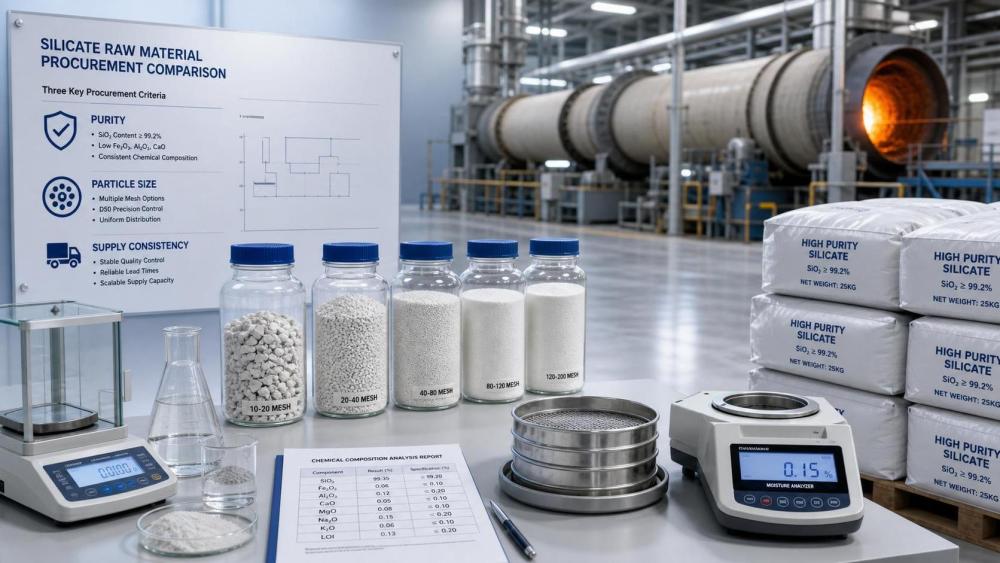
A useful silicate sourcing guide starts before pricing discussions. The real question is whether a material will behave consistently inside heat, pressure, and continuous production.
In cement, glass, refractories, incineration, and extrusion, silicates are rarely simple commodities. Small shifts in purity or particle size can change melting behavior, reactivity, dust loading, and final product strength.
That is why sourcing decisions often connect directly to kiln stability, furnace energy use, lining life, and rejection rates. A cheaper ton can become an expensive process variable.
CF-Elite follows these links closely across high-temperature industries. Its intelligence focus on thermal management, reaction kinetics, and carbon reduction reflects a practical reality: raw material variation affects both cost and decarbonization performance.
So when using a silicate sourcing guide, the goal is not only to identify acceptable chemistry. It is to build confidence that quality, throughput, and supply continuity will hold across repeated orders.
Is purity always the first number to compare?
Purity matters, but it should never be read as a standalone headline figure. A high assay can still hide impurities that create serious downstream effects.
The more useful approach is to ask which impurities are critical for the target process. Iron, alkalis, calcium, alumina, moisture, and insoluble residues do not carry the same risk in every application.
For glass and specialty materials, trace contamination may affect color, transparency, or melt control. In refractory and kiln-related applications, impurity balance can influence expansion, slag resistance, and thermal shock behavior.
This is where a silicate sourcing guide becomes more operational. Instead of asking for the highest purity available, define the acceptable impurity ceiling for the process window.
It also helps to verify how purity is measured. Check the test method, batch frequency, and whether results come from composite samples or shipment-specific analysis.
More common problems come from inconsistent reporting than from obviously poor material. One supplier may report average monthly chemistry, while another reports every lot. Those are not equivalent.
A quick purity check usually includes
- Main silicate content and target range
- Critical impurity limits by application
- Moisture variation across seasons
- Sampling and laboratory methods
- Certificate consistency across recent shipments
How much does particle size really affect process stability?
Usually more than first-time buyers expect. Particle size is not only a handling issue. It changes surface area, packing density, feeding behavior, and reaction speed.
In high-temperature systems, finer particles may improve reaction efficiency, yet they can also increase dust generation and alter residence time. Coarser fractions may reduce dust, but they can slow homogenization or melting.
That balance matters in rotary kilns, glass melting systems, refractory mixes, and extrusion formulations. A narrow distribution often supports predictable performance, while an unstable distribution creates adjustment work inside the plant.
A practical silicate sourcing guide should therefore ask for full particle size distribution, not only one mesh number or a single D50 value.
When possible, compare D10, D50, and D90 together. Then relate those values to real plant outcomes such as feeder reliability, blend uniformity, firing response, and product surface quality.
Needle-like or irregular particle shape may also affect flowability. Two materials with similar size data can still behave differently in silos, conveyors, and mixing lines.
What should be asked when particle size looks acceptable on paper?
Ask whether the size range is controlled by milling, screening, or blending. Then confirm tolerance drift across volume production, not just the qualification sample.
In actual operations, process engineers often care less about the nominal target than about how often the material falls outside the agreed band.
When does supply consistency become more important than unit price?
Usually once production losses exceed the apparent savings from a low quote. Supply consistency is not only about on-time delivery. It includes lot-to-lot chemistry, PSD stability, packaging quality, and logistics resilience.
This matters most for large-volume lines where shutdowns, reformulation, or retesting are expensive. A delayed truck or drifting batch may force recipe changes, extra fuel consumption, or temporary throughput cuts.
CF-Elite tracks these risks across cement plants, float lines, industrial kilns, and new building material systems because raw material reliability often shapes wider operating economics.
The stronger suppliers usually show evidence in three places: reserve stability, process control discipline, and transparent quality records over time. One good test batch proves very little.
The table below helps turn this silicate sourcing guide into a comparison tool during qualification.
A silicate sourcing guide becomes far more useful when these points are scored side by side, instead of comparing price alone.
What are the common mistakes when comparing suppliers?
One common mistake is approving material from a polished lab sample that never represents routine production. Qualification should include shipment-scale evidence.
Another mistake is treating all silicate grades as interchangeable because the headline chemistry looks similar. In practice, mineral origin, beneficiation route, and milling discipline create measurable performance differences.
There is also a frequent cost error. Buyers calculate purchase price per ton, but not total cost per stable operating hour, acceptable yield, or maintenance cycle.
A stronger silicate sourcing guide will include hidden cost questions such as dust housekeeping, blend correction, thermal efficiency losses, and testing delays after each lot change.
It is wise to request recent trend data, not one certificate. Three to six months of shipment records can reveal whether quality control is robust or merely selective.
Warning signs worth noticing early
- Broad tolerance wording without numeric limits
- Inconsistent moisture values between seasons
- No explanation of test frequency
- Strong sample performance but weak scale-up references
- Sudden discounting tied to unclear source changes
How can a silicate sourcing guide support cost control without lowering standards?
The answer is to define value in operating terms. Cost control works better when material selection is linked to process targets, not just procurement targets.
For example, a slightly higher-cost grade may lower specific energy use, reduce kiln deposits, improve extrusion uniformity, or extend refractory campaign life. Those gains often outweigh a narrow raw material saving.
A disciplined silicate sourcing guide should compare suppliers through a landed-cost-plus-performance model. Include freight, storage losses, testing frequency, yield impact, and expected process adjustment costs.
Where decarbonization targets matter, material consistency also has strategic value. Stable inputs support better thermal efficiency and more predictable emissions control, especially in continuous high-temperature operations.
This is where market intelligence becomes useful. CF-Elite’s sector tracking on heavy thermal industries can help connect sourcing decisions with broader signals such as environmental regulation, regional capacity shifts, and equipment modernization trends.
The best next step is usually simple. Build a comparison sheet around purity, particle size distribution, lot consistency, lead time, and total operating cost.
Then validate shortlisted suppliers with trial lots that reflect actual order volume. A silicate sourcing guide is most effective when it ends with measurable acceptance rules, not just a preferred quote.
Related News
 Thermal Energy ArchitectWhat Does CE Marking Require for an Energy-Efficient Industrial Kiln?Energy efficient kiln CE requirements explained: assess safety, technical files, energy performance, and EU compliance before purchase or commissioning.Oct 04, 2026
 Thermal Energy ArchitectRefractory Manufacturing Solutions for Brick Plants: How to Extend Kiln LifeRefractory manufacturing solutions for brick plant operations: discover proven strategies to extend kiln life, reduce heat loss, prevent lining failures, and plan cost-effective repairs.Oct 03, 2026
 Thermal Energy ArchitectHow to Specify Heavy Industrial Process Systems for High-Temperature PlantsHeavy industrial processes systems: learn how to specify high-temperature plants for efficiency, emissions control, maintainability, and lifecycle performance.Oct 02, 2026
 Structural Material AnalystHow Sustainable Material Extrusion Can Improve Wall Panel Durability and Design FlexibilityDiscover how sustainable material extrusion for wall panels improves durability, moisture resistance, design flexibility, and installation consistency for high-performing wall systems.Oct 01, 2026
 Thermal Energy ArchitectHow to Evaluate a High-Temperature Materials Manufacturer for Furnace ApplicationsChoose a high-temperature materials manufacturer with confidence: compare thermal performance, chemical resistance, quality controls, installation support, and lifecycle cost.Sep 30, 2026
 Ms. Elena RodriguezHow to Structure Global Specification Data for Faster Industrial Product EvaluationGlobal specification-oriented product information helps industrial teams compare capacity, energy, emissions, automation, and lifecycle data on a like-for-like basis for faster, confident equipment decisions.Sep 29, 2026
 Thermal Energy ArchitectHow to Specify High-Temperature Process Systems for Continuous Thermal OperationsHigh-temperature process engineering systems: learn how to specify resilient continuous thermal operations for efficiency, compliance, reliable uptime, and long-term performance.Sep 28, 2026
 Thermal Energy ArchitectHow to Evaluate a Thermal Engineering Contractor for High-Temperature Plant ProjectsChoose a thermal engineering contractor with proven process expertise, lifecycle value, emissions control, and delivery discipline for reliable high-temperature plant performance.Sep 27, 2026
 Silicate Process EngineerHow Latin American Cement Plants Can Reduce Dust Emissions in Kilns and Transfer PointsCement plant dust control Latin America: reduce kiln and transfer-point emissions with practical airflow, filtration, monitoring, and maintenance strategies.Sep 26, 2026
 Material Heat-Resist ExpertHow to Evaluate Refractory Production Lines for Output, Quality, and Energy UseRefractory production lines: learn how to assess qualified output, consistent quality, and total energy use for smarter, lower-risk investment decisions.Sep 25, 2026
 Dr. Alistair VaughnHow Waste Recycling Technology Improves Material Recovery in Industrial PlantsWaste recycling technology improves material recovery through source segregation, smart separation, thermal treatment, and quality control for industrial plants.Sep 24, 2026
 Optical Glass Tech FellowHow to Specify Glass Annealing Equipment for European Quality and Energy RequirementsGlass annealing equipment Europe: learn how to specify lehrs for consistent glass quality, energy efficiency, compliance, automation, and reliable long-term performance.Sep 23, 2026
 Optical Glass Tech FellowSilicate Process Automation: Improving Batch Consistency and Energy ControlSilicate process automation improves batch consistency, energy control, traceability, and operator confidence across high-temperature manufacturing operations.Sep 22, 2026
 Optical Glass Tech FellowHow Silicate Industrial Processes Control Viscosity, Energy Use, and Product QualitySilicate industrial processes: learn how viscosity, chemistry, heat transfer, and atmosphere control reduce energy use, improve stability, and protect product quality.Sep 21, 2026
 Thermal Energy ArchitectHow European Plants Can Evaluate Energy Recovery Equipment for High-Temperature ProcessesIndustrial energy recovery equipment Europe: learn how high-temperature plants can assess waste-heat sources, integration risks, lifecycle value, and reliable recovery routes.Sep 20, 2026
 Thermal Energy ArchitectIndustrial Furnace Process Optimization: Reducing Fuel Use Without Sacrificing ThroughputIndustrial process optimization furnace strategies that cut fuel use while protecting throughput. Explore combustion control, heat recovery, refractory performance, and data-driven efficiency gains.Sep 19, 2026
 Ms. Elena RodriguezWhat Drives High-Pressure Extrusion Equipment Cost in Industrial Projects?High pressure extrusion equipment cost explained: compare pressure, die design, automation, wear, energy, and installation factors for smarter industrial investments.Sep 18, 2026
 Thermal Energy ArchitectHow to Size a Waste Heat Recovery Exchanger for High-Temperature Kiln Exhaust?Waste heat recovery exchanger sizing for high-temperature kiln exhaust: balance recoverable duty, fouling, corrosion limits, pressure drop, and reliable heat use.Sep 17, 2026
 Thermal Energy ArchitectWhy Heat-Resistant Materials Lose Abrasion Resistance at High TemperaturesHeat-resistant materials abrasion resistance can decline at high temperatures. Discover the thermal, chemical, and mechanical causes of wear—and how to choose longer-lasting linings.Sep 16, 2026
 Thermal Energy ArchitectHow to Evaluate a Thermal Energy Optimization Company for High-Temperature PlantsChoose a thermal energy optimization company with proven process expertise, measurable savings, and reliable delivery for high-temperature plants. Learn what to assess.Sep 15, 2026


Related News
- 00
0000-00
How Sustainable Material Extrusion Can Improve Wall Panel Durability and Design Flexibility - 00
0000-00
How to Evaluate Lightweight Material Machinery for Output, Energy Use, and Product Quality - 00
0000-00
What Thermal Barrier Technology Works Best for Lightweight Industrial Panels? - 00
0000-00
Advanced Ceramic Processing for Honeycomb: Which Methods Improve Strength and Thermal Shock Resistance? - 00
0000-00
Building Material Extrusion Equipment Supplier Selection: 7 Parameters That Affect Line Performance
Weekly Insights
Stay ahead with our curated technology reports delivered every Monday.