
What Thermal Barrier Technology Works Best for Lightweight Industrial Panels?




Meta Title: What Thermal Barrier Technology Lightweight Industrial Panels Need for Real-World Performance
If you are evaluating lightweight industrial panels, the short answer is this: the best thermal barrier technology lightweight panel systems use is rarely a single material. In most practical projects, the strongest results come from a well-matched system, usually a non-combustible core, controlled heat-flow layers, and a facing structure that stays stable under service conditions. The right choice depends less on brochure claims and more on temperature range, fire requirements, moisture exposure, weight limits, and installation reality.
Many buyers get stuck on one number, usually thermal conductivity. That matters, but it does not decide the job by itself. A panel can test well in the lab and still disappoint in service if the core shrinks, absorbs moisture, cracks under vibration, or creates thermal bridges at joints and fasteners. For technical evaluation, that is the real issue: which barrier approach keeps insulation performance, structural integrity, and compliance working together over time.
What usually works best in practice
For most lightweight industrial panel applications, mineral-based core systems and engineered ceramic or silicate-based thermal barriers tend to be the safest choice when fire resistance, dimensional stability, and long service life matter more than shaving every last kilogram. If the panel is close to sustained heat, process equipment, kiln-adjacent zones, incineration areas, or high-risk fire compartments, non-combustible insulation usually wins the decision.
Where lower operating temperatures and stricter weight targets dominate, high-performance foam-based panels or hybrid sandwich constructions may still make sense. But they need more careful review around flame spread, smoke, long-term aging, and code acceptance. That is where many lightweight projects become expensive later: the initial panel looks efficient on paper, but the thermal barrier strategy is too narrow for the real duty cycle.
A good evaluator asks a harder question: not “Which material insulates best?” but “Which panel system still performs after heat cycling, mechanical fixing, moisture exposure, and maintenance access?” That question usually leads to better decisions.
Not all lightweight panel applications are asking for the same barrier
“Lightweight industrial panel” covers a wide field. Exterior wall panels for a green building line, enclosure panels near a glass furnace, modular equipment housings, kiln peripheral structures, and fire-separated process rooms may all use lightweight assemblies, but they do not need the same thermal barrier design.
In low-to-moderate temperature building envelopes, the barrier is often about energy retention and code-level fire performance. In high-temperature industry, it becomes a stability problem. The panel has to resist radiant heat, intermittent spikes, thermal shock, and sometimes corrosive atmospheres. A solution that performs acceptably in a standard insulated facade may fail quickly beside combustion equipment or waste-heat systems.
This is why experienced teams classify the duty first:
- Continuous service temperature
- Peak or upset temperature events
- Direct flame risk or only radiant exposure
- Indoor dry use or moisture-prone environment
- Mechanical load, vibration, and impact risk
- Required fire rating and local compliance standard
Without that baseline, “best” is just guesswork.
Comparing the main thermal barrier strategies
There are four broad approaches that show up again and again in lightweight industrial panels.
1. Mineral wool or rock wool sandwich cores
This is often the default serious option for industrial panels because it gives a balanced profile: good thermal resistance, non-combustibility, reasonable acoustic benefit, and stable fire behavior. It is not the lightest route, but it is often the lowest-risk route where insurance, plant safety, and code review are part of the decision.
Its strengths are clear in process-related buildings, utility areas, and industrial partitions. It is less attractive when ultra-low weight, very thin panel depth, or high compressive precision is the priority. The other common complaint is that poor edge detailing can reduce actual performance.
2. Calcium silicate and related silicate-based boards
These are especially relevant when the panel is expected to manage higher temperatures or remain dimensionally reliable under thermal stress. They are not always used as the only core; often they act as a thermal barrier layer within a composite panel. In applications connected to kilns, refractory support environments, or heat-shielding assemblies, silicate-based systems deserve serious attention.
The advantage is not just heat resistance. It is the combination of stability, non-combustibility, and compatibility with demanding thermal environments. The tradeoff is that they may require more deliberate assembly design to stay lightweight and cost-effective.
In sectors covered by intelligence platforms such as CF-Elite, especially refractory production lines, industrial incineration, and new building material extrusion, this kind of layered evaluation is more useful than product-level marketing claims because the panel choice often sits inside a bigger thermal management chain.
3. Ceramic fiber-based barrier layers
Ceramic fibers perform very well in high-temperature insulation, especially where low mass and strong thermal resistance are needed. They can be excellent in specialized industrial shielding, but they are not automatically the best choice for every lightweight panel. Mechanical durability, handling practice, enclosure design, and regulatory expectations all need review.
In other words, ceramic fiber can be technically impressive and still be the wrong answer for a panel that must survive repeated handling, puncture risk, or basic building-service abuse.
4. Foam-core systems with enhanced facings
PIR, PUR, phenolic, and similar foam-core panels remain attractive because they are light and thermally efficient for their thickness. For many cold-storage and controlled-envelope projects, they are a practical answer. But when people try to stretch them into more demanding thermal barrier roles, the weak points appear: fire scenario behavior, smoke concerns, aging under heat, and dependency on facing integrity.
This does not make them bad products. It means they are application-specific. For hotter industrial settings, they usually need either separation distance, added protective layers, or a completely different barrier concept.
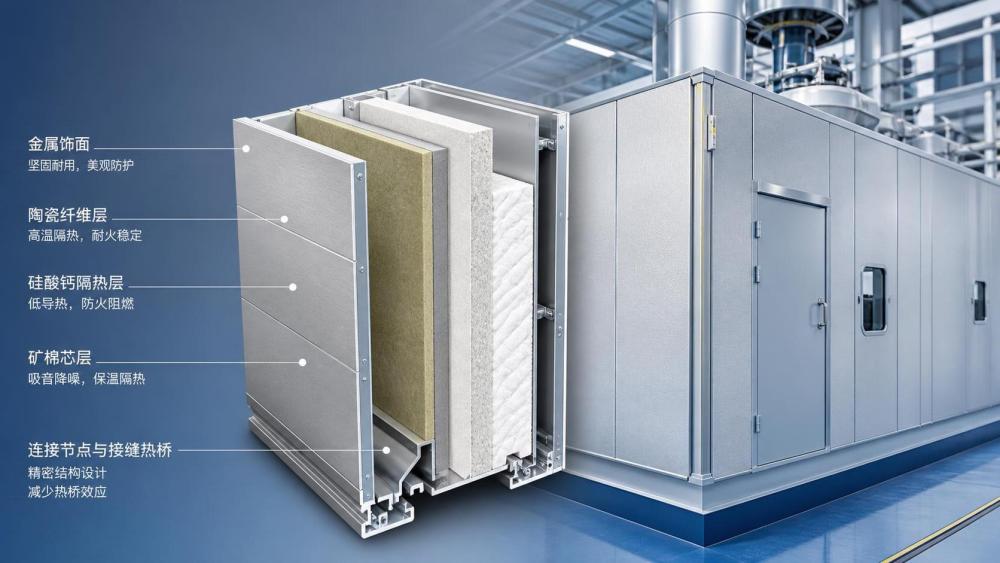
Why hybrid systems often outperform “best material” thinking
A common mistake in selection work is looking for one hero material. Real panel performance is more often won by combination design.
For example, a lightweight industrial panel may use a thin metal skin for durability, a non-combustible inner board for fire integrity, and an insulating core selected for thermal resistance and weight. Another system may rely on thermal break details at joints and fasteners because the field-installed connection points create more heat leakage than the panel body itself.
This matters because thermal bridges can erase the theoretical gains of a premium core. I have seen evaluation matrices where the panel center performance looked excellent, yet the joint layout made the assembly much less efficient in real service. The technical file looked clean; the installed system did not.
So when comparing options, ask suppliers for assembly-level data where available, not just material-level values. If assembly testing is unavailable, that is a signal to slow down.
What technical evaluators should pay attention to before approving a panel
There are a few checks that prevent most bad decisions.
- Confirm the actual temperature exposure. Designers often specify to normal operating temperature and ignore upset conditions.
- Check whether the stated thermal performance is dry-state, aged-state, or installed-state.
- Review fire classification and test basis carefully. Similar-looking panels may be certified under different standards.
- Inspect joint design, fastener layout, edge sealing, and support spacing.
- Ask about dimensional stability after heat cycling, not just at room temperature.
- Consider moisture. Some high-performing materials lose value quickly when wet or repeatedly condensed.
- Match service life expectations with maintenance access. A panel over a difficult shutdown zone should not be chosen like a simple partition wall.
These points sound basic, but they are exactly where selection errors happen. Many teams compare catalog data from different testing methods and assume they are directly equivalent. They often are not.
When each option makes sense
If the project sits in a standard industrial building envelope and the main target is energy efficiency with acceptable fire performance, a proven sandwich panel with a mineral-based core is often the sensible middle path.
If the panel is near sustained heat, thermal cycling, or high fire consequence areas, silicate and ceramic-based barrier strategies move much higher on the shortlist. This is especially true where the panel is part of a broader high-temperature process environment rather than a simple building enclosure.
If ultra-low weight and thin build-up are driving the design, foam-core options may still be valid, but only if the fire and aging limits are clearly understood and accepted. They are often chosen for the wrong reason: easy thermal numbers per thickness. That can be useful, but it is not the same as robust thermal barrier performance.
And if the project is unusual, such as modular industrial units exposed to vibration and periodic heat spikes, hybrid assemblies usually deserve first review. They may look more complex upfront, but they often reduce rework and compliance risk later.
The budget question is usually asked too early
Technical evaluators are often pushed to compare panel cost before they have pinned down the duty profile. That reverses the logic. A cheaper panel that needs extra fire protection, more frequent replacement, or additional support structure may not stay cheaper for long.
Lifecycle cost matters more here than unit cost. Installation speed, support frame weight, shutdown risk, maintenance interval, and replacement difficulty all belong in the comparison. Some lightweight systems save money only if the operating conditions stay mild. Once the thermal load rises, the cost picture changes fast.
If you need a practical decision rule, use this one: where fire exposure, process heat, or long service intervals are critical, bias toward non-combustible and dimensionally stable barrier systems first, then optimize weight and cost inside that safe zone. That is usually a more reliable path than starting from the lightest panel available.
Final judgment: what thermal barrier technology lightweight industrial panels work best with?
For most technical evaluations, the best answer is a non-combustible or hybrid barrier system tailored to the real thermal duty, not the lightest or lowest-lambda material in isolation. Mineral wool remains a dependable baseline for many industrial panel applications. Silicate-based and ceramic-derived barrier layers become stronger choices as temperature severity, fire consequence, and dimensional stability requirements increase. Foam-core systems can still be effective, but mostly in lower-risk thermal environments where their limitations are openly accounted for.
That is why the best thermal barrier technology lightweight panel projects rely on is usually the one that holds performance at the assembly level: core, facing, joints, fixings, fire behavior, and service life all considered together. If your evaluation process is rigorous enough to compare those factors side by side, the right option usually becomes much easier to see.
FAQ
Is the lowest thermal conductivity material always the best panel core?
No. Low thermal conductivity helps, but it does not cover fire behavior, moisture sensitivity, thermal cycling, joint loss, or long-term stability.
Are lightweight foam-core panels suitable for hot industrial zones?
Sometimes, but only in controlled conditions. They need careful review for fire performance, aging under heat, and code acceptance.
When should silicate-based barriers move to the top of the shortlist?
When the panel is near sustained heat, process equipment, high fire-risk compartments, or applications where dimensional stability matters as much as insulation value.
Should evaluators focus on material data sheets or full panel assemblies?
Full assemblies. Material data is useful, but installed performance depends heavily on skins, joints, fasteners, and edge details.
Image Placeholder Notes
- : Place near the section comparing barrier strategies; show a cross-sectional comparison of lightweight panel assemblies with core, facing, joint, and thermal bridge points. Alt: Comparison of thermal barrier technology in lightweight industrial panel assemblies
Internal Link Anchor Suggestions
- Anchor text: refractory lining monitoring systems - Suggested page: industrial refractory monitoring or maintenance intelligence
- Anchor text: industrial kiln heat management - Suggested page: kiln efficiency or thermal control topic page
- Anchor text: lightweight construction material extrusion - Suggested page: building material extrusion equipment or process guide
- Anchor text: fire-resistant industrial panel selection - Suggested page: industrial fire safety materials guide
- Anchor text: thermal insulation performance in high-temperature plants - Suggested page: thermal efficiency or plant energy management article
External Source Directions
- Industry association guidance on fire testing and insulated panel standards
- Government or building-code authority pages covering non-combustible material requirements
- Official technical documentation from established mineral wool, calcium silicate, or ceramic insulation manufacturers
Related News
 Structural Material AnalystHow Sustainable Material Extrusion Can Improve Wall Panel Durability and Design FlexibilityDiscover how sustainable material extrusion for wall panels improves durability, moisture resistance, design flexibility, and installation consistency for high-performing wall systems.Oct 01, 2026
 Thermal Energy ArchitectHow to Evaluate a High-Temperature Materials Manufacturer for Furnace ApplicationsChoose a high-temperature materials manufacturer with confidence: compare thermal performance, chemical resistance, quality controls, installation support, and lifecycle cost.Sep 30, 2026
 Ms. Elena RodriguezHow to Structure Global Specification Data for Faster Industrial Product EvaluationGlobal specification-oriented product information helps industrial teams compare capacity, energy, emissions, automation, and lifecycle data on a like-for-like basis for faster, confident equipment decisions.Sep 29, 2026
 Thermal Energy ArchitectHow to Specify High-Temperature Process Systems for Continuous Thermal OperationsHigh-temperature process engineering systems: learn how to specify resilient continuous thermal operations for efficiency, compliance, reliable uptime, and long-term performance.Sep 28, 2026
 Thermal Energy ArchitectHow to Evaluate a Thermal Engineering Contractor for High-Temperature Plant ProjectsChoose a thermal engineering contractor with proven process expertise, lifecycle value, emissions control, and delivery discipline for reliable high-temperature plant performance.Sep 27, 2026
 Silicate Process EngineerHow Latin American Cement Plants Can Reduce Dust Emissions in Kilns and Transfer PointsCement plant dust control Latin America: reduce kiln and transfer-point emissions with practical airflow, filtration, monitoring, and maintenance strategies.Sep 26, 2026
 Material Heat-Resist ExpertHow to Evaluate Refractory Production Lines for Output, Quality, and Energy UseRefractory production lines: learn how to assess qualified output, consistent quality, and total energy use for smarter, lower-risk investment decisions.Sep 25, 2026
 Dr. Alistair VaughnHow Waste Recycling Technology Improves Material Recovery in Industrial PlantsWaste recycling technology improves material recovery through source segregation, smart separation, thermal treatment, and quality control for industrial plants.Sep 24, 2026
 Optical Glass Tech FellowHow to Specify Glass Annealing Equipment for European Quality and Energy RequirementsGlass annealing equipment Europe: learn how to specify lehrs for consistent glass quality, energy efficiency, compliance, automation, and reliable long-term performance.Sep 23, 2026
 Optical Glass Tech FellowSilicate Process Automation: Improving Batch Consistency and Energy ControlSilicate process automation improves batch consistency, energy control, traceability, and operator confidence across high-temperature manufacturing operations.Sep 22, 2026
 Optical Glass Tech FellowHow Silicate Industrial Processes Control Viscosity, Energy Use, and Product QualitySilicate industrial processes: learn how viscosity, chemistry, heat transfer, and atmosphere control reduce energy use, improve stability, and protect product quality.Sep 21, 2026
 Thermal Energy ArchitectHow European Plants Can Evaluate Energy Recovery Equipment for High-Temperature ProcessesIndustrial energy recovery equipment Europe: learn how high-temperature plants can assess waste-heat sources, integration risks, lifecycle value, and reliable recovery routes.Sep 20, 2026
 Thermal Energy ArchitectIndustrial Furnace Process Optimization: Reducing Fuel Use Without Sacrificing ThroughputIndustrial process optimization furnace strategies that cut fuel use while protecting throughput. Explore combustion control, heat recovery, refractory performance, and data-driven efficiency gains.Sep 19, 2026
 Ms. Elena RodriguezWhat Drives High-Pressure Extrusion Equipment Cost in Industrial Projects?High pressure extrusion equipment cost explained: compare pressure, die design, automation, wear, energy, and installation factors for smarter industrial investments.Sep 18, 2026
 Thermal Energy ArchitectHow to Size a Waste Heat Recovery Exchanger for High-Temperature Kiln Exhaust?Waste heat recovery exchanger sizing for high-temperature kiln exhaust: balance recoverable duty, fouling, corrosion limits, pressure drop, and reliable heat use.Sep 17, 2026
 Thermal Energy ArchitectWhy Heat-Resistant Materials Lose Abrasion Resistance at High TemperaturesHeat-resistant materials abrasion resistance can decline at high temperatures. Discover the thermal, chemical, and mechanical causes of wear—and how to choose longer-lasting linings.Sep 16, 2026
 Thermal Energy ArchitectHow to Evaluate a Thermal Energy Optimization Company for High-Temperature PlantsChoose a thermal energy optimization company with proven process expertise, measurable savings, and reliable delivery for high-temperature plants. Learn what to assess.Sep 15, 2026
 Thermal Energy ArchitectRotary Kiln Efficiency: How Feed Rate, Fuel Use, and Heat Loss Affect OutputRotary kiln efficiency explained: discover how feed rate, fuel use, heat loss, combustion, and cooling performance shape output, quality, and energy costs.Sep 14, 2026
 Thermal Energy ArchitectHow to Select Heat-Resistant Materials That Maintain Abrasion Resistance in KilnsHeat-resistant materials abrasion resistance: learn how to select kiln linings that withstand heat, wear, thermal cycling, and chemical attack for longer service life.Sep 13, 2026
 Thermal Energy ArchitectHow Rotary Kiln Automation Improves Temperature Control and Fuel EfficiencyRotary kiln technology automation enhances temperature control, stabilizes combustion, and improves fuel efficiency with smarter data, predictive control, and safer operations.Sep 12, 2026

Related News
- 00
0000-00
How Sustainable Material Extrusion Can Improve Wall Panel Durability and Design Flexibility - 00
0000-00
How to Evaluate Lightweight Material Machinery for Output, Energy Use, and Product Quality - 00
0000-00
What Thermal Barrier Technology Works Best for Lightweight Industrial Panels? - 00
0000-00
Advanced Ceramic Processing for Honeycomb: Which Methods Improve Strength and Thermal Shock Resistance? - 00
0000-00
Building Material Extrusion Equipment Supplier Selection: 7 Parameters That Affect Line Performance
Weekly Insights
Stay ahead with our curated technology reports delivered every Monday.