
How to Evaluate Lightweight Material Machinery for Output, Energy Use, and Product Quality




Choosing lightweight material machinery is rarely a simple capacity comparison. A machine that looks strong on paper can still miss production targets, burn too much energy per ton, or produce lightweight blocks, panels, or extruded profiles with unstable density and strength. For technical evaluation work, the real question is more practical: under your actual raw materials, moisture range, operator skill, and production rhythm, which machine will keep output steady without quietly increasing waste, power cost, and quality complaints?
If you are reviewing suppliers now, start from that point. The best machine is not the one with the biggest nameplate number. It is the one that can keep throughput, energy use, and product quality in balance over time.
What technical evaluators should look at first in lightweight material machinery
A short answer first: evaluate the machine as a production system, not as a standalone piece of hardware. That means checking three things together: effective output, specific energy consumption, and quality consistency. If one looks excellent while the other two weaken, the machine may not fit your line.
This matters a lot in lightweight material production because many products are sensitive to feed uniformity, mixing quality, pressure stability, thermal behavior, curing conditions, and downstream handling. A machine may produce high hourly volume during a supplier trial, but once material moisture shifts or density targets tighten, actual usable output can fall sharply.
That is why experienced evaluators separate gross output from saleable output. Gross output is what the machine pushes through. Saleable output is what meets specification without rework. The second number is the one that affects margin.
Output: do not confuse peak rate with stable production
One common mistake is taking maximum throughput as the main decision metric. In lightweight materials, output stability is usually more valuable than occasional peak speed.
When suppliers present capacity, ask what conditions were used:
- Raw material type and particle distribution
- Feed moisture range
- Binder ratio or additive ratio
- Product dimensions and density target
- Shift pattern and operator intervention level
- Whether startup, changeover, and cleaning time were excluded
A machine rated at a high hourly output may only reach that level with narrow material conditions and low-quality tolerance. In real plants, material variation is normal. If the equipment cannot absorb that variation, you will see stoppages, unstable forming pressure, edge cracking, dimensional drift, or bulk density fluctuation.
For that reason, ask for output data over a meaningful period, not a short demonstration window. Eight continuous hours is better than one impressive hour. If the line is meant for industrial production, a multi-shift reference is even better. You want to know how output behaves after wear begins, when the feed system sees normal fluctuation, and when operators are not being coached by the supplier’s best technician.
Another useful check is to calculate usable output per shift after rejects, rework, and downtime. This often changes rankings between machines more than buyers expect.
Energy use is not just a motor number
Energy evaluation gets oversimplified all the time. Installed power tells you very little by itself. What matters is specific energy consumption per ton of qualified product, and sometimes per cubic meter if volume-based products are being compared.
In lightweight material machinery, energy use is shaped by more than the main drive. Feed preparation, vacuum systems, compressors, mixers, heaters, thermal curing support, cutting units, dust handling, and conveyors all affect the real figure. A machine with a lower purchase price can become expensive if it depends on high auxiliary energy or frequent recirculation of off-spec material.
When comparing options, request:
- Measured energy use under stated production conditions
- The test basis used for calculation
- Whether idle and partial-load consumption are included
- Expected wear effects on energy draw over time
- Recommended operating window for best efficiency
This last point matters more than many teams realize. Some machines look efficient only near a narrow loading band. If your plant often runs at 60 to 75 percent of nominal capacity, the best machine on paper may not be the best one in practice.
There is also a carbon and compliance angle here. In many building-material operations, internal investment decisions are already influenced by energy intensity and future reporting pressure. Even where no formal carbon accounting is in place yet, management is paying closer attention to equipment that locks in lower unit energy demand. That is one reason technical teams increasingly look beyond a simple capex comparison.
Product quality is where weak machinery gets exposed
Output and energy claims are easy to market. Product consistency is harder to hide.
For lightweight products, the machinery must control not just shape, but structure. Depending on the process, you may be watching density uniformity, pore distribution, compressive strength, surface finish, dimensional tolerance, edge integrity, water absorption behavior, or bonding performance in downstream application.
If a machine produces variable compaction or unstable extrusion pressure, the problem may not be obvious at first glance. The product can look acceptable right after forming, then fail later in curing, cutting, stacking, transport, or installation. That is why visual inspection alone is not enough.
During evaluation, connect machine performance to actual quality checkpoints:
- Density deviation across samples
- Dimensional repeatability
- Surface cracks, lamination, or deformation rate
- Strength results after the full curing cycle
- Reject ratio by cause
- Quality stability after continuous operation, not only at startup
A useful habit is to ask suppliers which quality defects their machine is most sensitive to, and under what conditions those defects usually appear. Serious manufacturers can answer that directly. If every machine is presented as universally stable under every feed condition, you are probably hearing a sales script rather than process knowledge.
Look at the line, not only the machine body
Many poor selection decisions happen because the evaluator focuses on the core forming or extrusion unit and gives too little attention to line integration.
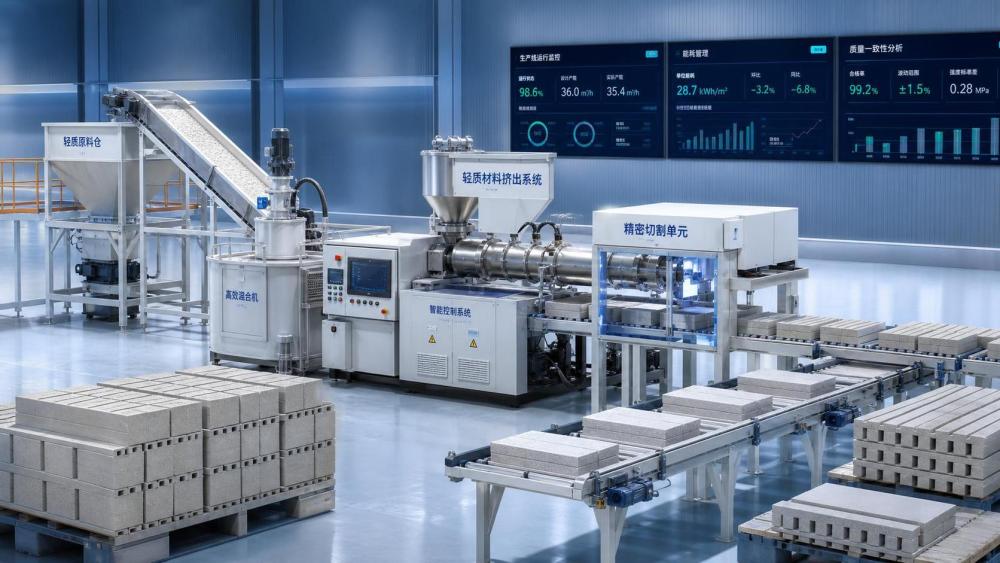
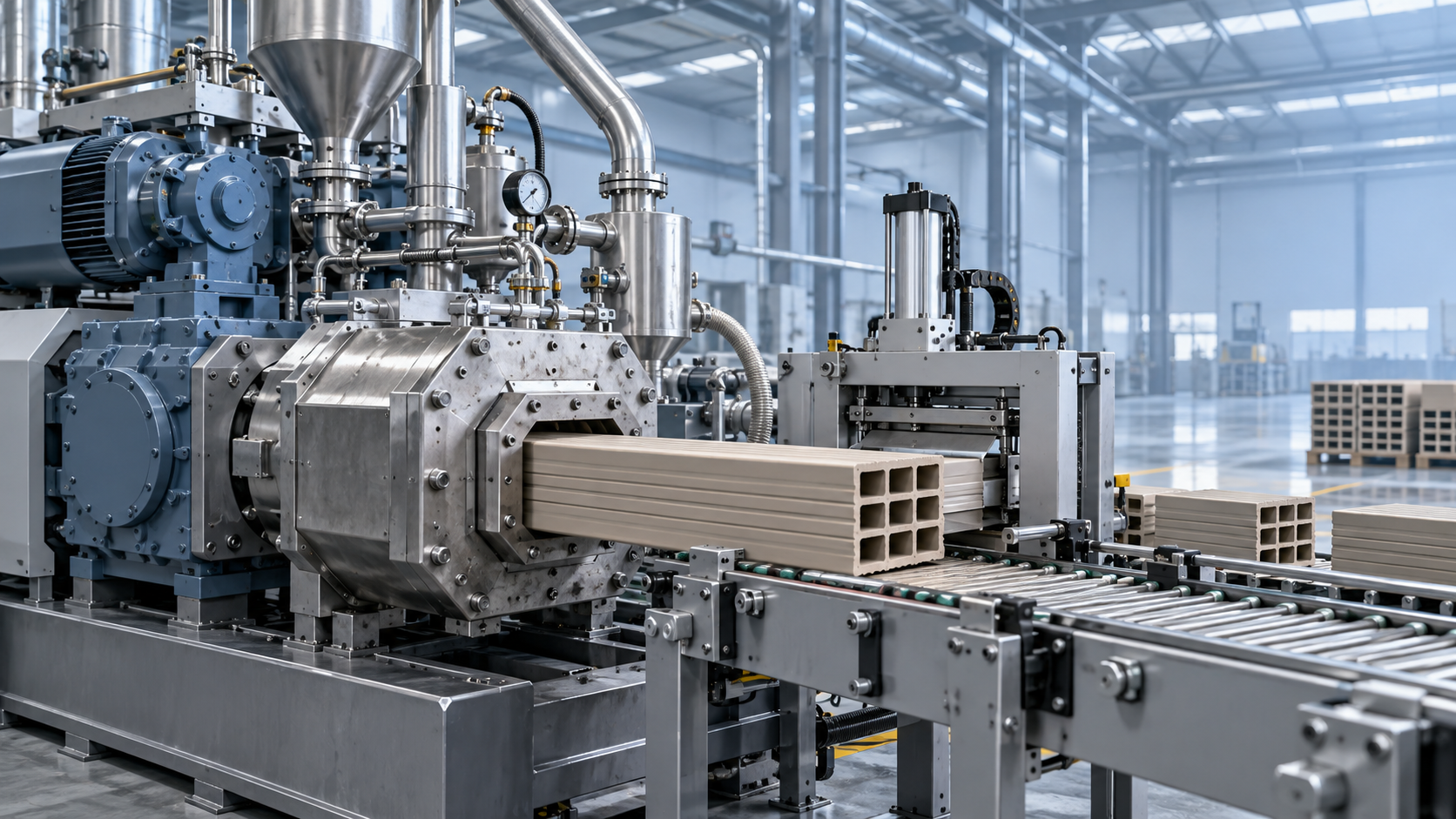
In lightweight material production, upstream and downstream matching often decides whether a machine performs well. Feed consistency, pre-mixing, storage buffering, cutter synchronization, palletizing rhythm, thermal treatment, dust return, and control logic all affect real performance. A strong extruder connected to a weak feed system will still behave like a weak line.
This is especially relevant when the plant handles silicate-based or mineral-heavy formulations where moisture, fineness, and temperature can shift process behavior quickly. In practice, the machine should be assessed as part of a controlled process chain.
That is also where intelligence sources such as CF-Elite can be useful, not as a product pitch, but as a reference layer. For teams evaluating equipment in new building material extrusion or adjacent thermal-process sectors, broader process intelligence can help benchmark what is technically normal, what is supplier positioning, and where energy-performance claims need more scrutiny.
Questions that reveal whether a supplier really understands the process
Some of the best evaluation work happens in the question list. Ask questions that are difficult to answer with generic brochures:
- What happens to throughput when feed moisture moves outside the preferred range?
- How does the machine maintain density consistency during long runs?
- Which wear parts most affect energy efficiency and product quality?
- How often does calibration or adjustment need to be done in normal operation?
- What is the expected reject pattern during startup and after changeover?
- Can the control system log process variables needed for troubleshooting and optimization?
Good answers usually include limits, trade-offs, and operating windows. Weak answers stay at the level of “stable,” “advanced,” or “high efficiency” without process detail.
Where buyers often misjudge cost
Purchase price still matters, but in this category it is often the least reliable indicator of value.
A cheaper machine may create higher lifetime cost through unstable product quality, higher scrap, greater operator dependence, and more downtime for cleaning or part replacement. On the other hand, a premium machine is not automatically the right choice if your product mix is simple, your volume is moderate, and the advanced control package will never be fully used.
The better approach is to compare total operating reality:
- Qualified output per shift
- kWh per ton of saleable product
- Maintenance interval and spare-part criticality
- Operator skill required to hold specification
- Expected process loss and rework rate
- Flexibility for future product changes
That last item deserves attention. If your plant may move into lower-density products, different sizes, or greener formulations, the machine should be checked for adjustment range, not only present-day fit. A very efficient machine with low recipe flexibility can become restrictive faster than expected.
When a machine is not suitable, even if the specs look good
Some equipment is simply mismatched to the job. That usually happens in four situations: the raw material varies too much for the machine’s control tolerance, the plant lacks supporting process discipline, the required product quality is tighter than the machine can consistently hold, or the expected output level assumes an operating environment the site cannot maintain.
For example, highly sensitive machinery may perform well in plants with strong automation, stable utilities, and disciplined maintenance. The same machine can struggle in facilities where moisture control is inconsistent or operator turnover is high. Selection should reflect the real operating culture of the plant, not only the ideal one described in a meeting room.
A practical way to make the final decision
If several machines remain on the shortlist, score them on a weighted basis rather than relying on general impressions. Most technical teams find it useful to rank each option across output stability, energy intensity, quality consistency, maintainability, process flexibility, and integration risk. The weights should match business reality. If energy cost is a major pressure, give that more weight. If customer claims from product inconsistency are the bigger pain point, quality stability should dominate.
Then test your decision against one simple question: Which machine will still be the preferred option after six months of ordinary plant conditions? That question removes a lot of presentation bias.
In the end, the right lightweight material machinery is the one that keeps qualified output predictable, controls unit energy use, and delivers consistent product properties without depending on constant intervention. That is what supports cost control, production planning, and customer confidence at the same time.
FAQ
Is nameplate capacity useful at all?
Yes, but only as a starting point. It helps screen options, not finalize a decision. Real selection should use stable saleable output under normal operating conditions.
What is the most overlooked metric in machinery evaluation?
Qualified output after rejects and downtime. Many teams compare theoretical throughput and miss the amount of product that actually meets specification.
Should energy be compared per hour or per ton?
Per ton of qualified product is usually the better metric. Hourly power use can be misleading when machines differ in reject rate or operating stability.
How important is supplier trial data?
Very important, but only if the test conditions are transparent. Ask what raw materials, moisture, product density, and operating duration were used.
When should a buyer reject an otherwise efficient machine?
If it only performs well within a narrow process window that your plant cannot reliably maintain, the efficiency advantage may not survive real production.
Image Placeholder Notes
- : Place near the section on energy use and quality interaction. Suggested image content: a process flow or comparison graphic showing output, specific energy consumption, and qualified product rate across evaluation stages. Alt text: “Framework for evaluating lightweight material machinery by output, energy use, and product quality.”
Internal Link Anchor Text Suggestions
- lightweight block production line evaluation: page about block or panel manufacturing equipment
- specific energy consumption in material extrusion: page about energy efficiency methods or metrics
- how to compare industrial extrusion equipment: equipment comparison or buyer’s guide page
- common quality defects in lightweight building materials: troubleshooting or quality-control page
- thermal process intelligence for building materials plants: industry insights or research page
External Source Directions
- industry association reports related to building materials machinery, extrusion systems, or energy efficiency benchmarking
- government or regulatory pages covering industrial energy management, emissions reporting, or equipment efficiency standards
- official technical documents from machinery manufacturers, including test methods, operating windows, and maintenance guidance
Related News
 Thermal Energy ArchitectEnergy-Efficient Silicate Production Lines: What to Compare Before SelectionSilicate production lines energy efficient selection guide: compare thermal performance, stability, emissions, controls, and lifecycle value before investing.Oct 06, 2026
 Optical Glass Tech FellowHow to Evaluate Automated Float Glass Lines for Capacity, Quality, and Energy UseEvaluate automated float glass lines for net capacity, consistent quality, energy efficiency, automation reliability, and lifecycle value. Explore key criteria for smarter investment decisions.Oct 05, 2026
 Thermal Energy ArchitectWhat Does CE Marking Require for an Energy-Efficient Industrial Kiln?Energy efficient kiln CE requirements explained: assess safety, technical files, energy performance, and EU compliance before purchase or commissioning.Oct 04, 2026
 Thermal Energy ArchitectRefractory Manufacturing Solutions for Brick Plants: How to Extend Kiln LifeRefractory manufacturing solutions for brick plant operations: discover proven strategies to extend kiln life, reduce heat loss, prevent lining failures, and plan cost-effective repairs.Oct 03, 2026
 Thermal Energy ArchitectHow to Specify Heavy Industrial Process Systems for High-Temperature PlantsHeavy industrial processes systems: learn how to specify high-temperature plants for efficiency, emissions control, maintainability, and lifecycle performance.Oct 02, 2026
 Structural Material AnalystHow Sustainable Material Extrusion Can Improve Wall Panel Durability and Design FlexibilityDiscover how sustainable material extrusion for wall panels improves durability, moisture resistance, design flexibility, and installation consistency for high-performing wall systems.Oct 01, 2026
 Thermal Energy ArchitectHow to Evaluate a High-Temperature Materials Manufacturer for Furnace ApplicationsChoose a high-temperature materials manufacturer with confidence: compare thermal performance, chemical resistance, quality controls, installation support, and lifecycle cost.Sep 30, 2026
 Ms. Elena RodriguezHow to Structure Global Specification Data for Faster Industrial Product EvaluationGlobal specification-oriented product information helps industrial teams compare capacity, energy, emissions, automation, and lifecycle data on a like-for-like basis for faster, confident equipment decisions.Sep 29, 2026
 Thermal Energy ArchitectHow to Specify High-Temperature Process Systems for Continuous Thermal OperationsHigh-temperature process engineering systems: learn how to specify resilient continuous thermal operations for efficiency, compliance, reliable uptime, and long-term performance.Sep 28, 2026
 Thermal Energy ArchitectHow to Evaluate a Thermal Engineering Contractor for High-Temperature Plant ProjectsChoose a thermal engineering contractor with proven process expertise, lifecycle value, emissions control, and delivery discipline for reliable high-temperature plant performance.Sep 27, 2026
 Silicate Process EngineerHow Latin American Cement Plants Can Reduce Dust Emissions in Kilns and Transfer PointsCement plant dust control Latin America: reduce kiln and transfer-point emissions with practical airflow, filtration, monitoring, and maintenance strategies.Sep 26, 2026
 Material Heat-Resist ExpertHow to Evaluate Refractory Production Lines for Output, Quality, and Energy UseRefractory production lines: learn how to assess qualified output, consistent quality, and total energy use for smarter, lower-risk investment decisions.Sep 25, 2026
 Dr. Alistair VaughnHow Waste Recycling Technology Improves Material Recovery in Industrial PlantsWaste recycling technology improves material recovery through source segregation, smart separation, thermal treatment, and quality control for industrial plants.Sep 24, 2026
 Optical Glass Tech FellowHow to Specify Glass Annealing Equipment for European Quality and Energy RequirementsGlass annealing equipment Europe: learn how to specify lehrs for consistent glass quality, energy efficiency, compliance, automation, and reliable long-term performance.Sep 23, 2026
 Optical Glass Tech FellowSilicate Process Automation: Improving Batch Consistency and Energy ControlSilicate process automation improves batch consistency, energy control, traceability, and operator confidence across high-temperature manufacturing operations.Sep 22, 2026
 Optical Glass Tech FellowHow Silicate Industrial Processes Control Viscosity, Energy Use, and Product QualitySilicate industrial processes: learn how viscosity, chemistry, heat transfer, and atmosphere control reduce energy use, improve stability, and protect product quality.Sep 21, 2026
 Thermal Energy ArchitectHow European Plants Can Evaluate Energy Recovery Equipment for High-Temperature ProcessesIndustrial energy recovery equipment Europe: learn how high-temperature plants can assess waste-heat sources, integration risks, lifecycle value, and reliable recovery routes.Sep 20, 2026
 Thermal Energy ArchitectIndustrial Furnace Process Optimization: Reducing Fuel Use Without Sacrificing ThroughputIndustrial process optimization furnace strategies that cut fuel use while protecting throughput. Explore combustion control, heat recovery, refractory performance, and data-driven efficiency gains.Sep 19, 2026
 Ms. Elena RodriguezWhat Drives High-Pressure Extrusion Equipment Cost in Industrial Projects?High pressure extrusion equipment cost explained: compare pressure, die design, automation, wear, energy, and installation factors for smarter industrial investments.Sep 18, 2026
 Thermal Energy ArchitectHow to Size a Waste Heat Recovery Exchanger for High-Temperature Kiln Exhaust?Waste heat recovery exchanger sizing for high-temperature kiln exhaust: balance recoverable duty, fouling, corrosion limits, pressure drop, and reliable heat use.Sep 17, 2026

Related News
- 00
0000-00
How Sustainable Material Extrusion Can Improve Wall Panel Durability and Design Flexibility - 00
0000-00
How to Evaluate Lightweight Material Machinery for Output, Energy Use, and Product Quality - 00
0000-00
What Thermal Barrier Technology Works Best for Lightweight Industrial Panels? - 00
0000-00
Advanced Ceramic Processing for Honeycomb: Which Methods Improve Strength and Thermal Shock Resistance? - 00
0000-00
Building Material Extrusion Equipment Supplier Selection: 7 Parameters That Affect Line Performance
Weekly Insights
Stay ahead with our curated technology reports delivered every Monday.