
How to Evaluate a High-Temperature Materials Manufacturer for Furnace Applications




Furnace materials should be evaluated against the real thermal, chemical, and mechanical conditions at each lining zone, then priced over their expected service life. A low unit price can become the expensive choice when premature wear causes unplanned shutdowns, excessive heat loss, contamination, or difficult demolition. The useful question is not whether a material is rated for a high temperature in isolation; it is whether the proposed grade, shape, installation method, and production controls fit the furnace’s operating profile.
Start with a written application brief before requesting quotations. It should identify the furnace type, process material, operating temperature range, heat-up and cool-down pattern, atmosphere, likely chemical attack, lining thickness, existing failure locations, and installation constraints. A rotary kiln burning alternative fuels, a glass forehearth, a heat-treatment furnace, and an incinerator may all operate at elevated temperatures, yet their material requirements differ sharply. Without this context, suppliers often quote a familiar catalog grade rather than a defensible lining solution.
Read temperature data in context
Maximum service temperature is useful as a screening figure, but it is often overinterpreted. It does not confirm resistance to load, rapid cycling, abrasion, alkali vapor, slag penetration, or reducing gases. A material that remains stable in a laboratory furnace at a stated temperature may deform or crack in a loaded wall exposed to repeated burner cycling.
Ask for the temperature at the hot face, the expected temperature gradient through the lining, and the duration at peak temperature. A continuous operation with a steady profile places different demands on the material than a batch furnace that is opened frequently. Thermal shock resistance becomes more significant where charging doors open, cold feed enters intermittently, or burner control produces rapid temperature swings. In these positions, a dense material with excellent hot strength can fail sooner than a more thermally tolerant grade.
Heat conductivity also needs a zone-specific interpretation. Lower conductivity can reduce shell temperature and fuel demand in an insulating backup layer, while a hot-face lining may require density, abrasion resistance, and structural strength that insulation cannot provide. Treating every layer as a search for the lowest conductivity can lead to an unstable working lining. Conversely, choosing a dense backup where insulation is required may raise heat losses throughout the campaign.
Separate material ratings from installed performance
A credible proposal distinguishes between tested material properties and the expected behavior of the installed lining. Ask which values apply to fired shapes, castables after dry-out, precast components, or rammed materials. Moisture removal, curing conditions, anchor design, joint geometry, and local heating rates affect the result after installation. A castable data sheet cannot substitute for a dry-out schedule or an explanation of how the proposed lining accommodates expansion.
Map the attack mechanism before comparing grades
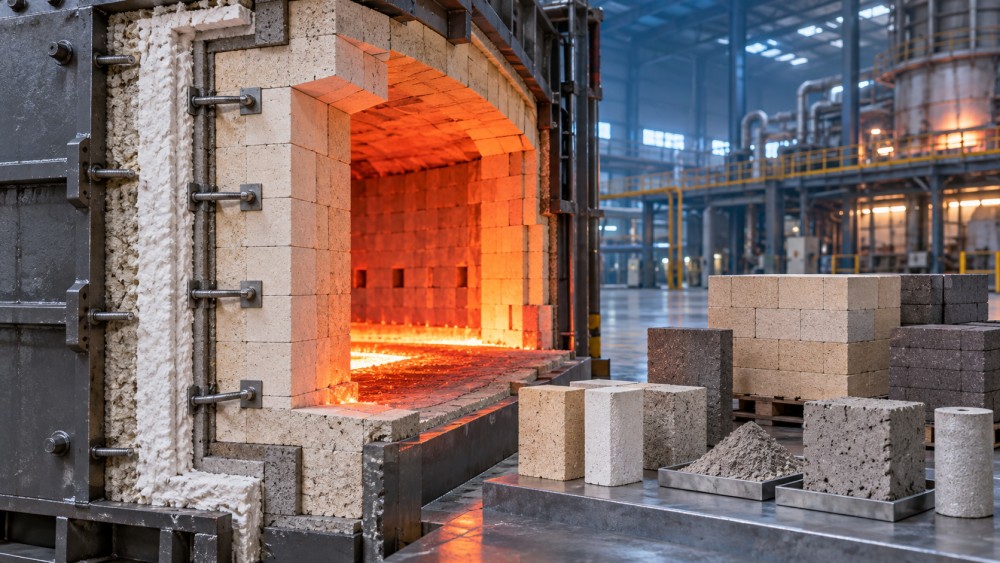
Furnace damage is rarely caused by temperature alone. The chemical composition and physical state of the process medium determine whether corrosion, penetration, erosion, spalling, or structural creep will dominate. These mechanisms can occur together, but the primary mechanism should guide the material selection.
Process chemistry should be described in operational terms, not only as a generic “corrosive environment.” In cement and lime kilns, alkali, chloride, sulfur, and coating behavior can determine which refractory chemistry is appropriate. In waste incineration, ash composition and volatile salts can attack joints and exposed surfaces. Glass contact applications require attention to contamination and corrosion by the specific glass composition. In metal-processing furnaces, the interaction of scale, slag, fluxes, and atmosphere may change between zones.
Where deposits have been sampled after a campaign, their composition and location are valuable evidence. A material supplier that asks for failure samples, photographs of the worn profile, operating records, and previous lining data is taking a more technically grounded approach than one that relies only on nominal temperature. Samples should be interpreted carefully: a deposit collected after cooling may not perfectly represent its molten state, but it can still reveal the elements driving corrosion.
Examine production consistency, not just sample quality
High-temperature materials are sensitive to raw-material selection, particle-size distribution, mixing, forming pressure, firing profile, and quality inspection. Two products sold under a similar name can differ in density, porosity, dimensional tolerance, or mineral phase development. These differences affect installation fit and service behavior, especially in large linings where small variations accumulate across many units.
Request the proposed grade’s technical data sheet together with the manufacturer’s acceptance criteria for the properties that matter in the application. The objective is to understand the controlled range, not simply to receive a favorable single value. For shaped refractories, examine dimensional tolerances, bulk density, apparent porosity, cold crushing strength, permanent linear change, and thermal expansion where relevant. For monolithic products, include water addition range, working time, curing procedure, dry-out profile, installed bulk density, and storage life.
Traceability deserves particular attention when the furnace contains several zones or when a lining failure has serious production consequences. Packaging and delivery documents should allow a batch to be identified later. This enables investigation if a problem emerges and avoids mixing materials with different installation dates or storage histories. Bagged castables exposed to moisture, aged beyond their stated shelf period, or stored in uncontrolled conditions may not develop the expected strength even when the formulation itself is suitable.
Factory capability matters most when the order includes special shapes, tight jointing, precast components, or large volumes delivered in stages. Ask how drawings are reviewed, how shapes are inspected before dispatch, and how substitutions are controlled. A change in aggregate source, binder system, or shape geometry should not enter the order without written technical review. This is especially important when an existing furnace lining was designed around a specific expansion allowance or interlocking brick pattern.
Test the proposal against the furnace geometry
Materials do not perform independently of the lining design. Brick selection, joint thickness, expansion joints, anchor layout, wear allowance, and transitions between dense and insulating layers must work together. A technically strong material can fail through mechanical restraint, unsupported overhangs, poor anchor spacing, or a sudden change in stiffness between adjoining sections.
For shaped linings, confirm that the proposed dimensions suit the furnace radius, shell ovality, and available tolerances. In rotary equipment, the brick design must account for movement, coating behavior, and local mechanical loading. For monolithic linings, determine whether site mixing, pumping, vibration, gunning, or casting is planned. These methods can produce different densities and water contents. A laboratory-tested castable placed with excess water or inadequate vibration will not match the published performance.
Installation support should be evaluated as a defined deliverable. Useful support includes a method statement, anchor recommendations where applicable, cure and dry-out requirements, inspection points, and a named technical contact during start-up. Vague assurances of field assistance are weaker than a clear description of what will be reviewed, when it will be reviewed, and which site records are needed before heat-up.
Build lifecycle cost from failure consequences
Material price, freight, installation labor, energy loss, maintenance interruptions, demolition, and disposal all belong in the commercial comparison. The relative weight of these costs changes by furnace. A short maintenance window may justify a precast or faster-setting solution even if the delivered material cost is higher. A continuously operating process may place much greater value on lining stability and predictable campaign planning than on an initial price reduction.
Compare offers on a common basis. Normalize the material quantity to installed volume or lining area at the specified thickness, then include associated items such as anchors, mortars, backup insulation, special shapes, packaging, and technical attendance. A quotation that omits these elements can appear favorable until installation begins. For dense products, freight and handling costs also deserve attention because weight affects both logistics and site access.
Service-life claims should be treated as engineering hypotheses tied to stated operating conditions. Ask what assumptions support the estimate: temperature, atmosphere, throughput, cleaning practice, heating rate, and expected chemical exposure. If the assumptions do not match the actual furnace, the estimate cannot be used for a meaningful cost comparison. A supplier should also explain the anticipated end-of-life mode, whether gradual wear, cracking, joint opening, or corrosion, because each one affects inspection planning and shutdown risk differently.
Use technical clarification to reveal capability
The quality of pre-award questions often provides better evidence than polished brochures. Strong technical engagement links each proposed grade to a specific zone and explains any uncertainty. It identifies missing information, flags incompatible operating conditions, and distinguishes between a proven standard configuration and a solution requiring trials or additional analysis.
- Ask for a zone-by-zone material schedule rather than one generic grade for the entire furnace.
- Where failure history exists, request an explanation of the probable mechanism and how the new proposal changes that mechanism.
- Clarify required site conditions: substrate preparation, ambient temperature limits, water quality for castables, curing time, and the sequence for heat-up.
- Review replacement and emergency supply arrangements for critical shapes, but ensure substitute materials require technical approval before shipment.
Energy efficiency requirements should be considered through measurable design choices: lining thickness, backup insulation, shell-temperature control, heat leakage at openings, and the durability of those features over time. A lining that insulates well initially but deteriorates rapidly at joints or around penetrations may not preserve its thermal performance. Any compliance statement should be supported by documentation applicable to the equipment location and project scope, rather than assumed from a material’s general description.
Final selection is strongest when the technical scope, commercial scope, and installation scope describe the same furnace condition. The selected high-temperature materials manufacturer should be able to show how its material data, production controls, delivery condition, and field requirements connect to the expected duty. That connection turns a material quotation into a usable basis for controlling downtime and lifecycle cost.
Related News
 Thermal Energy ArchitectHow to Evaluate a High-Temperature Materials Manufacturer for Furnace ApplicationsChoose a high-temperature materials manufacturer with confidence: compare thermal performance, chemical resistance, quality controls, installation support, and lifecycle cost.Sep 30, 2026
 Ms. Elena RodriguezHow to Structure Global Specification Data for Faster Industrial Product EvaluationGlobal specification-oriented product information helps industrial teams compare capacity, energy, emissions, automation, and lifecycle data on a like-for-like basis for faster, confident equipment decisions.Sep 29, 2026
 Thermal Energy ArchitectHow to Specify High-Temperature Process Systems for Continuous Thermal OperationsHigh-temperature process engineering systems: learn how to specify resilient continuous thermal operations for efficiency, compliance, reliable uptime, and long-term performance.Sep 28, 2026
 Thermal Energy ArchitectHow to Evaluate a Thermal Engineering Contractor for High-Temperature Plant ProjectsChoose a thermal engineering contractor with proven process expertise, lifecycle value, emissions control, and delivery discipline for reliable high-temperature plant performance.Sep 27, 2026
 Silicate Process EngineerHow Latin American Cement Plants Can Reduce Dust Emissions in Kilns and Transfer PointsCement plant dust control Latin America: reduce kiln and transfer-point emissions with practical airflow, filtration, monitoring, and maintenance strategies.Sep 26, 2026
 Material Heat-Resist ExpertHow to Evaluate Refractory Production Lines for Output, Quality, and Energy UseRefractory production lines: learn how to assess qualified output, consistent quality, and total energy use for smarter, lower-risk investment decisions.Sep 25, 2026
 Dr. Alistair VaughnHow Waste Recycling Technology Improves Material Recovery in Industrial PlantsWaste recycling technology improves material recovery through source segregation, smart separation, thermal treatment, and quality control for industrial plants.Sep 24, 2026
 Optical Glass Tech FellowHow to Specify Glass Annealing Equipment for European Quality and Energy RequirementsGlass annealing equipment Europe: learn how to specify lehrs for consistent glass quality, energy efficiency, compliance, automation, and reliable long-term performance.Sep 23, 2026
 Optical Glass Tech FellowSilicate Process Automation: Improving Batch Consistency and Energy ControlSilicate process automation improves batch consistency, energy control, traceability, and operator confidence across high-temperature manufacturing operations.Sep 22, 2026
 Optical Glass Tech FellowHow Silicate Industrial Processes Control Viscosity, Energy Use, and Product QualitySilicate industrial processes: learn how viscosity, chemistry, heat transfer, and atmosphere control reduce energy use, improve stability, and protect product quality.Sep 21, 2026
 Thermal Energy ArchitectHow European Plants Can Evaluate Energy Recovery Equipment for High-Temperature ProcessesIndustrial energy recovery equipment Europe: learn how high-temperature plants can assess waste-heat sources, integration risks, lifecycle value, and reliable recovery routes.Sep 20, 2026
 Thermal Energy ArchitectIndustrial Furnace Process Optimization: Reducing Fuel Use Without Sacrificing ThroughputIndustrial process optimization furnace strategies that cut fuel use while protecting throughput. Explore combustion control, heat recovery, refractory performance, and data-driven efficiency gains.Sep 19, 2026
 Ms. Elena RodriguezWhat Drives High-Pressure Extrusion Equipment Cost in Industrial Projects?High pressure extrusion equipment cost explained: compare pressure, die design, automation, wear, energy, and installation factors for smarter industrial investments.Sep 18, 2026
 Thermal Energy ArchitectHow to Size a Waste Heat Recovery Exchanger for High-Temperature Kiln Exhaust?Waste heat recovery exchanger sizing for high-temperature kiln exhaust: balance recoverable duty, fouling, corrosion limits, pressure drop, and reliable heat use.Sep 17, 2026
 Thermal Energy ArchitectWhy Heat-Resistant Materials Lose Abrasion Resistance at High TemperaturesHeat-resistant materials abrasion resistance can decline at high temperatures. Discover the thermal, chemical, and mechanical causes of wear—and how to choose longer-lasting linings.Sep 16, 2026
 Thermal Energy ArchitectHow to Evaluate a Thermal Energy Optimization Company for High-Temperature PlantsChoose a thermal energy optimization company with proven process expertise, measurable savings, and reliable delivery for high-temperature plants. Learn what to assess.Sep 15, 2026
 Thermal Energy ArchitectRotary Kiln Efficiency: How Feed Rate, Fuel Use, and Heat Loss Affect OutputRotary kiln efficiency explained: discover how feed rate, fuel use, heat loss, combustion, and cooling performance shape output, quality, and energy costs.Sep 14, 2026
 Thermal Energy ArchitectHow to Select Heat-Resistant Materials That Maintain Abrasion Resistance in KilnsHeat-resistant materials abrasion resistance: learn how to select kiln linings that withstand heat, wear, thermal cycling, and chemical attack for longer service life.Sep 13, 2026
 Thermal Energy ArchitectHow Rotary Kiln Automation Improves Temperature Control and Fuel EfficiencyRotary kiln technology automation enhances temperature control, stabilizes combustion, and improves fuel efficiency with smarter data, predictive control, and safer operations.Sep 12, 2026
 Silicate Process EngineerCement Plant Emission Control: Selecting Systems for Dust, NOx, and SO2 LimitsCement plant emission control guide: compare dust collectors, NOx reduction, and SO2 systems for reliable compliance across kiln modes, fuel changes, and operating upsets.Sep 11, 2026


Related News
- 00
0000-00
How to Evaluate a High-Temperature Materials Manufacturer for Furnace Applications - 00
0000-00
How to Specify High-Temperature Process Systems for Continuous Thermal Operations - 00
0000-00
How to Evaluate a Thermal Engineering Contractor for High-Temperature Plant Projects - 00
0000-00
How European Plants Can Evaluate Energy Recovery Equipment for High-Temperature Processes - 00
0000-00
Industrial Furnace Process Optimization: Reducing Fuel Use Without Sacrificing Throughput
Weekly Insights
Stay ahead with our curated technology reports delivered every Monday.