
How Sustainable Material Extrusion Can Improve Wall Panel Durability and Design Flexibility




A wall-panel package can appear sound at design review and still create problems once it reaches the site: corners chip during handling, long boards show slight bowing, joints do not align cleanly, or a finish cracks after repeated heat and moisture cycles. These issues are rarely solved by choosing a thicker panel alone. They usually begin with the interaction between material formulation, profile geometry, production control, and the conditions the finished wall will face.
Sustainable material extrusion for wall panels can improve durability and design flexibility when it is treated as a controlled system rather than simply a lower-waste manufacturing method. Extrusion allows a formulated material to be shaped into a consistent continuous profile, with reinforcement, cavities, surface features, and connection details considered before production. The practical benefit is not that every extruded panel will automatically last longer; it is that a properly specified process gives the project team more control over the factors that cause cracking, deformation, water-related damage, and installation inconsistency.
Start with the failure mode, not the panel appearance
Wall panels are often selected from samples viewed under stable indoor conditions. The panel may look rigid, smooth, and well finished, yet the project may later expose it to impact near circulation routes, fastener loads at support points, thermal cycling behind a rainscreen, or persistent moisture in wet rooms. A sustainable extrusion route should be evaluated against these real service conditions before profile drawings are finalized.
The first question is not “Which recycled or low-impact material is available?” It is “What must this panel resist throughout its intended life?” Exterior cladding, interior partitions, utility enclosures, acoustic liners, and ventilated façade elements place different demands on the same basic profile. A board that performs adequately as a protected interior finish may not have the dimensional stability, UV resistance, drainage strategy, or impact tolerance needed for an exposed wall system.
A useful early review separates the likely risks into four groups:
- Mechanical exposure: handling damage, point impact, wind-related loading, fastener pull-through, or support-span deflection.
- Moisture exposure: rain ingress, condensation, wash-down, freeze-thaw conditions, or moisture retained at joints.
- Thermal movement: daily surface-temperature swings, localized heat gain, or movement where panels meet dissimilar materials.
- Visual and functional requirements: flatness, joint regularity, texture, fire-related performance requirements, acoustics, insulation space, and maintainability.
Once these risks are defined, material extrusion becomes a means of engineering the panel cross-section and manufacturing consistency around them. It is not a substitute for a suitable substructure, drainage plane, expansion design, or installation procedure.
Why extrusion can create a more durable wall panel
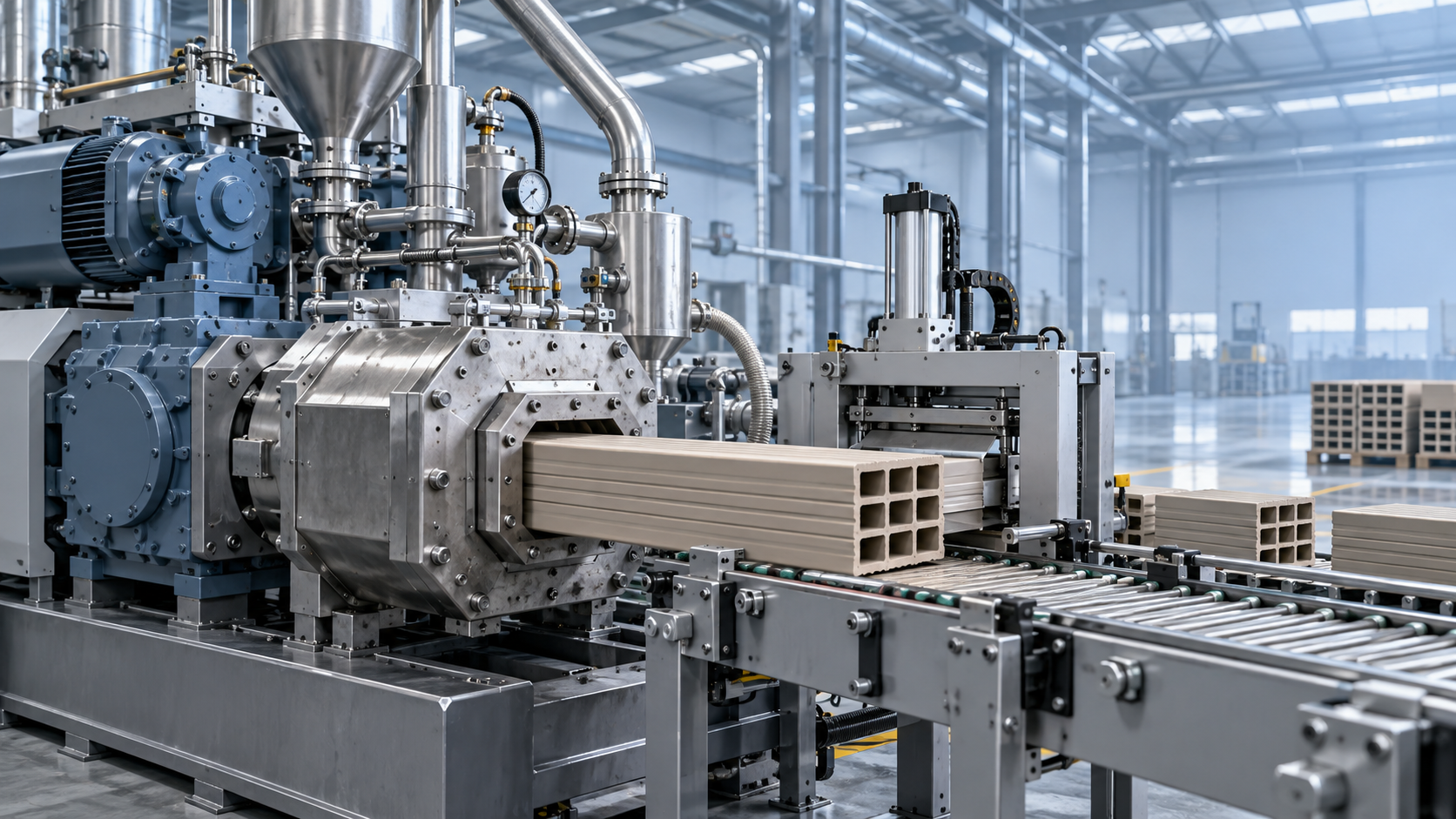
In an extrusion process, a conditioned material mix is pushed through a die that defines the panel profile. Depending on the material system, the feedstock may contain mineral fillers, binders, fibers, recycled constituents, pigments, additives, or lightweight components. The important point for durability is that the profile is formed continuously under controlled pressure and shape constraints. This can reduce variation from panel to panel when feed preparation, moisture level, extrusion pressure, die condition, and curing or cooling are kept within the intended operating range.
Consistency matters because weak points are often created by variation rather than by the nominal design. A panel may have sufficient average strength but still develop isolated defects where material distribution is uneven, fiber dispersion is poor, a hollow section has a thin wall, or a local stress concentration was overlooked. These defects can show up later as edge cracking, screw-zone damage, surface checking, or unwanted distortion.
Profile geometry can carry part of the structural work
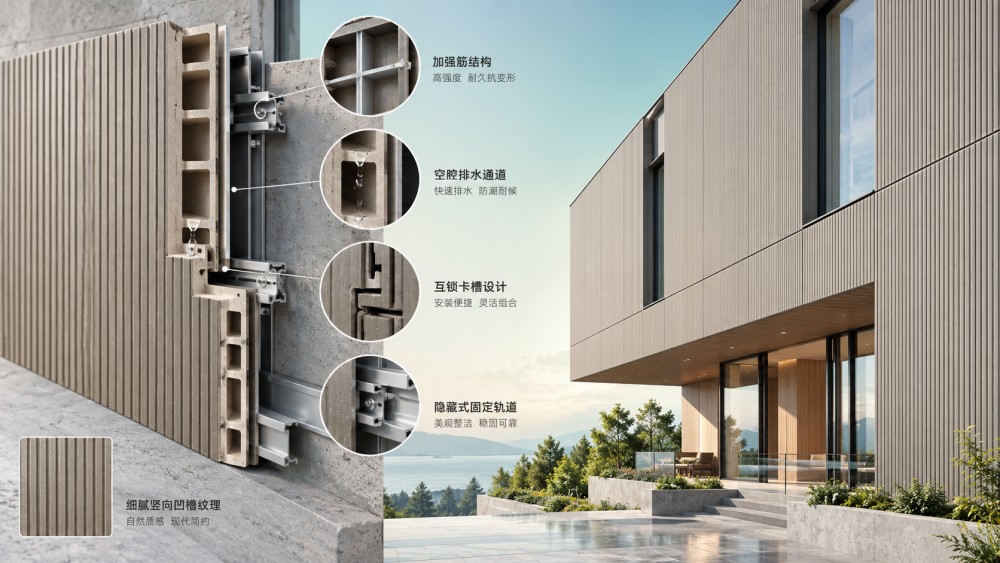
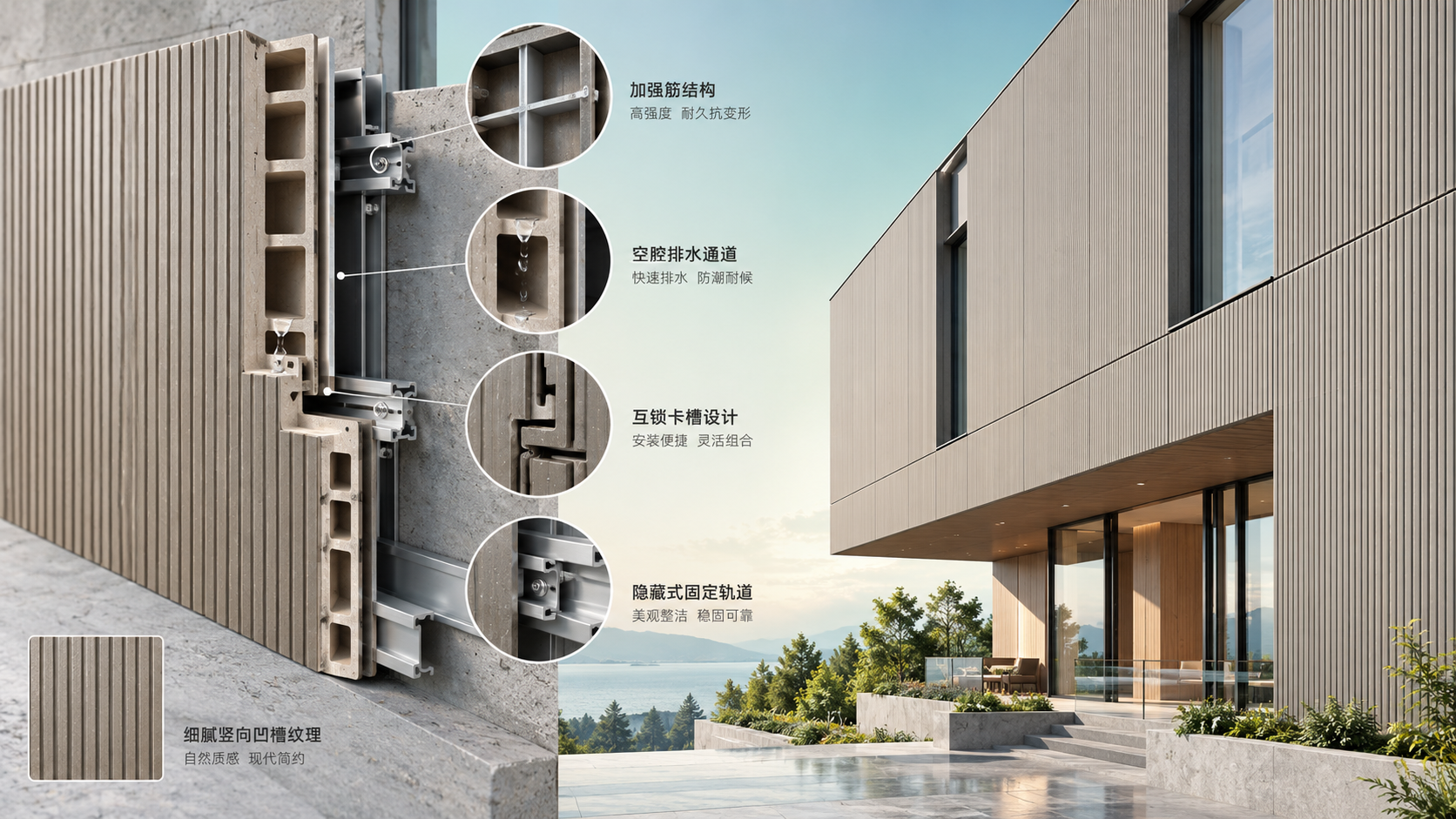
A flat solid board is not the only possible extruded form. A profile can incorporate ribs, internal webs, tongue-and-groove edges, concealed fixing channels, drainage features, or cavities for services and insulation. Used carefully, these details can improve stiffness without relying solely on more material thickness. That can reduce material consumption while maintaining the performance required at the installed span.
However, more complex geometry is not always better. Thin ribs can be vulnerable during cutting or fastening. Deep cavities may trap moisture if joint and drainage details are poorly designed. Sharp internal corners can concentrate stress, especially where panels are exposed to movement. The profile should therefore be reviewed as an installed component, not only as a cross-section that looks efficient on a drawing.
When evaluating a proposed profile, inspect the following areas closely:
- Minimum wall thickness at corners, grooves, and fastener zones.
- Whether ribs are positioned to resist the actual direction of bending.
- How loads transfer from the face of the panel into the support system.
- Whether cut edges, penetrations, and panel ends remain protected after installation.
- How water can drain or dry from cavities, joints, and interfaces.
- Whether the geometry allows realistic access for fixing, alignment, cleaning, and replacement.
A profile that supports controlled movement and predictable fixing is often more durable in service than a heavier panel that relies on sealant, field trimming, or excessive fastening to compensate for weak detailing.
Material sustainability must not introduce hidden durability risks
Lower-impact material choices can include recycled mineral content, recycled polymer fractions, industrial by-products, bio-based additives, or formulations designed to reduce waste during manufacture. These choices should be assessed according to how they affect the panel’s actual behavior, not only according to their origin.
For example, recycled inputs can vary in particle size, moisture condition, contamination level, color, and chemical composition. In a controlled formulation, those variables may be managed successfully. Without that control, they can affect melt flow, compaction, cure behavior, surface appearance, water uptake, and long-term stability. A project specification should therefore ask for consistency controls on incoming material and production batches rather than assuming that a declared recycled content guarantees uniform panel quality.
Mineral-based extruded panels may offer stiffness, dimensional stability, and resistance to biological degradation, but they can still be sensitive to curing conditions, moisture movement, and edge damage. Polymer-rich profiles may offer lower water absorption and impact resilience, yet they may require more attention to thermal expansion, surface heat exposure, UV protection, and fire-performance requirements. Composite formulations can balance characteristics, but the bond between phases becomes important. If the matrix, fillers, and reinforcement respond differently to heat or moisture, repeated cycling can gradually create internal stresses.
Durability review should focus on material behavior at the edges of use. Ask how the formulation responds to wet-dry cycling, temperature changes, repeated fastening loads, surface abrasion, cutting, and the cleaning agents expected in the building. A smooth sample alone does not answer these questions.
Design freedom works best when tolerances are designed in early
Extrusion is particularly useful where the wall system needs a repeatable visual language: linear ribs, fluted surfaces, shiplap forms, narrow reveals, integrated battens, curved transitions, or custom panel widths. Because the die controls the profile, features can be incorporated into the panel instead of added later through secondary machining. This can reduce trimming waste and simplify some assembly steps.
Yet design freedom introduces a coordination issue. Repeated visual features make small dimensional variation more visible. A deep shadow line that looks precise in a rendering can reveal minor alignment differences across a long elevation. Long slender panels can also show movement more clearly than shorter modules. The right response is not necessarily to abandon the design; it is to coordinate panel length, fixing locations, expected expansion, joint width, and substrate tolerance as a single package.
Long panels should be assessed for transport and lifting as early as their architectural appearance. A profile that is stable once fixed can still be vulnerable while unsupported during storage, movement, or installation. Define pallet support points, lifting orientation, permitted stack height, and acceptable handling methods before panels arrive on site. Damage introduced before installation is often mistaken for a production defect.
Process control is where durability becomes repeatable
Durable extruded panels depend on stable production conditions. Even a sound material recipe can produce inconsistent results when feedstock moisture changes, mixing is incomplete, die temperature fluctuates, cooling is uneven, or cutters are misaligned. For a project team, the useful task is not to prescribe every factory setting. It is to identify the production controls that affect the specified properties and confirm that they are documented for the chosen panel type.
Material preparation deserves particular attention. Fine materials, fibers, fillers, and recycled fractions need appropriate distribution in the mix. Lumps, dry pockets, excess moisture, or poorly dispersed reinforcement can create local weak zones that are difficult to identify after the surface is finished. The extrusion stage must then shape the material without introducing voids, tearing the profile, or creating uneven density across the section.
Post-extrusion treatment is equally important. Some materials require controlled cooling; others require curing, drying, or conditioning before they are handled and finished. Rushing this stage can leave residual moisture or internal stress. Later, the panel may warp, shrink, crack near details, or change dimension after installation. Where coatings, laminates, or surface treatments are used, adhesion and compatibility must be reviewed against expected service exposure rather than treated as a separate cosmetic choice.
Use samples as a verification tool, not a styling exercise
Before committing to full production, request samples that represent the actual profile, intended finish, edge condition, fixing approach, and relevant panel length where feasible. Small coupons are useful for color and texture, but they cannot reveal all issues related to bowing, fastening, joint engagement, or long-profile handling.
The review should include the project’s actual interface conditions: support rails or framing, insulation thickness where relevant, corner details, openings, terminations, and panel joints. A simple mock-up can expose whether a concealed fixing system leaves enough adjustment, whether a profile tolerates normal installation variation, or whether a cut edge needs a defined treatment. It is more efficient to revise a profile or joint detail before die finalization than after panels have been produced.
Installation decisions can preserve or undo the panel’s advantages
A well-extruded panel can fail prematurely when site installation restrains natural movement, places fasteners too close to vulnerable edges, or leaves water paths unresolved. The installation method should match the profile’s intended load path. Do not assume that a panel designed for concealed clips will behave the same way when face-fixed in the field, or that a hollow profile can accept arbitrary screw locations without local crushing.
Movement allowances should be addressed at joints, ends, corners, and transitions to other materials. The required allowance depends on the material system, panel length, exposure, and temperature range, so it should be established for the actual wall build-up. Sealants also need compatible substrates, adequate joint geometry, and a drainage strategy. A sealed joint is not automatically a durable joint if water can enter behind the panel and cannot escape.
Field cutting deserves a defined procedure. Cutting can expose internal cells, disrupt a protective finish, create burrs, or alter the fit of an interlocking edge. Identify which edges may be cut, how they are to be supported, whether exposed cavities require closure, and how dust or offcuts will be managed. This is especially relevant to sustainable material extrusion for wall panels because waste reduction is weakened when complex profiles are trimmed incorrectly or rejected due to preventable site damage.
Make the specification performance-led
Instead of specifying an extruded wall panel primarily by appearance, thickness, and nominal composition, connect the specification to the risks identified for the installation. Define the required profile dimensions and tolerances, permitted visual variation, relevant mechanical and environmental performance criteria, fixing method, maximum unsupported span where applicable, edge treatment, storage conditions, and installation limitations.
It also helps to state which substitutions require review. A change in recycled-content source, filler grade, pigment system, reinforcement, coating, or profile geometry can affect behavior even when the visible panel appears similar. The goal is not to block responsible material optimization; it is to ensure that changes affecting the installed wall are assessed before they become a site issue.
The strongest outcome comes from linking formulation, profile design, production control, and installation detail from the outset. That connection allows an extruded panel to use material more efficiently while giving designers useful formal freedom and giving the completed wall a better chance of retaining its alignment, finish, and protective function over time.
Related News
 Structural Material AnalystHow Sustainable Material Extrusion Can Improve Wall Panel Durability and Design FlexibilityDiscover how sustainable material extrusion for wall panels improves durability, moisture resistance, design flexibility, and installation consistency for high-performing wall systems.Oct 01, 2026
 Thermal Energy ArchitectHow to Evaluate a High-Temperature Materials Manufacturer for Furnace ApplicationsChoose a high-temperature materials manufacturer with confidence: compare thermal performance, chemical resistance, quality controls, installation support, and lifecycle cost.Sep 30, 2026
 Ms. Elena RodriguezHow to Structure Global Specification Data for Faster Industrial Product EvaluationGlobal specification-oriented product information helps industrial teams compare capacity, energy, emissions, automation, and lifecycle data on a like-for-like basis for faster, confident equipment decisions.Sep 29, 2026
 Thermal Energy ArchitectHow to Specify High-Temperature Process Systems for Continuous Thermal OperationsHigh-temperature process engineering systems: learn how to specify resilient continuous thermal operations for efficiency, compliance, reliable uptime, and long-term performance.Sep 28, 2026
 Thermal Energy ArchitectHow to Evaluate a Thermal Engineering Contractor for High-Temperature Plant ProjectsChoose a thermal engineering contractor with proven process expertise, lifecycle value, emissions control, and delivery discipline for reliable high-temperature plant performance.Sep 27, 2026
 Silicate Process EngineerHow Latin American Cement Plants Can Reduce Dust Emissions in Kilns and Transfer PointsCement plant dust control Latin America: reduce kiln and transfer-point emissions with practical airflow, filtration, monitoring, and maintenance strategies.Sep 26, 2026
 Material Heat-Resist ExpertHow to Evaluate Refractory Production Lines for Output, Quality, and Energy UseRefractory production lines: learn how to assess qualified output, consistent quality, and total energy use for smarter, lower-risk investment decisions.Sep 25, 2026
 Dr. Alistair VaughnHow Waste Recycling Technology Improves Material Recovery in Industrial PlantsWaste recycling technology improves material recovery through source segregation, smart separation, thermal treatment, and quality control for industrial plants.Sep 24, 2026
 Optical Glass Tech FellowHow to Specify Glass Annealing Equipment for European Quality and Energy RequirementsGlass annealing equipment Europe: learn how to specify lehrs for consistent glass quality, energy efficiency, compliance, automation, and reliable long-term performance.Sep 23, 2026
 Optical Glass Tech FellowSilicate Process Automation: Improving Batch Consistency and Energy ControlSilicate process automation improves batch consistency, energy control, traceability, and operator confidence across high-temperature manufacturing operations.Sep 22, 2026
 Optical Glass Tech FellowHow Silicate Industrial Processes Control Viscosity, Energy Use, and Product QualitySilicate industrial processes: learn how viscosity, chemistry, heat transfer, and atmosphere control reduce energy use, improve stability, and protect product quality.Sep 21, 2026
 Thermal Energy ArchitectHow European Plants Can Evaluate Energy Recovery Equipment for High-Temperature ProcessesIndustrial energy recovery equipment Europe: learn how high-temperature plants can assess waste-heat sources, integration risks, lifecycle value, and reliable recovery routes.Sep 20, 2026
 Thermal Energy ArchitectIndustrial Furnace Process Optimization: Reducing Fuel Use Without Sacrificing ThroughputIndustrial process optimization furnace strategies that cut fuel use while protecting throughput. Explore combustion control, heat recovery, refractory performance, and data-driven efficiency gains.Sep 19, 2026
 Ms. Elena RodriguezWhat Drives High-Pressure Extrusion Equipment Cost in Industrial Projects?High pressure extrusion equipment cost explained: compare pressure, die design, automation, wear, energy, and installation factors for smarter industrial investments.Sep 18, 2026
 Thermal Energy ArchitectHow to Size a Waste Heat Recovery Exchanger for High-Temperature Kiln Exhaust?Waste heat recovery exchanger sizing for high-temperature kiln exhaust: balance recoverable duty, fouling, corrosion limits, pressure drop, and reliable heat use.Sep 17, 2026
 Thermal Energy ArchitectWhy Heat-Resistant Materials Lose Abrasion Resistance at High TemperaturesHeat-resistant materials abrasion resistance can decline at high temperatures. Discover the thermal, chemical, and mechanical causes of wear—and how to choose longer-lasting linings.Sep 16, 2026
 Thermal Energy ArchitectHow to Evaluate a Thermal Energy Optimization Company for High-Temperature PlantsChoose a thermal energy optimization company with proven process expertise, measurable savings, and reliable delivery for high-temperature plants. Learn what to assess.Sep 15, 2026
 Thermal Energy ArchitectRotary Kiln Efficiency: How Feed Rate, Fuel Use, and Heat Loss Affect OutputRotary kiln efficiency explained: discover how feed rate, fuel use, heat loss, combustion, and cooling performance shape output, quality, and energy costs.Sep 14, 2026
 Thermal Energy ArchitectHow to Select Heat-Resistant Materials That Maintain Abrasion Resistance in KilnsHeat-resistant materials abrasion resistance: learn how to select kiln linings that withstand heat, wear, thermal cycling, and chemical attack for longer service life.Sep 13, 2026
 Thermal Energy ArchitectHow Rotary Kiln Automation Improves Temperature Control and Fuel EfficiencyRotary kiln technology automation enhances temperature control, stabilizes combustion, and improves fuel efficiency with smarter data, predictive control, and safer operations.Sep 12, 2026

Related News
- 00
0000-00
How Sustainable Material Extrusion Can Improve Wall Panel Durability and Design Flexibility - 00
0000-00
How to Evaluate Lightweight Material Machinery for Output, Energy Use, and Product Quality - 00
0000-00
What Thermal Barrier Technology Works Best for Lightweight Industrial Panels? - 00
0000-00
Advanced Ceramic Processing for Honeycomb: Which Methods Improve Strength and Thermal Shock Resistance? - 00
0000-00
Building Material Extrusion Equipment Supplier Selection: 7 Parameters That Affect Line Performance
Weekly Insights
Stay ahead with our curated technology reports delivered every Monday.