
What Causes Thermal Shock Failure in Heat-Resistant Materials During Development?




In heat-resistant material development, thermal shock is often the hidden trigger behind early cracking, spalling, and test failure. For technical evaluators, understanding what causes thermal shock failure in heat-resistant materials is essential to judging formulation stability, kiln suitability, and long-term operating risk. A sample may pass room-temperature strength checks and still break down the moment it faces a sharp startup ramp, emergency air ingress, burner fluctuation, or quench event. That gap between laboratory promise and operating reality is where thermal shock earns its reputation.
The difficulty is that thermal shock failure rarely comes from a single flaw. It usually develops from the interaction of thermal gradients, elastic response, microstructural weakness, residual stress, and chemistry under temperature cycling. In development work, this means the “best” material on paper can still be the wrong material for the process if the testing logic is incomplete.
For sectors tracked closely by CF-Elite—cement plants, glass production, industrial kilns, incineration systems, refractory lines, and extrusion equipment—this is not a theoretical problem. It directly affects lining life, maintenance frequency, energy retention, and risk exposure during commissioning. Evaluators need more than a textbook definition. They need a practical way to identify why a candidate material fails and whether the failure can be designed out.
Why thermal shock failure happens before anyone sees visible damage
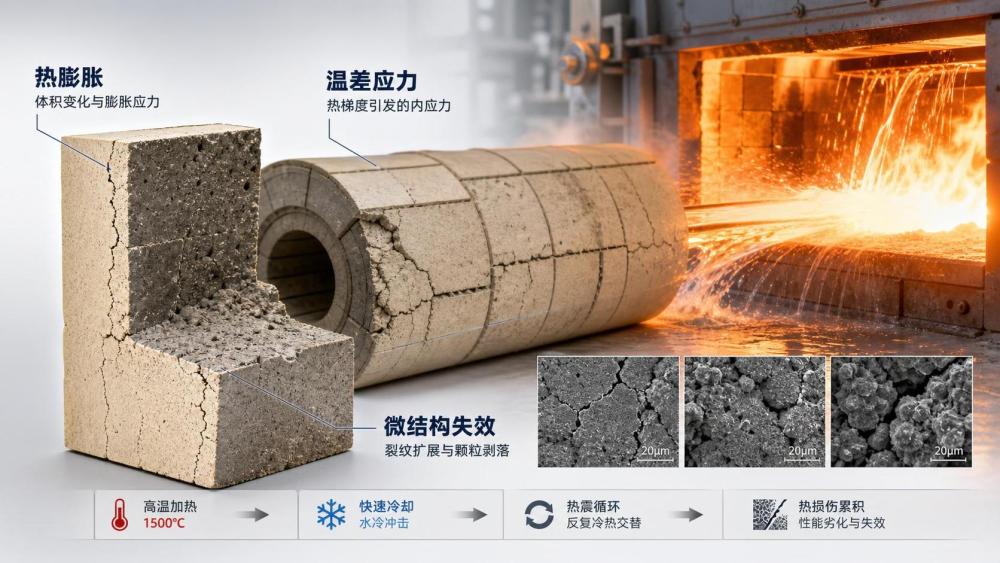
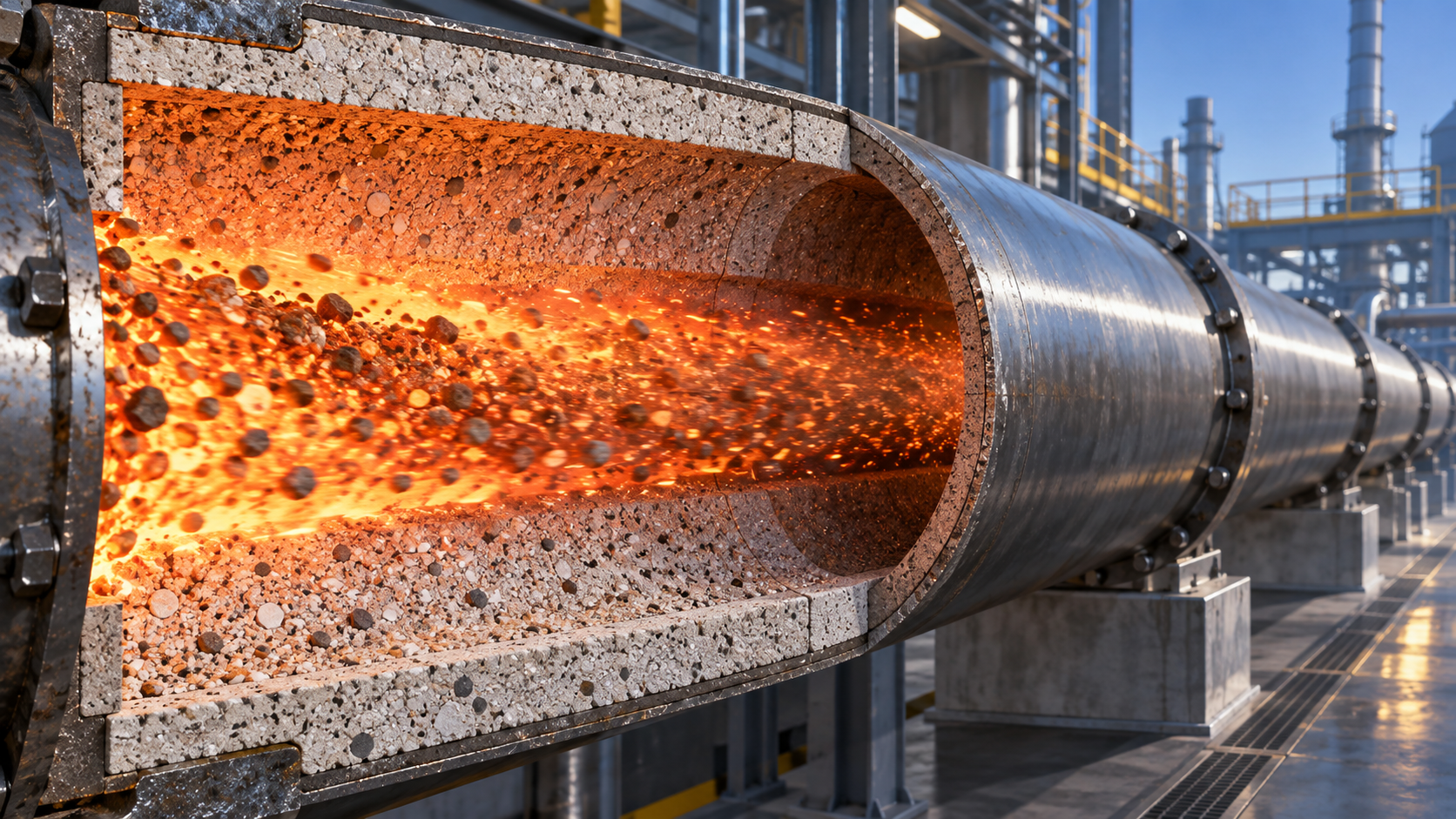
Thermal shock begins with uneven temperature change. When one part of a heat-resistant body heats or cools faster than another, the hotter zone wants to expand while the cooler zone restrains it. That mismatch creates stress. If the stress exceeds the material’s ability to deform, dissipate energy, or arrest cracks, failure follows.
What makes this tricky during development is that visible cracks are often late-stage evidence. Damage may start as subcritical microcracking around pores, grain boundaries, phase interfaces, or inclusions. Repeated cycling then links these microcracks into larger fracture paths. By the time spalling appears on the hot face or edge chipping shows up after testing, the material has already lost structural integrity.
In practical evaluation terms, thermal shock resistance is not just “survival after one temperature jump.” It is the capacity to tolerate stress, redistribute it, and avoid catastrophic crack growth over repeated thermal events.
The main causes of thermal shock failure in heat-resistant material development
1. High thermal expansion with low strain tolerance
Materials with a high coefficient of thermal expansion are naturally more vulnerable when temperature changes rapidly. They generate larger internal strain for the same thermal gradient. If this expansion is paired with high stiffness and low fracture toughness, the material has very little room to absorb stress.
This is why some dense, strong formulations look impressive in static mechanical tests but fail abruptly under cycling. Strength alone is not enough. A technically attractive composition may still be brittle in service if it cannot accommodate thermal movement.
2. Low thermal conductivity that traps temperature gradients
Low conductivity is often desirable for insulation and energy efficiency, but it can also be a source of thermal shock risk. When heat does not move through the body quickly, steep gradients form between the surface and the core. The surface responds first; the interior lags behind. That difference can become severe during fast heating, flame impingement, or rapid cooling from process gas changes.
For evaluators, this creates a familiar tension: a material optimized for thermal efficiency may become mechanically unstable if the process involves aggressive transients. The development decision cannot be made from conductivity values alone.
3. Weak microstructure and poor crack deflection behavior
Microstructure often decides whether thermal stress becomes damage or simply remains stress. Grain size distribution, pore shape, phase continuity, bond quality, and the presence of engineered crack deflection features all matter. A material with a rigid, continuous crack path is far more likely to fail than one with a microstructure that forces cracks to branch, blunt, or stop.
Large angular pores, poorly bonded aggregates, and sharp phase boundaries often act as stress concentrators. So do inhomogeneous regions created by segregation during forming or incomplete reaction during firing. In development batches, these issues may appear as inconsistent edge cracking, variable test outcomes, or failure concentrated near corners and thickness transitions.
4. Residual stress introduced during processing
Not all thermal shock failure starts in service. Some of it is already built into the material before the first field exposure. Drying gradients, binder burnout, sintering shrinkage mismatch, phase transformation during firing, and uneven cooling from the kiln can leave residual stress locked inside the structure.
That means a specimen may enter thermal shock testing with a hidden disadvantage. Two samples from the same nominal formula can behave differently if one carries more internal stress because of process variation. Technical evaluators sometimes blame formulation first, when the root cause is actually development-scale manufacturing control.
5. Phase transformations and chemical instability
Certain heat-resistant materials undergo crystal changes, glassy phase softening, oxidation, or reaction with process species that alter expansion behavior and fracture resistance. A phase transformation with volume change is especially dangerous under cycling. Even when the base chemistry appears stable, secondary reactions with alkalis, sulfur compounds, chlorides, molten ash, or slag can weaken the hot-face region and increase thermal shock sensitivity.
This matters in incineration, cement, and waste-to-energy environments where the thermal profile is only half the story; the chemical atmosphere is the other half. A formulation that performs well in clean laboratory air may degrade quickly when exposed to real combustion byproducts.
6. Geometry, thickness, and constraint effects
Development teams often focus on composition while underestimating shape-related stress. Sharp corners, abrupt thickness changes, anchoring interfaces, and rigid installation constraints amplify thermal shock vulnerability. Even a capable material can fail if the component design prevents free expansion or concentrates stress at local features.
For monolithics, cast shapes, burner blocks, kiln furniture, nozzles, and wear inserts, geometry is part of the material system. Evaluating a coupon in isolation may not predict installed behavior.
Where technical evaluators most often misread the problem
One common mistake is equating high cold crushing strength with high thermal shock resistance. In many cases, the opposite trade-off appears: as density and strength rise, brittleness may increase and crack tolerance may fall. Another mistake is testing only one heating rate or one quench condition and then generalizing the result to every plant scenario.
There is also a tendency to ask whether the material “passes” thermal shock, as if failure were binary. In reality, the more useful question is how it fails: surface crack network, edge spall, through-thickness fracture, property decay after cycles, or chemical weakening followed by crack propagation. The failure mode tells you whether to adjust formulation, processing, component design, or test method.
In heavy thermal industries, this distinction is practical. A lining that develops controlled microcracks but stays attached may still be acceptable. A body that remains visually intact for several cycles and then suddenly sheds a large section is far more dangerous.
How to evaluate heat-resistant material development more accurately
To judge thermal shock risk well, technical evaluators should compare the material’s development history with the actual thermal events it will face. That means looking beyond standard catalog properties and asking process-specific questions.
- What is the real heating and cooling profile? Startup, shutdown, upset conditions, flame exposure, and air leakage often matter more than steady-state temperature.
- Is the material exposed to clean heat or reactive species? Thermal shock in oxidizing air differs from shock in alkali-rich, sulfur-bearing, or ash-loaded environments.
- Does the test specimen represent final geometry? Thin bars can mislead when the final component is thick, constrained, or locally anchored.
- How repeatable is the processing route? Small changes in drying, particle packing, firing schedule, or binder burnout can shift shock performance substantially.
- What property changes after cycling? Residual strength, modulus reduction, crack density, mass change, and dimensional stability are often more revealing than a simple survival count.
For organizations working across rotary kilns, float glass lines, refractory production, and high-temperature extrusion systems, intelligence-led evaluation becomes valuable here. A development decision improves when lab data is interpreted alongside process dynamics, installation constraints, and known degradation patterns from comparable industrial systems. This is the kind of stitched insight that platforms such as CF-Elite are built to support: not replacing testing, but making it smarter and more context-aware.
Practical ways to reduce thermal shock failure during development
When thermal shock becomes the limiting factor, the response should not be automatic densification or chemistry escalation. Often the better answer is balance.
Microstructural tuning can help by introducing controlled porosity, optimizing aggregate grading, improving bond uniformity, or adding features that interrupt crack propagation. In some systems, lowering elastic modulus or adjusting phase assemblage produces better cycling performance than simply chasing maximum strength. Processing discipline matters just as much: uniform drying, controlled burnout, and stable firing schedules reduce residual stress before service even begins.
Design-side improvements are equally important. Rounding edges, reducing thickness transitions, allowing thermal movement, or modifying anchoring layout can dramatically change failure behavior. In kilns and incineration units, operational changes such as controlled ramp rates, burner balancing, and minimizing cold air ingress may extend life more effectively than changing the entire material family.
For evaluators, the key is to avoid looking for a universally “shock-proof” solution. The right development target depends on whether the priority is rapid startup tolerance, emergency cooling resilience, chemical stability under cycling, or life under repetitive medium-severity thermal swings.
A better decision framework for thermal shock risk
If a new heat-resistant material fails during development, the most useful response is not simply to reject it. Instead, isolate the dominant failure driver. Was the issue excessive expansion, low conductivity, poor toughness, processing stress, environmental reaction, or geometry constraint? Once that is clear, the next development step becomes rational rather than trial-and-error.
Thermal shock failure in heat-resistant material development is rarely random. It is usually the visible outcome of a mismatch between material behavior and service reality. Technical evaluators who understand that mismatch can make faster, safer decisions—whether they are screening refractory candidates for a cement preheater, assessing burner-block stability in glass melting, or reviewing wear-part durability in specialized extrusion equipment.
In other words, the question is not only what causes thermal shock failure. It is also whether the development process is asking the material to prove the right thing. When testing, process knowledge, and microstructural understanding are aligned, failure becomes less of a surprise and more of a design signal.
Related News
 Thermal Energy ArchitectRefractory Manufacturing Solutions for Brick Plants: How to Extend Kiln LifeRefractory manufacturing solutions for brick plant operations: discover proven strategies to extend kiln life, reduce heat loss, prevent lining failures, and plan cost-effective repairs.Oct 03, 2026
 Thermal Energy ArchitectHow to Specify Heavy Industrial Process Systems for High-Temperature PlantsHeavy industrial processes systems: learn how to specify high-temperature plants for efficiency, emissions control, maintainability, and lifecycle performance.Oct 02, 2026
 Structural Material AnalystHow Sustainable Material Extrusion Can Improve Wall Panel Durability and Design FlexibilityDiscover how sustainable material extrusion for wall panels improves durability, moisture resistance, design flexibility, and installation consistency for high-performing wall systems.Oct 01, 2026
 Thermal Energy ArchitectHow to Evaluate a High-Temperature Materials Manufacturer for Furnace ApplicationsChoose a high-temperature materials manufacturer with confidence: compare thermal performance, chemical resistance, quality controls, installation support, and lifecycle cost.Sep 30, 2026
 Ms. Elena RodriguezHow to Structure Global Specification Data for Faster Industrial Product EvaluationGlobal specification-oriented product information helps industrial teams compare capacity, energy, emissions, automation, and lifecycle data on a like-for-like basis for faster, confident equipment decisions.Sep 29, 2026
 Thermal Energy ArchitectHow to Specify High-Temperature Process Systems for Continuous Thermal OperationsHigh-temperature process engineering systems: learn how to specify resilient continuous thermal operations for efficiency, compliance, reliable uptime, and long-term performance.Sep 28, 2026
 Thermal Energy ArchitectHow to Evaluate a Thermal Engineering Contractor for High-Temperature Plant ProjectsChoose a thermal engineering contractor with proven process expertise, lifecycle value, emissions control, and delivery discipline for reliable high-temperature plant performance.Sep 27, 2026
 Silicate Process EngineerHow Latin American Cement Plants Can Reduce Dust Emissions in Kilns and Transfer PointsCement plant dust control Latin America: reduce kiln and transfer-point emissions with practical airflow, filtration, monitoring, and maintenance strategies.Sep 26, 2026
 Material Heat-Resist ExpertHow to Evaluate Refractory Production Lines for Output, Quality, and Energy UseRefractory production lines: learn how to assess qualified output, consistent quality, and total energy use for smarter, lower-risk investment decisions.Sep 25, 2026
 Dr. Alistair VaughnHow Waste Recycling Technology Improves Material Recovery in Industrial PlantsWaste recycling technology improves material recovery through source segregation, smart separation, thermal treatment, and quality control for industrial plants.Sep 24, 2026
 Optical Glass Tech FellowHow to Specify Glass Annealing Equipment for European Quality and Energy RequirementsGlass annealing equipment Europe: learn how to specify lehrs for consistent glass quality, energy efficiency, compliance, automation, and reliable long-term performance.Sep 23, 2026
 Optical Glass Tech FellowSilicate Process Automation: Improving Batch Consistency and Energy ControlSilicate process automation improves batch consistency, energy control, traceability, and operator confidence across high-temperature manufacturing operations.Sep 22, 2026
 Optical Glass Tech FellowHow Silicate Industrial Processes Control Viscosity, Energy Use, and Product QualitySilicate industrial processes: learn how viscosity, chemistry, heat transfer, and atmosphere control reduce energy use, improve stability, and protect product quality.Sep 21, 2026
 Thermal Energy ArchitectHow European Plants Can Evaluate Energy Recovery Equipment for High-Temperature ProcessesIndustrial energy recovery equipment Europe: learn how high-temperature plants can assess waste-heat sources, integration risks, lifecycle value, and reliable recovery routes.Sep 20, 2026
 Thermal Energy ArchitectIndustrial Furnace Process Optimization: Reducing Fuel Use Without Sacrificing ThroughputIndustrial process optimization furnace strategies that cut fuel use while protecting throughput. Explore combustion control, heat recovery, refractory performance, and data-driven efficiency gains.Sep 19, 2026
 Ms. Elena RodriguezWhat Drives High-Pressure Extrusion Equipment Cost in Industrial Projects?High pressure extrusion equipment cost explained: compare pressure, die design, automation, wear, energy, and installation factors for smarter industrial investments.Sep 18, 2026
 Thermal Energy ArchitectHow to Size a Waste Heat Recovery Exchanger for High-Temperature Kiln Exhaust?Waste heat recovery exchanger sizing for high-temperature kiln exhaust: balance recoverable duty, fouling, corrosion limits, pressure drop, and reliable heat use.Sep 17, 2026
 Thermal Energy ArchitectWhy Heat-Resistant Materials Lose Abrasion Resistance at High TemperaturesHeat-resistant materials abrasion resistance can decline at high temperatures. Discover the thermal, chemical, and mechanical causes of wear—and how to choose longer-lasting linings.Sep 16, 2026
 Thermal Energy ArchitectHow to Evaluate a Thermal Energy Optimization Company for High-Temperature PlantsChoose a thermal energy optimization company with proven process expertise, measurable savings, and reliable delivery for high-temperature plants. Learn what to assess.Sep 15, 2026
 Thermal Energy ArchitectRotary Kiln Efficiency: How Feed Rate, Fuel Use, and Heat Loss Affect OutputRotary kiln efficiency explained: discover how feed rate, fuel use, heat loss, combustion, and cooling performance shape output, quality, and energy costs.Sep 14, 2026


Related News
- 00
0000-00
How Waste Recycling Technology Improves Material Recovery in Industrial Plants - 00
0000-00
Industrial Process Engineering: How to Map Processes for Safer, More Efficient Plants - 00
0000-00
What Should a Process Technology Database Track for High-Temperature Plants? - 00
0000-00
How to Specify Custom Agricultural Processing Equipment for Throughput and Hygiene - 00
0000-00
How to Select Process Plant Equipment for High-Temperature, Abrasive Production Lines
Weekly Insights
Stay ahead with our curated technology reports delivered every Monday.