
Why Heat-Resistant Materials Lose Abrasion Resistance at High Temperatures




Heat-resistant materials lose abrasion resistance at high temperatures because the properties that keep a lining intact under heat are not always the same properties that resist particle impact, sliding solids, and turbulent dust. A refractory can retain its shape and still become easier to wear away. Its hot face may soften slightly, its bonding phase may change, pores may open, or a chemically altered surface layer may form. Once that surface is repeatedly struck by clinker, ash, cullet, fuel-derived solids, or other abrasive material, wear accelerates.
The visible result is often described simply as “high-temperature abrasion,” but the failure mechanism matters. A dense, polished-looking wear zone suggests a different cause from a rough, friable surface with exposed grains. Premature loss at brick joints points toward installation, movement, or local gas infiltration rather than bulk material weakness alone. Correct diagnosis begins by separating mechanical removal from the thermal and chemical changes that made removal easier.
Hot strength is not the same as abrasion resistance
Material datasheets often include cold crushing strength, bulk density, apparent porosity, and a maximum service temperature. These values are useful, but none alone predicts resistance to abrasion at operating temperature. Cold crushing strength describes behavior under a compressive load at room temperature. Abrasion in a hot vessel is usually a combination of impact, shear, thermal stress, and corrosive attack acting on a surface that may be hundreds of degrees hotter than the test specimen.
A material with high room-temperature strength may contain a glassy or low-melting bonding phase. At elevated temperature, that phase can soften enough for abrasive particles to pull out coarse aggregates. Conversely, a somewhat lower-strength refractory with stable ceramic bonding and tightly held grains can outlast it in a severe sliding-abrasion zone. The question is therefore not whether a material is “heat resistant,” but whether its aggregate, matrix, bond, and pore structure remain mechanically coherent at the actual hot-face temperature.
Temperature also changes the behavior of the abrasive material. Fine ash that flows freely when cold can become sticky when alkali salts or low-melting constituents are present. Large particles may fracture on impact and create a finer, more erosive stream. A deposit can shield a surface in one zone while causing localized turbulence and higher particle velocity at its edge in another.
Microstructural changes weaken the wear surface
Most heat-resistant materials are composites. They contain coarse aggregates for skeleton strength, a finer matrix that fills space between grains, and a bonding system that develops during firing or service. Abrasion resistance depends on these parts remaining well connected. High temperature can disturb that connection in several ways.
At a suitable firing temperature, ceramic bonds grow between particles and may improve hot strength. Beyond the stable range for a particular composition, liquid phases can develop or increase. A small amount of liquid is not automatically harmful; some systems rely on it for densification or bonding. The problem appears when the liquid phase lowers viscosity enough to permit grain movement, increases susceptibility to chemical penetration, or leaves a weaker phase after cooling.
Grain pull-out is a common progression. Abrasive solids first remove the fine matrix between larger particles. The exposed aggregate then receives direct impacts, loses lateral support, and is dislodged. The lining may look as though large grains have been scooped from its surface. This is different from uniform wear caused by steady sliding abrasion, and it often signals inadequate hot bonding, incompatible chemistry, or a material that is too coarse for the particle stream.
Porosity changes also matter. Open pores give corrosive gases and liquid slag pathways into the lining. They reduce the load-bearing contact area at the surface and provide starting points for cracking. A highly dense body is not always the answer, since very low permeability can complicate dryout or trap moisture during installation. The relevant target is a pore structure that limits penetration while remaining compatible with the heating schedule and the service environment.
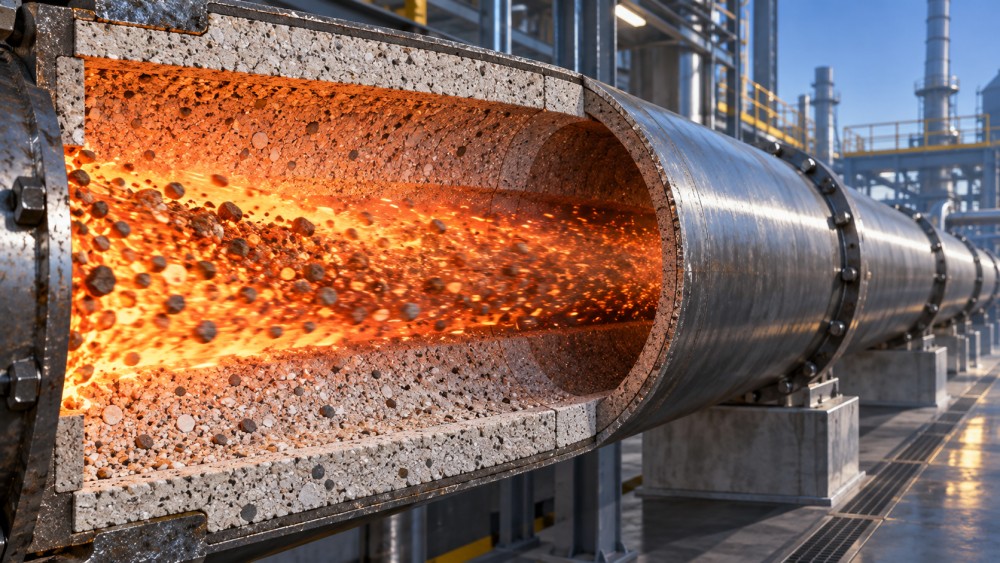
Thermal cycling creates a surface that abrasive flow can strip away
Even when peak temperature stays within the material’s rating, repeated heating and cooling can reduce abrasion resistance. Aggregate grains, matrix phases, anchors, steel shell components, and adjacent lining materials expand at different rates. Each cycle creates internal stress. If the stresses exceed local bond strength, microcracks form around aggregate particles, at joints, and near the hot-face surface.
These cracks are often too small to see during a routine visual inspection. Abrasive flow changes the situation: particles enter the openings, apply wedging forces, and remove unsupported fragments. A wear pattern with thin sheets or flakes coming away from the surface is more consistent with spalling than with simple abrasive thinning. Repairing that area with a harder material alone may not solve the problem if rapid burner shutdowns, cold-air ingress, process trips, or uneven preheating continue.
Temperature gradients deserve as much attention as peak temperature. A hot face exposed to flame or radiant heat can expand while the colder backing remains restrained. Thick sections are particularly sensitive when heat-up is fast. Castable linings may develop damage from retained water or inadequate staged dryout before normal operation begins. That damage may remain hidden until solids begin moving across the surface.
Joints and interfaces provide another clue. If wear is concentrated along mortar joints, around repair boundaries, or at the transition between dissimilar refractories, movement and differential expansion are likely contributors. If wear crosses joints evenly, the material’s hot-face resistance and process abrasion deserve closer examination.
Oxidation and chemical attack can convert a hard face into a weak layer
High temperature often changes the chemistry at the exposed surface before obvious mechanical wear appears. Oxygen, water vapor, sulfur-bearing gases, alkali vapors, chlorine-bearing species, metal oxides, and molten deposits can react with the matrix or bonding phase. The reaction products may have a larger volume, lower melting point, weaker bond, or different thermal expansion from the original material.
Oxidation is especially relevant where carbon-containing refractories, metallic additives, or embedded metallic components are present. As carbon oxidizes, the original protective structure becomes more porous. Oxidation of metallic phases can create expansion stresses and cracking. In an abrasive environment, the altered outer layer is removed rapidly, exposing fresh material and allowing the reaction to continue inward.
Alkali attack can be deceptive because the surface may initially appear glazed or dense. A glassy deposit can temporarily mask underlying penetration. Beneath it, reactions may dissolve matrix phases, form lower-melting compounds, or create a brittle reaction zone. When thermal cycling occurs, the mismatch between the reaction layer and the original refractory can cause peeling. Similar-looking glaze can therefore indicate either a relatively stable protective coating or a precursor to rapid loss; its adhesion, thickness, chemistry, and location determine the interpretation.
In incineration and waste-derived fuel systems, the gas composition and ash chemistry can change over short intervals. A material selected for dry abrasion in a neutral atmosphere may perform poorly where salt-bearing deposits periodically melt and solidify. In glass contact zones, vapor attack and alkali-rich dust can alter a lining without the large solid particles associated with kiln discharge areas. The abrasive mechanism should always be assessed together with the atmosphere and deposited material.
Particle energy changes the wear mechanism
Abrasion severity is driven by more than material hardness. Particle size, shape, hardness, concentration, velocity, impact angle, and flow pattern all affect the lining. Fine, angular particles traveling at high velocity tend to erode surfaces. Larger solids dropped or carried at a shallow angle create impact and gouging. Sliding beds of hot granular material can polish a surface while gradually removing matrix.
Changes in duct geometry often explain why a lining begins wearing after a process modification even though its nominal temperature has not changed. A narrowed cross-section, damaged baffle, partial build-up, misaligned chute, or altered material feed can concentrate solids onto a small area. Local velocity and impact angle rise. The resulting wear patch may be mistaken for a batch defect in the refractory, especially when adjacent areas remain sound.
Wear close to a bend, transfer point, burner throat, discharge lip, or constricted passage should be mapped rather than described only by depth. The shape of the worn area carries information. A directional fan pattern suggests particle flow. A deep pocket below a ledge suggests falling material. Broad, even thinning points more toward sustained sliding or a uniformly weak surface. This mapping also helps distinguish process-driven erosion from generalized chemical degradation.
Read the failure surface before selecting a replacement
Replacement selection should begin with evidence from the removed lining. Preserve representative pieces from the hot face through the unaffected backing where possible. A surface-only sample cannot show penetration depth, internal cracking, or changes in pore structure. Note the location, orientation, operating side, adjacent material, repair history, and whether deposits were present before shutdown.
Hardness tests on a cold, removed sample have limited value if the hot-face chemistry has changed. Compare the reacted zone with the unreacted interior. A lining can have a sound backing and a failed surface because the issue is external attack, while through-thickness cracking indicates a broader thermal or installation problem.
Material selection must match the dominant wear mode
For dry, high-velocity abrasion, dense compositions with strong ceramic bonding and stable hard aggregates are often preferable. For zones exposed to slag, alkali, or salt-bearing deposits, chemical compatibility may take priority over nominal abrasion figures. A composition that resists particle impact but reacts to the deposit can fail faster than a less hard material with a more stable chemistry.
Aggregate choice should be considered with the matrix, not in isolation. Very hard aggregate particles do little when the matrix erodes first. Fine-grained systems can produce a more uniform surface and stronger matrix, but they may require careful water control, mixing, placement, and dryout. Adding excess water to improve workability raises porosity after drying and can reduce both abrasion and corrosion resistance. The installed material is therefore the relevant material, not merely the formulation stated on a bag or drawing.
Installation quality has a direct effect on hot abrasion life. Segregation during placement, inconsistent compaction, incorrect vibration, contaminated forms, poorly prepared repair interfaces, and incomplete curing produce weak zones that abrasive flow finds quickly. For precast shapes and brick linings, dimensional gaps, irregular joints, and unsupported edges can become erosion initiators. A sound material installed with poor geometry will not deliver its expected service behavior.
Control the conditions that keep exposing fresh weak material
Where process conditions permit, reduce abrupt thermal changes, prevent cold-air leaks near hot linings, and maintain a heat-up schedule suited to lining thickness and binder system. Remove build-up that redirects abrasive solids, but examine why it formed before changing the geometry. A deposit may be a process symptom, and its removal can reveal an already-thinned area receiving concentrated flow.
During inspections, track wear depth together with surface character, temperature history, deposit location, and changes in fuel or feed. Depth alone is a lagging indicator. A newly roughened, cracked, or chemically glazed surface often gives earlier warning that abrasion resistance has fallen. Recording that condition before extensive material loss makes it easier to decide whether the next intervention requires a local repair, a different lining composition, a geometry correction, or a change to the thermal operating pattern.
Heat resistance protects a material from immediate collapse at high temperature. Abrasion resistance survives only when that heat exposure leaves the surface bonded, chemically stable, and structurally supported. When wear increases, the most useful question is not simply whether the lining exceeded its temperature rating, but what changed at the hot face before the solids began removing it.
Related News
 Thermal Energy ArchitectWhy Heat-Resistant Materials Lose Abrasion Resistance at High TemperaturesHeat-resistant materials abrasion resistance can decline at high temperatures. Discover the thermal, chemical, and mechanical causes of wear—and how to choose longer-lasting linings.Sep 16, 2026
 Thermal Energy ArchitectHow to Evaluate a Thermal Energy Optimization Company for High-Temperature PlantsChoose a thermal energy optimization company with proven process expertise, measurable savings, and reliable delivery for high-temperature plants. Learn what to assess.Sep 15, 2026
 Thermal Energy ArchitectRotary Kiln Efficiency: How Feed Rate, Fuel Use, and Heat Loss Affect OutputRotary kiln efficiency explained: discover how feed rate, fuel use, heat loss, combustion, and cooling performance shape output, quality, and energy costs.Sep 14, 2026
 Thermal Energy ArchitectHow to Select Heat-Resistant Materials That Maintain Abrasion Resistance in KilnsHeat-resistant materials abrasion resistance: learn how to select kiln linings that withstand heat, wear, thermal cycling, and chemical attack for longer service life.Sep 13, 2026
 Thermal Energy ArchitectHow Rotary Kiln Automation Improves Temperature Control and Fuel EfficiencyRotary kiln technology automation enhances temperature control, stabilizes combustion, and improves fuel efficiency with smarter data, predictive control, and safer operations.Sep 12, 2026
 Silicate Process EngineerCement Plant Emission Control: Selecting Systems for Dust, NOx, and SO2 LimitsCement plant emission control guide: compare dust collectors, NOx reduction, and SO2 systems for reliable compliance across kiln modes, fuel changes, and operating upsets.Sep 11, 2026
 Thermal Energy ArchitectSelecting Abrasion-Resistant High-Temperature Materials for Kiln and Conveyor Wear ZonesHigh-temp material engineering guide to abrasion-resistant kiln and conveyor solutions—match wear, heat, chemistry, and installation design for longer service life.Sep 10, 2026
 Dr. Alistair VaughnIndustrial Process Engineering: How to Map Processes for Safer, More Efficient PlantsIndustrial process engineering reveals bottlenecks, safety risks, and energy losses through practical process mapping for safer, more efficient plants.Sep 09, 2026
 Optical Glass Tech FellowHow to Evaluate a Glass Annealing Equipment Manufacturer for Production StabilityChoose a glass annealing equipment manufacturer with proven thermal uniformity, reliable controls, lifecycle value, and responsive service for stable production.Sep 08, 2026
 Prof. Marcus ChenThermal Energy Architecture in North America: Strategies for Lower Building Energy UseThermal energy architecture North America helps project leaders cut building energy use through stronger envelopes, right-sized HVAC, storage, and smart commissioning.Sep 07, 2026
 Ms. Elena RodriguezHow Should Buyers Evaluate Building Material Industry Intelligence Pricing?Building material industry intelligence pricing: learn how to compare coverage, technical depth, and ROI to choose intelligence that reduces procurement risk.Sep 07, 2026
 Ms. Elena RodriguezHow to Use Building Material Intelligence Data for Market and Investment DecisionsBuilding material industry intelligence data helps leaders evaluate demand, costs, regulation, capacity, and technology to make smarter market and investment decisions.Sep 05, 2026
 Thermal Energy ArchitectHow PLC Control Improves Energy Efficiency and Temperature Stability in KilnsEnergy efficient kilns PLC control improves temperature stability, cuts fuel waste, and optimizes combustion, draft, and material flow. Explore proven strategies for smarter kiln modernization.Sep 04, 2026
 Optical Glass Tech FellowEuropean Glass Melting Processes: Furnace Choices, Energy Use, and Quality ControlGlass melting process Europe: explore furnace choices, energy efficiency, cullet strategy, and quality control to improve output, compliance, and long-term glass performance.Sep 03, 2026
 Thermal Energy ArchitectWhat Determines Refractory Lining Monitoring Price for Industrial Kilns?Refractory lining monitoring price depends on kiln size, sensor technology, installation, software, and support. Compare total lifecycle costs and choose the right solution.Sep 02, 2026
 Silicate Process EngineerCement Production System Costs: A Plant Buyer’s Guide to Budgeting and ROICement production systems cost planning made clear: compare CAPEX, operating costs, compliance, and ROI to build a resilient, profitable cement plant investment.Sep 01, 2026
 Dr. Alistair VaughnWhat Should a Process Technology Database Track for High-Temperature Plants?Process technology database essentials for high-temperature plants: track thermal profiles, feed chemistry, refractory wear, emissions, energy, and maintenance for safer, data-driven decisions.Aug 31, 2026
 Ms. Elena RodriguezHow to Evaluate a Silicate Processing Equipment Manufacturer for Plant ProjectsSilicate processing equipment manufacturer selection: assess process fit, guarantees, energy, compliance, delivery risk, and lifecycle support for dependable plant performance.Aug 30, 2026
 Dr. Alistair VaughnHow to Specify Custom Agricultural Processing Equipment for Throughput and HygieneEquipment customization services for agricultural processing: learn to specify hygienic, high-throughput lines that improve yield, reliability, and long-term efficiency.Aug 29, 2026
 Dr. Alistair VaughnHow to Select Process Plant Equipment for High-Temperature, Abrasive Production LinesProcess plant equipment selection for high-temperature, abrasive lines: reduce downtime, improve durability, and optimize lifecycle performance.Aug 28, 2026




Related News
- 00
0000-00
Why Heat-Resistant Materials Lose Abrasion Resistance at High Temperatures - 00
0000-00
How to Evaluate a Thermal Energy Optimization Company for High-Temperature Plants - 00
0000-00
Rotary Kiln Efficiency: How Feed Rate, Fuel Use, and Heat Loss Affect Output - 00
0000-00
How to Select Heat-Resistant Materials That Maintain Abrasion Resistance in Kilns - 00
0000-00
How Rotary Kiln Automation Improves Temperature Control and Fuel Efficiency
Weekly Insights
Stay ahead with our curated technology reports delivered every Monday.