How Digital Twin Simulations Help Kiln Operators Cut Fuel Use and Stabilize Output




Anyone who has spent time around a kiln floor knows the frustrating version of the same shift: fuel use creeps up, the burning zone looks less predictable than it did yesterday, and output starts drifting just enough to make everyone uneasy. Nothing may look like a full breakdown, but the process no longer feels tight. Operators adjust air, feed, draft, or speed based on experience, then wait to see whether the line settles or becomes even more sensitive. In high-temperature production, that waiting period is expensive.
The difficult part is that kiln instability rarely comes from one obvious cause. A small change in raw mix moisture, a draft imbalance, coating development, refractory condition, alternative fuel variability, or delayed sensor response can all interact. When people are asked to cut fuel use at the same time, the pressure increases. Reducing heat input without understanding how the whole thermal system will react can lead to colder zones, incomplete reactions, ring formation risks, or uneven product quality. This is where digital twin simulations for kilns become practical rather than theoretical: they give operators a safer way to test process decisions before the real kiln pays the price.
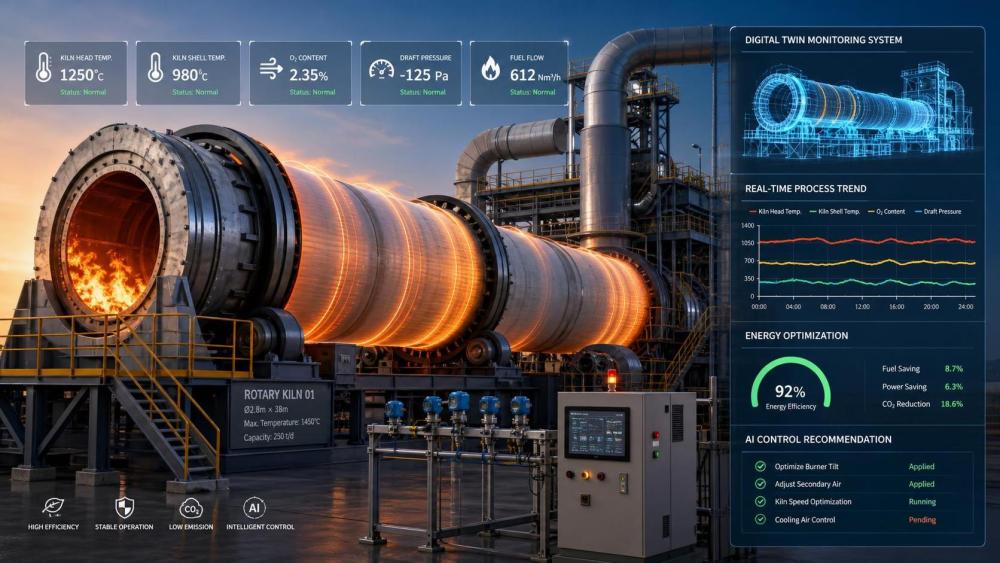
Many teams first look at simulation only after a period of repeated small problems. The line may not be in crisis, but the pattern is familiar: one day the flame shape is acceptable but stack losses seem high; another day fuel rate looks controlled but free lime or melt quality drifts; another day the kiln runs, yet everyone knows it is not running comfortably. In those moments, a digital twin is useful because it turns scattered operating signals into a working process picture. Instead of relying on isolated temperatures or one trend line at a time, operators can compare the likely consequences of changing one variable against the response of the whole kiln system.
Why experienced operators still run into avoidable fuel waste
A common misunderstanding is that excess fuel use always shows up as an obvious hot kiln. In reality, waste often hides inside compensating adjustments. If secondary air weakens, someone may increase fuel to maintain a target temperature. If feed chemistry shifts, the thermal demand changes and fuel is added before the root cause is fully understood. If draft behavior is unstable, combustion may become less efficient even while headline temperature readings appear normal. These are not careless mistakes. They are normal responses to incomplete visibility.
Traditional trend screens help, but they often leave a gap between “what is happening now” and “what is likely to happen next.” Operators can see temperatures, pressures, oxygen levels, fan loads, and feed rates, yet they still have to mentally connect heat transfer, residence time, combustion quality, and material transformation. That mental model is valuable, but on a live line it is also limited by time pressure and measurement delays. A digital twin does not replace judgment; it gives judgment a stronger process context.
Where simulation fits into day-to-day kiln control
At its most useful level, a kiln twin is a virtual operating model built from actual process data and engineering relationships. It reflects how the kiln tends to behave under certain combinations of feed, fuel, airflow, speed, and thermal load. The point is not to create a perfect copy of reality. The point is to build a model accurate enough to help the team ask better operational questions.
For example, instead of wondering whether a fuel reduction is safe, the team can ask whether the reduction is likely to shift the burning profile too far downstream, reduce material conversion margin, or change exhaust behavior under current feed conditions. Instead of reacting after output becomes erratic, they can test whether a speed adjustment, air balance change, or different setpoint strategy would stabilize the process with less thermal oversupply.
That matters because kiln systems are strongly coupled. A decision that appears efficient at one point in the line can introduce hidden instability elsewhere. Simulation helps reveal those interactions earlier.
Signs that a digital twin approach may help more than another round of manual tuning
Not every kiln problem needs simulation. If an instrument has failed, a burner is mechanically damaged, or raw material quality has moved far outside normal limits, the first task is still basic troubleshooting. But many operating situations sit in the middle zone where the line is technically running yet not running well. That is often where digital twin simulations for kilns become most valuable.
One sign is repeated overcorrection. The line drifts, operators intervene, the process swings in the other direction, and stability takes too long to recover. Another sign is when fuel targets and production targets seem to conflict every week instead of only during unusual conditions. A third sign is when process discussions rely heavily on memory and instinct but lack a shared predictive framework. In these cases, the issue is not lack of effort. It is lack of a safe testing environment for process decisions.
Simulation is also useful during operating changes that are known to be sensitive: alternative fuel adjustments, feed shifts, startup stabilization, coating changes, draft modifications, or efforts to lower excess air. These are moments when a small decision can have delayed thermal effects. A digital twin makes those delays easier to think through.
What operators should prepare before trusting the model
One of the biggest mistakes is assuming the software itself creates insight automatically. It does not. A useful model starts with process discipline. If core measurements are drifting, if sensors are not maintained, or if event logging is inconsistent, the twin will reflect those weaknesses. Before expecting good simulation output, teams usually need to tighten several habits.
First, confirm that the critical signals used for thermal interpretation are dependable enough for comparison over time. That does not mean every instrument must be perfect, but major errors in temperature, oxygen, pressure, flow, or feed reporting will distort the model. Second, separate steady-state periods from upset periods. Feeding a model with mixed-quality operating history can make normal behavior look chaotic. Third, record operator actions clearly. If a change in draft or fuel split is not logged, later analysis becomes guesswork.
It also helps to agree on the question the twin is supposed to answer. Some teams want to reduce specific fuel use. Others want to reduce instability during throughput changes. Others are trying to understand why output quality becomes inconsistent after apparently minor process adjustments. A model that tries to solve everything at once often becomes less useful on the floor.
Using the twin without turning it into a control-room distraction
The best simulation support is usually simple at the operator level. It should help with decisions already happening during the shift, not create a second full-time job. In practice, many operators benefit most when the twin is used in a rhythm like this: review current process condition, test one or two likely adjustments virtually, choose the lowest-risk move, then watch whether the real process responds in the expected direction.
Suppose the kiln shows signs of rising fuel demand while output consistency is slipping. Instead of immediately adding thermal input, the team might use the model to explore whether the issue is more consistent with air distribution, material load behavior, or a residence-time shift. If the simulation suggests that the burning profile is moving because of upstream variation rather than true heat deficiency, the response may be very different from a simple fuel increase.
That shift in thinking is important. The twin is not there to encourage endless experimentation. It is there to reduce blind intervention.
One practical way to apply it during a normal operating cycle
Start with a narrow operating window rather than the full plant complexity. Choose a period where the line is reasonably stable and use that as the comparison base. Then identify one recurring disturbance, such as production rate changes, secondary air fluctuation, or variable fuel quality. Use the simulation to examine how that disturbance tends to alter temperature distribution, combustion behavior, and likely output consistency.
From there, develop response rules that are specific enough to help but not so rigid that they ignore operator judgment. For instance, if a certain pattern appears in the model and the live trends confirm it, the preferred first response may be to adjust airflow balance before changing total fuel. If another pattern appears, the first response may be to review feed and speed coordination. Over time, the model becomes less of a special project and more of a structured reference for known situations.
Where fuel savings usually come from
People often expect simulation to reveal one dramatic efficiency trick. More often, savings come from reducing routine thermal waste. That includes operating with more excess heat than necessary because no one is confident enough to tighten the margin, compensating for instability with fuel instead of correcting the real cause, or allowing slow disturbances to continue until they require larger interventions.
A digital twin helps by making those margins visible. If the model shows that current operation carries more thermal cushion than process conditions require, the team can trim it carefully and watch for predicted responses. If it shows that a disturbance is likely to resolve through air-path correction rather than higher firing, fuel can be protected without gambling on guesswork. If it shows that a feed change will create delayed effects, the team can avoid chasing the process too early.
None of this removes the need for practical experience. In fact, experienced operators usually get the most from simulation because they can recognize when the model supports what the kiln is already “saying” and when a reading should be treated cautiously.
Stabilizing output means looking past the main temperature number
When output quality becomes uneven, the immediate temptation is to focus on the most watched temperature values. Those matter, but they are not the whole story. Output stability depends on heat distribution, reaction completeness, material movement, combustion consistency, and the timing between process changes and measured results. This is another reason simulation is useful: it helps connect those layers.
For operators, that often changes the decision standard. Instead of asking, “Did the temperature recover?” the better question becomes, “Did the process recover in the way the kiln usually needs in order to keep output steady?” A temperature can recover while the thermal profile remains poorly positioned. A fuel rate can look improved while the process becomes more sensitive to the next disturbance. Simulation helps reveal that difference.
Limits to keep in mind
It is worth being realistic. A digital twin is not a substitute for instrumentation care, refractory inspection, burner maintenance, or understanding raw material variability. It will not fix a bad mechanical condition through modeling. It also should not be treated as unquestionable authority. If the twin suggests a response that conflicts with clear field evidence, the right move is to pause and inspect assumptions.
Models age as operating conditions change. Fuel mix, equipment wear, process targets, and control logic can all shift the validity of earlier assumptions. That means the twin needs periodic review, not blind trust. The useful mindset is to treat it as a structured decision tool that improves with disciplined use.
When this approach is most worth the effort
If your kiln already runs with stable output, predictable thermal behavior, and enough confidence to reduce fuel margins safely, simulation may be a lower priority. But if the line tends to live in the gray zone between “acceptable” and “fully under control,” a twin can help close that gap. It is especially relevant when the operating team is being asked to lower fuel use without increasing production risk, or when process behavior seems too interconnected to solve by looking at single trends one by one.
For many operators, the value is not that the model provides dramatic answers. It is that it reduces hesitation and unnecessary correction. It gives a clearer basis for deciding whether to hold, trim, or intervene. In a kiln environment, that kind of clarity matters because every delayed or misjudged response carries heat, time, and quality consequences.
Used carefully, digital twin simulations for kilns help turn daily operating pressure into a more manageable process. They do that by making thermal behavior easier to test, not by pretending the kiln has become simple. And for teams trying to cut fuel use while keeping output steady, that is often the difference between constant firefighting and controlled improvement.
Related News
 Thermal Energy ArchitectWhat Does CE Marking Require for an Energy-Efficient Industrial Kiln?Energy efficient kiln CE requirements explained: assess safety, technical files, energy performance, and EU compliance before purchase or commissioning.Oct 04, 2026
 Thermal Energy ArchitectRefractory Manufacturing Solutions for Brick Plants: How to Extend Kiln LifeRefractory manufacturing solutions for brick plant operations: discover proven strategies to extend kiln life, reduce heat loss, prevent lining failures, and plan cost-effective repairs.Oct 03, 2026
 Thermal Energy ArchitectHow to Specify Heavy Industrial Process Systems for High-Temperature PlantsHeavy industrial processes systems: learn how to specify high-temperature plants for efficiency, emissions control, maintainability, and lifecycle performance.Oct 02, 2026
 Structural Material AnalystHow Sustainable Material Extrusion Can Improve Wall Panel Durability and Design FlexibilityDiscover how sustainable material extrusion for wall panels improves durability, moisture resistance, design flexibility, and installation consistency for high-performing wall systems.Oct 01, 2026
 Thermal Energy ArchitectHow to Evaluate a High-Temperature Materials Manufacturer for Furnace ApplicationsChoose a high-temperature materials manufacturer with confidence: compare thermal performance, chemical resistance, quality controls, installation support, and lifecycle cost.Sep 30, 2026
 Ms. Elena RodriguezHow to Structure Global Specification Data for Faster Industrial Product EvaluationGlobal specification-oriented product information helps industrial teams compare capacity, energy, emissions, automation, and lifecycle data on a like-for-like basis for faster, confident equipment decisions.Sep 29, 2026
 Thermal Energy ArchitectHow to Specify High-Temperature Process Systems for Continuous Thermal OperationsHigh-temperature process engineering systems: learn how to specify resilient continuous thermal operations for efficiency, compliance, reliable uptime, and long-term performance.Sep 28, 2026
 Thermal Energy ArchitectHow to Evaluate a Thermal Engineering Contractor for High-Temperature Plant ProjectsChoose a thermal engineering contractor with proven process expertise, lifecycle value, emissions control, and delivery discipline for reliable high-temperature plant performance.Sep 27, 2026
 Silicate Process EngineerHow Latin American Cement Plants Can Reduce Dust Emissions in Kilns and Transfer PointsCement plant dust control Latin America: reduce kiln and transfer-point emissions with practical airflow, filtration, monitoring, and maintenance strategies.Sep 26, 2026
 Material Heat-Resist ExpertHow to Evaluate Refractory Production Lines for Output, Quality, and Energy UseRefractory production lines: learn how to assess qualified output, consistent quality, and total energy use for smarter, lower-risk investment decisions.Sep 25, 2026
 Dr. Alistair VaughnHow Waste Recycling Technology Improves Material Recovery in Industrial PlantsWaste recycling technology improves material recovery through source segregation, smart separation, thermal treatment, and quality control for industrial plants.Sep 24, 2026
 Optical Glass Tech FellowHow to Specify Glass Annealing Equipment for European Quality and Energy RequirementsGlass annealing equipment Europe: learn how to specify lehrs for consistent glass quality, energy efficiency, compliance, automation, and reliable long-term performance.Sep 23, 2026
 Optical Glass Tech FellowSilicate Process Automation: Improving Batch Consistency and Energy ControlSilicate process automation improves batch consistency, energy control, traceability, and operator confidence across high-temperature manufacturing operations.Sep 22, 2026
 Optical Glass Tech FellowHow Silicate Industrial Processes Control Viscosity, Energy Use, and Product QualitySilicate industrial processes: learn how viscosity, chemistry, heat transfer, and atmosphere control reduce energy use, improve stability, and protect product quality.Sep 21, 2026
 Thermal Energy ArchitectHow European Plants Can Evaluate Energy Recovery Equipment for High-Temperature ProcessesIndustrial energy recovery equipment Europe: learn how high-temperature plants can assess waste-heat sources, integration risks, lifecycle value, and reliable recovery routes.Sep 20, 2026
 Thermal Energy ArchitectIndustrial Furnace Process Optimization: Reducing Fuel Use Without Sacrificing ThroughputIndustrial process optimization furnace strategies that cut fuel use while protecting throughput. Explore combustion control, heat recovery, refractory performance, and data-driven efficiency gains.Sep 19, 2026
 Ms. Elena RodriguezWhat Drives High-Pressure Extrusion Equipment Cost in Industrial Projects?High pressure extrusion equipment cost explained: compare pressure, die design, automation, wear, energy, and installation factors for smarter industrial investments.Sep 18, 2026
 Thermal Energy ArchitectHow to Size a Waste Heat Recovery Exchanger for High-Temperature Kiln Exhaust?Waste heat recovery exchanger sizing for high-temperature kiln exhaust: balance recoverable duty, fouling, corrosion limits, pressure drop, and reliable heat use.Sep 17, 2026
 Thermal Energy ArchitectWhy Heat-Resistant Materials Lose Abrasion Resistance at High TemperaturesHeat-resistant materials abrasion resistance can decline at high temperatures. Discover the thermal, chemical, and mechanical causes of wear—and how to choose longer-lasting linings.Sep 16, 2026
 Thermal Energy ArchitectHow to Evaluate a Thermal Energy Optimization Company for High-Temperature PlantsChoose a thermal energy optimization company with proven process expertise, measurable savings, and reliable delivery for high-temperature plants. Learn what to assess.Sep 15, 2026

Related News
- 00
0000-00
What Does CE Marking Require for an Energy-Efficient Industrial Kiln? - 00
0000-00
Refractory Manufacturing Solutions for Brick Plants: How to Extend Kiln Life - 00
0000-00
How to Specify Heavy Industrial Process Systems for High-Temperature Plants - 00
0000-00
How to Evaluate a High-Temperature Materials Manufacturer for Furnace Applications - 00
0000-00
How to Specify High-Temperature Process Systems for Continuous Thermal Operations
Weekly Insights
Stay ahead with our curated technology reports delivered every Monday.