
Industrial Waste Management Compliance: Key Regulations and Risk Checks for Plants




What industrial waste management compliance actually covers inside a plant
Industrial waste management compliance is often misunderstood as a disposal issue handled at the end of production. In practice, regulators and auditors rarely see it that narrowly. They look at the full control chain: how a plant identifies waste, whether it distinguishes hazardous from non-hazardous streams correctly, how containers are labeled, how storage time is managed, whether incompatible materials are segregated, how transport is documented, and whether the final treatment route matches the legal classification. That is why plants with decent housekeeping can still fail inspections. The problem is not always visible disorder; it is usually weak classification logic, incomplete records, or inconsistent operating controls.
For quality control and safety managers, this matters because waste compliance sits between process discipline and legal exposure. A misdeclared solvent residue, kiln dust stream, refractory debris, spent filter media, sludge, or laboratory chemical can trigger far more than a paperwork issue. It may change storage requirements, personnel training needs, manifest obligations, transporter qualifications, and liability after the waste leaves the gate. In high-temperature industries, where by-products can contain heavy metals, corrosive residues, combustible material, or fine particulates, those decisions are rarely trivial.
The practical question is not “Do we have waste procedures?” It is “Can we demonstrate, line by line and container by container, why each stream is controlled the way it is?” That is the threshold most serious audits eventually reach.
The first risk check: waste classification is a technical judgment, not an admin label
Most compliance failures begin upstream, at classification. Plants generate wastes that look operationally similar but fall under different legal controls. Ash from incineration, baghouse dust from cement handling, spent refractories from kiln maintenance, oily absorbents from equipment service, wastewater treatment sludge, and off-spec extrusion compounds may all require different handling even when they are stored in the same utilities area.
The classification method depends on jurisdiction, but the underlying logic is broadly consistent. You need to know the source of the waste, the process that created it, the likely constituents, and whether it shows hazardous characteristics such as ignitability, corrosivity, reactivity, or toxicity. In some systems, listed wastes and mirror entries complicate the decision further. That is where plants get exposed: they rely on habit or naming conventions instead of traceable evidence such as SDS review, process chemistry, lab analysis where required, and documented waste coding rationale.
A common mistake is treating “production residue” as a single category. In a rotary kiln or thermal processing environment, one residue may be suitable for co-processing or material recovery, while another, generated only during upset conditions or maintenance shutdowns, may require hazardous waste controls. If the plant cannot explain that distinction, regulators may assume the more conservative interpretation.
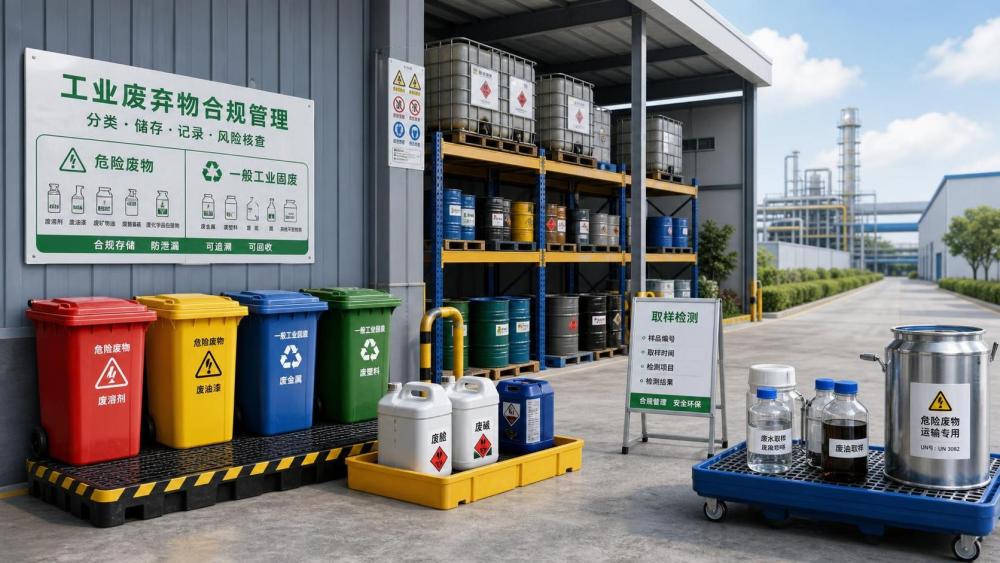
This is especially relevant for facilities trying to reduce disposal cost through reuse or internal recovery. Compliance does not prohibit resource circularity, but it does require that the plant distinguish clearly between a usable by-product, a recoverable secondary material, and a regulated waste. That boundary is technical, legal, and very fact-specific. Treating a waste as a product without the right basis is one of the more expensive mistakes a plant can make.
Storage compliance is where routine deviations become regulatory violations
Once classification is wrong, storage controls are usually wrong as well. But even correctly classified waste can become a compliance problem in storage because this is where daily operating discipline shows up in a visible way. Inspectors will usually check whether containers are closed, in sound condition, compatible with the contents, dated where required, and labeled in language that matches legal requirements rather than site shorthand.
Secondary containment is another frequent checkpoint, particularly for liquid hazardous waste, spent chemicals, oils, and treatment residues. The point is not just spill response. It is preventing a container defect from turning into soil, drainage, or fire exposure. In plants handling alkalis, acids, solvents, or combustible dust-related residues, segregation by compatibility matters as much as containment volume. Storing acids next to alkaline residues, oxidizers near combustible absorbents, or hot maintenance waste in unsuitable containers creates a compliance issue before it becomes a safety incident.
Time limits are also easy to underestimate. Many jurisdictions impose accumulation rules tied to generator status, waste type, or storage area designation. A plant may believe material is only “temporarily waiting for pickup,” while the record shows the legal accumulation period has already been exceeded. When collection schedules slip, the weakness is rarely logistics alone. It usually means no one owns the aging review.
Documentation is not separate from compliance; it is how compliance is proven
Plants sometimes divide the topic into two boxes: the operation handles waste physically, and the EHS function handles paperwork. That split works poorly under inspection. Waste manifests, transfer notes, consignment documentation, weighbridge records, contractor permits, acceptance criteria from treatment facilities, training logs, inspection checklists, and exception records all need to align with what is actually happening in the yard and process areas.
A regulator does not need a dramatic discrepancy to question control maturity. If a container says “filter dust,” the disposal record says “general industrial solids,” and the vendor approval file does not specify acceptance conditions, the plant has already lost the narrative. The same applies when monthly waste totals fluctuate sharply and no one can explain whether the change came from maintenance shutdowns, process instability, improved segregation, or misreporting.
For quality teams, this is familiar territory. Waste records should be treated like traceability records for critical material flows. The goal is not administrative perfection. It is defensible consistency.
The regulations differ by country, but plants are usually judged on the same control themes
A multinational plant network may operate under U.S. RCRA rules, EU Waste Framework and hazardous waste requirements, local permitting conditions, Basel-related transboundary controls, or national environmental licensing systems elsewhere. The exact coding structure and reporting pathway vary, but the core inspection themes are strikingly similar.
That is why experienced plants build their systems around control themes rather than trying to memorize regulations article by article. The legal text matters, but operational reliability comes from translating it into checks that supervisors can actually run.
Where high-temperature and heavy-process plants face added exposure
Facilities tied to cement, glass, refractory, incineration, and mineral processing often have a more complicated waste profile than light manufacturing sites. The reason is not just volume. It is the interaction between thermal treatment, raw material variability, air pollution control systems, and maintenance cycles.
Take air pollution control residues. Baghouse fines, scrubber by-products, and collected particulates may shift composition depending on feedstock, fuel mix, bypass operation, or upset events. Spent refractories can look inert but still require careful review if they were exposed to contaminants in service. Quench residues, ash, contaminated insulation, and wastewater treatment solids may also change status depending on what the process has absorbed over time. A plant that reviews waste classifications only once a year may miss real changes introduced by raw material substitutions, emissions-control upgrades, or co-processing campaigns.
This is one area where CF-Elite’s industry focus is useful: in thermal industries, compliance cannot be separated from process intelligence. Waste streams are often downstream evidence of what the furnace, kiln, or line has been doing. When classification, environmental control, and process engineering are disconnected, surprises tend to show up during inspection or disposal rejection.
Common misunderstandings that distort audit readiness
One persistent misunderstanding is that outsourced disposal transfers most of the risk away from the generator. It does not. In many regulatory systems, generator responsibility remains significant even after the waste is handed to a transporter or treatment facility. Vendor qualification therefore needs more than a purchase order and collection schedule.
Another is the idea that non-hazardous waste deserves lighter control. The label may reduce some legal burdens, but poor segregation, incomplete records, visible leakage, dust release, and undocumented destination changes can still create permit, nuisance, and duty-of-care issues. Plants also underestimate mixed waste. Once hazardous and non-hazardous materials are combined, the result is often regulated at the higher-risk level, and disposal cost rises accordingly.
There is also a technical misconception around testing. Laboratory analysis can be important, but it does not replace process knowledge. A test result taken from one batch or one month may not fully represent a waste stream influenced by changing feed chemistry or maintenance conditions. Good compliance decisions usually combine sampling evidence with operating context.
A practical compliance review that plants can actually sustain
The strongest plants do not run waste compliance as a yearly scramble before an audit. They build a repeating review cycle with a narrow focus:
- Confirm whether any process, raw material, fuel, maintenance, or treatment-system change could affect waste classification.
- Walk every accumulation point and compare physical reality against labels, dates, segregation rules, and container condition.
- Reconcile waste quantities across production records, shipment records, and contractor invoices.
- Review whether approved vendors, permits, and acceptance criteria are still current.
- Check that operators, maintenance crews, and lab personnel understand the waste-specific rules tied to their tasks.
That kind of review is less glamorous than a major compliance project, but it catches the failures that matter: containers with no start date, a new sludge stream no one formally classified, absorbents placed in the wrong waste channel, or a contractor continuing under expired documentation.
What good industrial waste management compliance looks like
Good compliance is not defined by low waste volume or polished procedures. It is visible when a plant can explain each waste stream from generation to final destination without hesitation or contradiction. The classification basis is current. Storage areas reflect the written rules. Contractors are controlled as extensions of the compliance system, not external assumptions. Process changes trigger waste review automatically. Records reconcile.
For plants under tighter environmental scrutiny, that is the real standard. Industrial waste management compliance is less about having a waste yard and more about proving that the plant understands its own residues with the same rigor it applies to product quality, emissions, and process safety. Once that mindset is in place, inspections become more predictable, disposal decisions become more defensible, and risk checks stop being a reactive exercise.
Related News
 Thermal Energy ArchitectHow to Select Heat-Resistant Materials That Maintain Abrasion Resistance in KilnsHeat-resistant materials abrasion resistance: learn how to select kiln linings that withstand heat, wear, thermal cycling, and chemical attack for longer service life.Sep 13, 2026
 Thermal Energy ArchitectHow Rotary Kiln Automation Improves Temperature Control and Fuel EfficiencyRotary kiln technology automation enhances temperature control, stabilizes combustion, and improves fuel efficiency with smarter data, predictive control, and safer operations.Sep 12, 2026
 Silicate Process EngineerCement Plant Emission Control: Selecting Systems for Dust, NOx, and SO2 LimitsCement plant emission control guide: compare dust collectors, NOx reduction, and SO2 systems for reliable compliance across kiln modes, fuel changes, and operating upsets.Sep 11, 2026
 Thermal Energy ArchitectSelecting Abrasion-Resistant High-Temperature Materials for Kiln and Conveyor Wear ZonesHigh-temp material engineering guide to abrasion-resistant kiln and conveyor solutions—match wear, heat, chemistry, and installation design for longer service life.Sep 10, 2026
 Dr. Alistair VaughnIndustrial Process Engineering: How to Map Processes for Safer, More Efficient PlantsIndustrial process engineering reveals bottlenecks, safety risks, and energy losses through practical process mapping for safer, more efficient plants.Sep 09, 2026
 Optical Glass Tech FellowHow to Evaluate a Glass Annealing Equipment Manufacturer for Production StabilityChoose a glass annealing equipment manufacturer with proven thermal uniformity, reliable controls, lifecycle value, and responsive service for stable production.Sep 08, 2026
 Prof. Marcus ChenThermal Energy Architecture in North America: Strategies for Lower Building Energy UseThermal energy architecture North America helps project leaders cut building energy use through stronger envelopes, right-sized HVAC, storage, and smart commissioning.Sep 07, 2026
 Ms. Elena RodriguezHow Should Buyers Evaluate Building Material Industry Intelligence Pricing?Building material industry intelligence pricing: learn how to compare coverage, technical depth, and ROI to choose intelligence that reduces procurement risk.Sep 07, 2026
 Ms. Elena RodriguezHow to Use Building Material Intelligence Data for Market and Investment DecisionsBuilding material industry intelligence data helps leaders evaluate demand, costs, regulation, capacity, and technology to make smarter market and investment decisions.Sep 05, 2026
 Thermal Energy ArchitectHow PLC Control Improves Energy Efficiency and Temperature Stability in KilnsEnergy efficient kilns PLC control improves temperature stability, cuts fuel waste, and optimizes combustion, draft, and material flow. Explore proven strategies for smarter kiln modernization.Sep 04, 2026
 Optical Glass Tech FellowEuropean Glass Melting Processes: Furnace Choices, Energy Use, and Quality ControlGlass melting process Europe: explore furnace choices, energy efficiency, cullet strategy, and quality control to improve output, compliance, and long-term glass performance.Sep 03, 2026
 Thermal Energy ArchitectWhat Determines Refractory Lining Monitoring Price for Industrial Kilns?Refractory lining monitoring price depends on kiln size, sensor technology, installation, software, and support. Compare total lifecycle costs and choose the right solution.Sep 02, 2026
 Silicate Process EngineerCement Production System Costs: A Plant Buyer’s Guide to Budgeting and ROICement production systems cost planning made clear: compare CAPEX, operating costs, compliance, and ROI to build a resilient, profitable cement plant investment.Sep 01, 2026
 Dr. Alistair VaughnWhat Should a Process Technology Database Track for High-Temperature Plants?Process technology database essentials for high-temperature plants: track thermal profiles, feed chemistry, refractory wear, emissions, energy, and maintenance for safer, data-driven decisions.Aug 31, 2026
 Ms. Elena RodriguezHow to Evaluate a Silicate Processing Equipment Manufacturer for Plant ProjectsSilicate processing equipment manufacturer selection: assess process fit, guarantees, energy, compliance, delivery risk, and lifecycle support for dependable plant performance.Aug 30, 2026
 Dr. Alistair VaughnHow to Specify Custom Agricultural Processing Equipment for Throughput and HygieneEquipment customization services for agricultural processing: learn to specify hygienic, high-throughput lines that improve yield, reliability, and long-term efficiency.Aug 29, 2026
 Dr. Alistair VaughnHow to Select Process Plant Equipment for High-Temperature, Abrasive Production LinesProcess plant equipment selection for high-temperature, abrasive lines: reduce downtime, improve durability, and optimize lifecycle performance.Aug 28, 2026
 Silicate Process EngineerHow Kiln Heat Recovery Systems Cut Fuel Use in Cement and Lime ProductionKiln heat recovery helps cement and lime plants cut fuel use, improve thermal stability, and build practical, reliable decarbonization strategies.Aug 27, 2026
 Ms. Elena RodriguezProcess Equipment Comparison: Which Metrics Matter Most for Reliable Selection?Process equipment comparison made practical: discover which metrics truly drive reliable selection, from energy efficiency and control stability to wear life, maintainability, and uptime.Aug 26, 2026
 Ms. Elena RodriguezWhat Buyers Should Check Before Sourcing Precision Alloy Bars for Critical PartsPrecision Alloy Bars buyers should verify grade, chemistry, tolerances, surface quality, traceability, and lead time before sourcing for critical parts. Learn what prevents costly machining and reliability risks.Aug 27, 2026





Related News
- 00
0000-00
How to Select Heat-Resistant Materials That Maintain Abrasion Resistance in Kilns - 00
0000-00
How Rotary Kiln Automation Improves Temperature Control and Fuel Efficiency - 00
0000-00
Selecting Abrasion-Resistant High-Temperature Materials for Kiln and Conveyor Wear Zones - 00
0000-00
How PLC Control Improves Energy Efficiency and Temperature Stability in Kilns - 00
0000-00
What Determines Refractory Lining Monitoring Price for Industrial Kilns?
Weekly Insights
Stay ahead with our curated technology reports delivered every Monday.