
Advanced Ceramic Processing Methods Compared: Sintering, Extrusion, and Isostatic Pressing




Advanced Ceramic Processing Methods Compared: Sintering, Extrusion, and Isostatic Pressing
For project managers evaluating production routes, advanced ceramic processing is not just a materials topic.
It directly shapes throughput, dimensional stability, energy demand, scrap rates, and downstream machining cost.
That is why process selection often becomes a commercial decision, not only an engineering one.
Among the main routes, sintering, extrusion, and isostatic pressing each solve different production problems.
The best choice depends on geometry, volume, thermal targets, tolerance strategy, and plant-level efficiency goals.
In advanced ceramic processing, the wrong route can lock a project into years of avoidable cost.
Why advanced ceramic processing decisions matter early
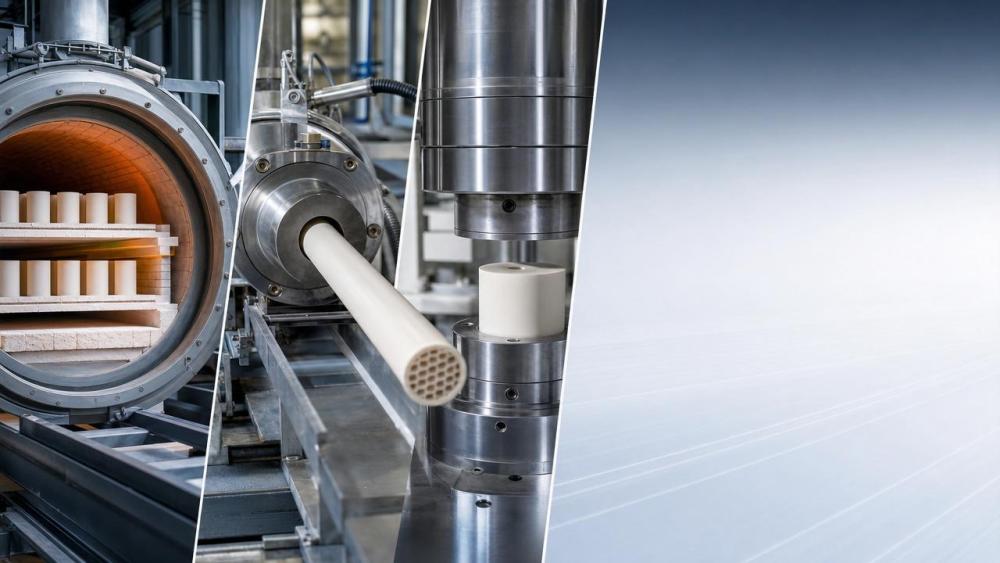
In practice, process choice affects more than forming.
It influences kiln loading, drying behavior, defect patterns, energy recovery design, and production scheduling.
For CF-Elite’s industrial audience, this link is especially clear in heat-intensive manufacturing systems.
Whether the product supports refractory lines, kiln furniture, wear parts, or extrusion-based building materials, forming route matters.
A route that looks cheaper at equipment purchase can become expensive during scale-up.
More obvious signals appear during commissioning, when yield loss and cycle time begin to expose hidden tradeoffs.
The five questions behind a sound decision
- What geometry must be produced consistently at target volume?
- How sensitive is the product to porosity, anisotropy, and density gradients?
- What is the acceptable balance between tooling cost and post-processing cost?
- How much energy can the line absorb without hurting project economics?
- How difficult will process control become during ramp-up and global replication?
These questions keep advanced ceramic processing tied to business outcomes instead of isolated lab performance.
Sintering: the backbone of density and performance
Sintering is usually the thermal heart of advanced ceramic processing.
It transforms a shaped green body into a dense, mechanically stable ceramic through high-temperature particle bonding.
This route is widely used after pressing, casting, or extrusion, so it often acts as the final performance gate.
If densification is uneven, strength, wear life, and thermal shock behavior can all drift.
Where sintering performs best
- Applications needing high density and controlled microstructure.
- Products where final thermal or dielectric performance depends on low residual porosity.
- Industrial parts requiring proven scale-up in kiln-based environments.
Main strengths
- Delivers strong material performance when powder preparation is well controlled.
- Supports a broad range of advanced ceramic processing systems and material chemistries.
- Fits large industrial plants that already manage high-temperature assets efficiently.
Main constraints
- Shrinkage must be predicted accurately, or dimensional drift becomes costly.
- Energy demand is significant, especially for high-density parts and long soak cycles.
- Defects created before firing usually become harder, not easier, to correct later.
From a decision angle, sintering is rarely judged alone.
Its success depends on powder quality, binder removal, thermal uniformity, and reliable furnace control.
That also means advanced ceramic processing projects must connect forming and firing teams from the start.
Extrusion: the efficiency route for continuous shapes
Extrusion is often the most practical route when geometry is long, repeatable, and cross-section driven.
In advanced ceramic processing, it is especially useful for tubes, honeycombs, rods, channels, and structural profiles.
For operations close to building materials, refractories, or thermal components, this route can align well with continuous production logic.
Why extrusion wins in many factories
- High throughput supports commercial-scale output more easily than many batch methods.
- Tooling economics improve when the same cross-section runs for long campaigns.
- Line integration with dryers, cutters, and kilns can be highly efficient.
This is why extrusion remains central in advanced ceramic processing for scalable industrial products.
It turns material flow behavior into a production advantage.
What needs close attention
- Paste rheology must stay stable, or dimensional variation rises quickly.
- Drying stress can crack thin walls or distort complex channels.
- Anisotropy may appear because material flow aligns particles during forming.
In real projects, extrusion works best when geometry standardization is acceptable.
If the product family changes often, die change, formulation adjustment, and startup scrap can erode the expected advantage.
So advanced ceramic processing teams should compare not only output speed, but also campaign stability.
Isostatic pressing: uniformity for demanding parts
Isostatic pressing uses pressure applied from multiple directions to compact powder more uniformly.
In advanced ceramic processing, that uniformity is the main reason engineers choose it.
The method is valuable for parts where density consistency drives performance, reliability, or machining response.
It is commonly considered for higher-value components rather than low-margin mass products.
Best-fit use cases
- Complex or thick sections where density gradients create failure risk.
- Applications requiring better isotropy than uniaxial methods can provide.
- Programs where performance value justifies slower throughput and tighter controls.
Tradeoffs to weigh
- Cycle times are usually longer than extrusion-based production.
- Equipment and handling requirements can raise capital intensity.
- Secondary finishing may still be required after firing.
Even so, isostatic pressing can reduce risk where part failure is expensive.
That matters in advanced ceramic processing decisions tied to service life, warranty exposure, and operating safety.
Side-by-side comparison for process selection
This comparison shows why advanced ceramic processing cannot be reduced to a simple ranking.
Each method becomes optimal only under the right operating and commercial conditions.
How to choose the right advanced ceramic processing route
A useful decision framework starts with product physics, then moves to plant economics.
That sequence helps prevent equipment-led decisions that ignore material behavior.
- Define the final property window, not only the target shape.
- Map defect sensitivity across forming, drying, debinding, and firing.
- Estimate total cost with scrap, energy, tooling, and finishing included.
- Check scale-up realism using expected campaign length and maintenance behavior.
- Align the route with carbon, heat recovery, and efficiency targets.
This is where CF-Elite’s perspective becomes relevant.
In high-temperature industries, advanced ceramic processing decisions should connect with kiln efficiency, thermal balance, and decarbonization planning.
A route that reduces rework and improves thermal consistency often creates value far beyond the forming department.
Final takeaway for industrial decision-making
Sintering, extrusion, and isostatic pressing are not competing answers to the same question.
They are different tools for different advanced ceramic processing priorities.
Choose sintering when final density and material performance drive project value.
Choose extrusion when volume, continuity, and repeatable cross-sections shape the business case.
Choose isostatic pressing when density uniformity and reliability justify higher processing intensity.
The strongest projects compare these routes through total system performance, not isolated equipment preference.
If the goal is better long-term efficiency, advanced ceramic processing should be selected as part of the whole thermal manufacturing strategy.
Related News
 Thermal Energy ArchitectRotary Kiln Efficiency: How Feed Rate, Fuel Use, and Heat Loss Affect OutputRotary kiln efficiency explained: discover how feed rate, fuel use, heat loss, combustion, and cooling performance shape output, quality, and energy costs.Sep 14, 2026
 Thermal Energy ArchitectHow to Select Heat-Resistant Materials That Maintain Abrasion Resistance in KilnsHeat-resistant materials abrasion resistance: learn how to select kiln linings that withstand heat, wear, thermal cycling, and chemical attack for longer service life.Sep 13, 2026
 Thermal Energy ArchitectHow Rotary Kiln Automation Improves Temperature Control and Fuel EfficiencyRotary kiln technology automation enhances temperature control, stabilizes combustion, and improves fuel efficiency with smarter data, predictive control, and safer operations.Sep 12, 2026
 Silicate Process EngineerCement Plant Emission Control: Selecting Systems for Dust, NOx, and SO2 LimitsCement plant emission control guide: compare dust collectors, NOx reduction, and SO2 systems for reliable compliance across kiln modes, fuel changes, and operating upsets.Sep 11, 2026
 Thermal Energy ArchitectSelecting Abrasion-Resistant High-Temperature Materials for Kiln and Conveyor Wear ZonesHigh-temp material engineering guide to abrasion-resistant kiln and conveyor solutions—match wear, heat, chemistry, and installation design for longer service life.Sep 10, 2026
 Dr. Alistair VaughnIndustrial Process Engineering: How to Map Processes for Safer, More Efficient PlantsIndustrial process engineering reveals bottlenecks, safety risks, and energy losses through practical process mapping for safer, more efficient plants.Sep 09, 2026
 Optical Glass Tech FellowHow to Evaluate a Glass Annealing Equipment Manufacturer for Production StabilityChoose a glass annealing equipment manufacturer with proven thermal uniformity, reliable controls, lifecycle value, and responsive service for stable production.Sep 08, 2026
 Prof. Marcus ChenThermal Energy Architecture in North America: Strategies for Lower Building Energy UseThermal energy architecture North America helps project leaders cut building energy use through stronger envelopes, right-sized HVAC, storage, and smart commissioning.Sep 07, 2026
 Ms. Elena RodriguezHow Should Buyers Evaluate Building Material Industry Intelligence Pricing?Building material industry intelligence pricing: learn how to compare coverage, technical depth, and ROI to choose intelligence that reduces procurement risk.Sep 07, 2026
 Ms. Elena RodriguezHow to Use Building Material Intelligence Data for Market and Investment DecisionsBuilding material industry intelligence data helps leaders evaluate demand, costs, regulation, capacity, and technology to make smarter market and investment decisions.Sep 05, 2026
 Thermal Energy ArchitectHow PLC Control Improves Energy Efficiency and Temperature Stability in KilnsEnergy efficient kilns PLC control improves temperature stability, cuts fuel waste, and optimizes combustion, draft, and material flow. Explore proven strategies for smarter kiln modernization.Sep 04, 2026
 Optical Glass Tech FellowEuropean Glass Melting Processes: Furnace Choices, Energy Use, and Quality ControlGlass melting process Europe: explore furnace choices, energy efficiency, cullet strategy, and quality control to improve output, compliance, and long-term glass performance.Sep 03, 2026
 Thermal Energy ArchitectWhat Determines Refractory Lining Monitoring Price for Industrial Kilns?Refractory lining monitoring price depends on kiln size, sensor technology, installation, software, and support. Compare total lifecycle costs and choose the right solution.Sep 02, 2026
 Silicate Process EngineerCement Production System Costs: A Plant Buyer’s Guide to Budgeting and ROICement production systems cost planning made clear: compare CAPEX, operating costs, compliance, and ROI to build a resilient, profitable cement plant investment.Sep 01, 2026
 Dr. Alistair VaughnWhat Should a Process Technology Database Track for High-Temperature Plants?Process technology database essentials for high-temperature plants: track thermal profiles, feed chemistry, refractory wear, emissions, energy, and maintenance for safer, data-driven decisions.Aug 31, 2026
 Ms. Elena RodriguezHow to Evaluate a Silicate Processing Equipment Manufacturer for Plant ProjectsSilicate processing equipment manufacturer selection: assess process fit, guarantees, energy, compliance, delivery risk, and lifecycle support for dependable plant performance.Aug 30, 2026
 Dr. Alistair VaughnHow to Specify Custom Agricultural Processing Equipment for Throughput and HygieneEquipment customization services for agricultural processing: learn to specify hygienic, high-throughput lines that improve yield, reliability, and long-term efficiency.Aug 29, 2026
 Dr. Alistair VaughnHow to Select Process Plant Equipment for High-Temperature, Abrasive Production LinesProcess plant equipment selection for high-temperature, abrasive lines: reduce downtime, improve durability, and optimize lifecycle performance.Aug 28, 2026
 Silicate Process EngineerHow Kiln Heat Recovery Systems Cut Fuel Use in Cement and Lime ProductionKiln heat recovery helps cement and lime plants cut fuel use, improve thermal stability, and build practical, reliable decarbonization strategies.Aug 27, 2026
 Ms. Elena RodriguezProcess Equipment Comparison: Which Metrics Matter Most for Reliable Selection?Process equipment comparison made practical: discover which metrics truly drive reliable selection, from energy efficiency and control stability to wear life, maintainability, and uptime.Aug 26, 2026



Related News
- 00
0000-00
Industrial Process Engineering: How to Map Processes for Safer, More Efficient Plants - 00
0000-00
What Should a Process Technology Database Track for High-Temperature Plants? - 00
0000-00
How to Specify Custom Agricultural Processing Equipment for Throughput and Hygiene - 00
0000-00
How to Select Process Plant Equipment for High-Temperature, Abrasive Production Lines - 00
0000-00
What Causes Thermal Shock Failure in Heat-Resistant Materials During Development?
Weekly Insights
Stay ahead with our curated technology reports delivered every Monday.