
Material Extrusion Machinery Types Explained: Which System Fits Your Product and Throughput?




Material Extrusion Machinery Types Explained: Which System Fits Your Product and Throughput?
Choosing among material extrusion machinery options is not just a technical decision.
It directly shapes product quality, line stability, energy use, and project return.
That is why selection should begin with process reality, not brochure claims.
In practice, the right material extrusion machinery depends on three linked factors.
First, how the material behaves under pressure, shear, and moisture variation.
Second, the required product geometry, density, and surface consistency.
Third, the throughput target, automation level, and lifetime operating cost.
For large industrial projects, weak matching usually appears later as downtime and scrap.
A stronger match improves commissioning speed and protects long-cycle investment decisions.
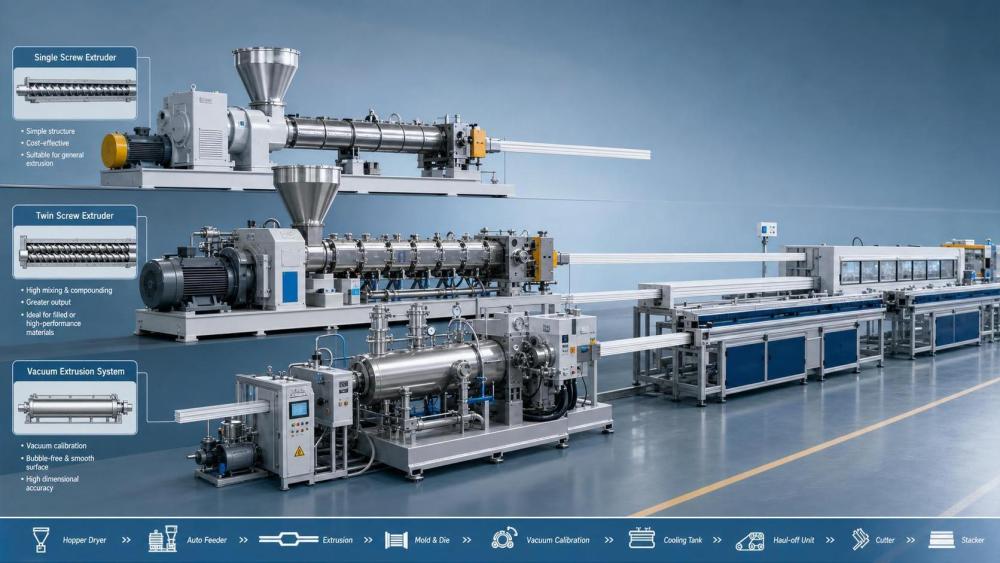
This guide reviews the main material extrusion machinery types and where each fits best.
It also highlights the practical questions that matter before final equipment approval.
Why Material Behavior Should Drive Machinery Selection
Not every extrusion line handles every feed mix with equal reliability.
Some materials flow smoothly with stable moisture and uniform particle size.
Others are abrasive, sticky, fiber-rich, or sensitive to pressure fluctuation.
This is where material extrusion machinery selection becomes a process engineering issue.
For example, clay-based mixes, silicate compounds, and lightweight building materials behave differently.
A line that performs well for dense ceramic bodies may struggle with porous formulations.
From a project perspective, the risk is rarely just low output.
More often, the real cost appears through die wear, unstable dimensions, and frequent cleaning.
That also means early material testing is more valuable than late equipment modification.
Key Material Questions Before Comparing Systems
- What is the normal and worst-case moisture range?
- How abrasive is the feed against screws, barrels, and dies?
- Does the product need hollow sections, dense shapes, or complex profiles?
- How sensitive is the mix to heat build-up during extrusion?
- What level of dimensional tolerance is required after cutting and drying?
Those answers narrow the material extrusion machinery options faster than generic capacity charts.
Main Material Extrusion Machinery Types and Best-Fit Uses
Most industrial lines fall into a few core equipment families.
Each material extrusion machinery type solves a different balance of pressure, mixing, and output.
Single-Screw Extrusion Systems
Single-screw systems are often chosen for stable, relatively consistent material flows.
They are simpler to maintain and usually easier to operate.
For straightforward profiles, they can offer solid cost efficiency.
Their limitation appears when the feed needs stronger homogenization or tighter pressure control.
Twin-Screw Extrusion Systems
Twin-screw material extrusion machinery handles more demanding formulations.
It offers stronger mixing, better feed control, and improved adaptability.
This can help when raw materials vary by source or seasonal condition.
The tradeoff is higher capital cost and more detailed maintenance planning.
Vacuum Extrusion Systems
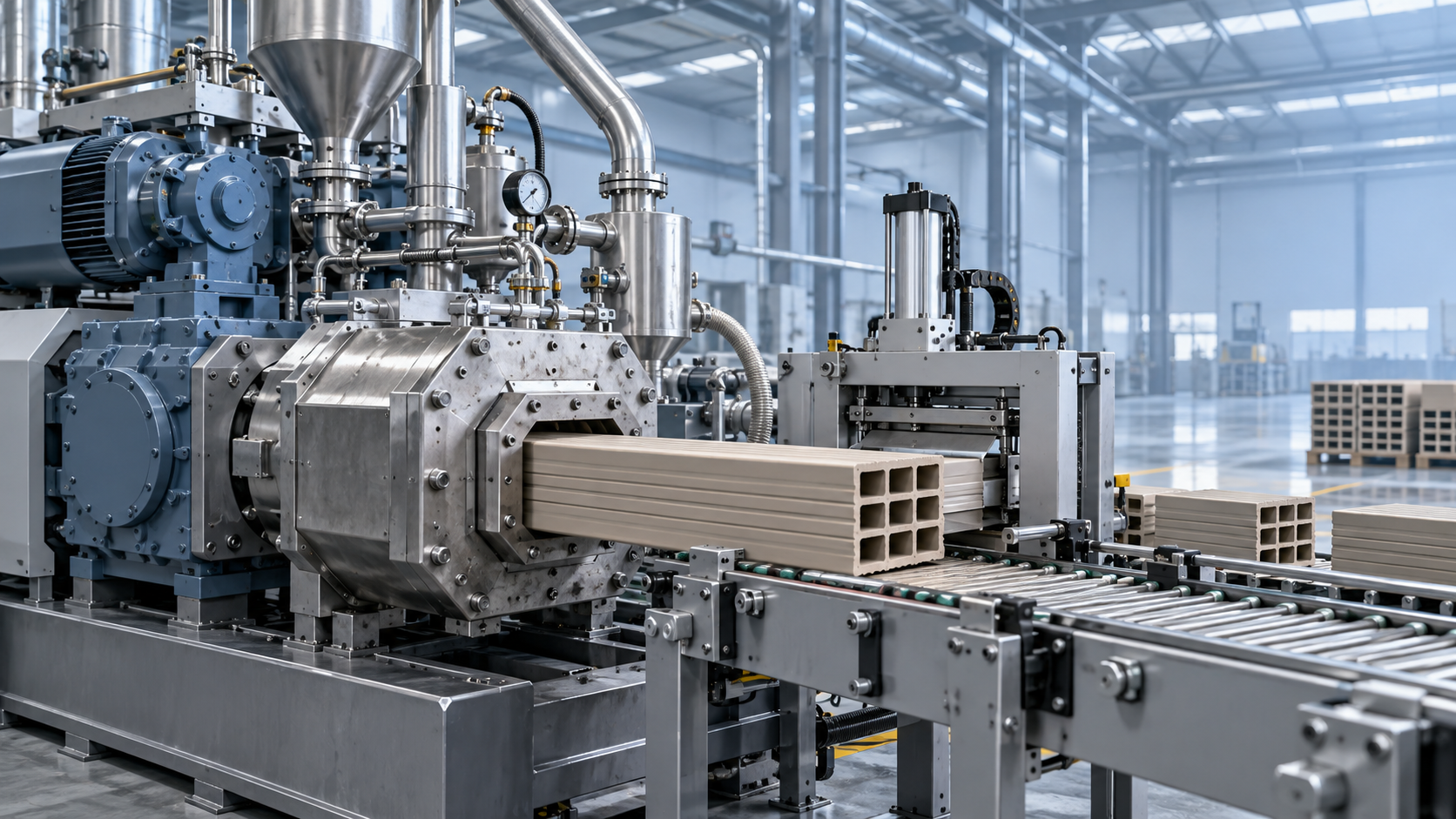
Vacuum-equipped systems remove trapped air before shaping.
That improves density consistency and reduces internal defects.
They are widely used when product structure and finish quality are critical.
In many building material applications, vacuum capability supports more stable downstream drying.
Piston or Ram Extrusion Systems
Ram-based systems suit high-pressure forming with lower continuous flow demand.
They are useful for difficult bodies or special shapes.
However, they are not always ideal for very high-throughput continuous production.
De-Airing and High-Pressure Combined Lines
Some advanced material extrusion machinery combines pre-mixing, de-airing, and high-pressure shaping.
These lines target industrial users needing better consistency at scale.
They usually make sense when quality losses cost more than system complexity.
How Throughput Changes the Right Equipment Decision
Throughput targets often distort machinery selection in the early planning stage.
A common mistake is choosing the largest unit for future expansion only.
That sounds safe, but oversized material extrusion machinery can create new problems.
Low-load operation may reduce pressure stability and increase specific energy consumption.
It can also complicate moisture balance and cutting synchronization.
On the other hand, undersized machinery creates chronic bottlenecks.
Those bottlenecks usually spread into mixers, dryers, handling systems, and labor efficiency.
A Practical Throughput Review Framework
- Define rated output, not just peak output.
- Check stable output across different feed conditions.
- Include startup losses and changeover frequency.
- Review how extrusion speed affects downstream curing or firing.
- Estimate wear cost per ton, not only equipment nameplate capacity.
This approach gives a more honest basis for comparing material extrusion machinery suppliers.
Selection Factors Beyond the Extruder Itself
An extruder never works alone in a real plant environment.
That is why material extrusion machinery evaluation should include the entire production chain.
The stronger signal in recent projects is integration, not isolated machine performance.
Upstream Compatibility
Feed preparation quality directly affects extrusion consistency.
If crushing, screening, or mixing is unstable, even premium machinery performs poorly.
Die and Tooling Strategy
The die is not a small accessory.
It strongly influences pressure drop, shape retention, and changeover time.
For multi-product plants, tooling flexibility can justify a higher initial machine cost.
Automation and Monitoring
Modern material extrusion machinery increasingly includes load, vacuum, pressure, and temperature monitoring.
That matters because early deviation signals reduce unplanned shutdowns.
In complex industrial lines, digital visibility is often a risk-control tool.
Energy and Carbon Performance
Selection today also connects to decarbonization and operating efficiency goals.
Better matched machinery reduces wasted power and avoidable reprocessing.
For energy-intensive industries, that improvement becomes strategically important over time.
Common Selection Mistakes in Material Extrusion Machinery Projects
Even experienced teams can misread early signals during vendor comparison.
Most errors happen when commercial pressure moves faster than technical validation.
- Selecting by headline capacity without verifying stable operating range.
- Ignoring raw material variability during pilot testing.
- Underestimating wear parts cost in abrasive formulations.
- Comparing purchase price without lifecycle service support.
- Treating the extruder as separate from drying, firing, or handling constraints.
Avoiding these mistakes usually saves more money than negotiating a lower sticker price.
A Decision Path for Shortlisting the Right System
A useful selection path keeps the team focused on production reality.
It also makes supplier discussions more transparent and measurable.
- Start with product specifications and acceptable quality deviation.
- Map raw material behavior under real plant conditions.
- Set realistic throughput by shift, season, and maintenance window.
- Compare material extrusion machinery by process fit, not marketing rank.
- Request pilot data, wear assumptions, and utility consumption benchmarks.
- Review integration with upstream preparation and downstream thermal stages.
This is where intelligence-led evaluation becomes especially valuable.
At CF-Elite, equipment insight is strongest when linked with thermal efficiency and process continuity.
That wider view helps industrial teams avoid narrow choices with expensive downstream consequences.
Final Takeaway
The best material extrusion machinery is not the most complex or the largest.
It is the system that fits your material, product design, throughput plan, and operating model.
When selection is grounded in testing, integration, and lifecycle thinking, project risk drops sharply.
That also improves energy performance, quality consistency, and long-term plant resilience.
If the next decision is a shortlist, begin with real feed behavior and required output stability.
That simple step usually leads to a better material extrusion machinery decision than any catalog alone.
Related News
 Optical Glass Tech FellowSilicate Process Automation: Improving Batch Consistency and Energy ControlSilicate process automation improves batch consistency, energy control, traceability, and operator confidence across high-temperature manufacturing operations.Sep 22, 2026
 Optical Glass Tech FellowHow Silicate Industrial Processes Control Viscosity, Energy Use, and Product QualitySilicate industrial processes: learn how viscosity, chemistry, heat transfer, and atmosphere control reduce energy use, improve stability, and protect product quality.Sep 21, 2026
 Thermal Energy ArchitectHow European Plants Can Evaluate Energy Recovery Equipment for High-Temperature ProcessesIndustrial energy recovery equipment Europe: learn how high-temperature plants can assess waste-heat sources, integration risks, lifecycle value, and reliable recovery routes.Sep 20, 2026
 Thermal Energy ArchitectIndustrial Furnace Process Optimization: Reducing Fuel Use Without Sacrificing ThroughputIndustrial process optimization furnace strategies that cut fuel use while protecting throughput. Explore combustion control, heat recovery, refractory performance, and data-driven efficiency gains.Sep 19, 2026
 Ms. Elena RodriguezWhat Drives High-Pressure Extrusion Equipment Cost in Industrial Projects?High pressure extrusion equipment cost explained: compare pressure, die design, automation, wear, energy, and installation factors for smarter industrial investments.Sep 18, 2026
 Thermal Energy ArchitectHow to Size a Waste Heat Recovery Exchanger for High-Temperature Kiln Exhaust?Waste heat recovery exchanger sizing for high-temperature kiln exhaust: balance recoverable duty, fouling, corrosion limits, pressure drop, and reliable heat use.Sep 17, 2026
 Thermal Energy ArchitectWhy Heat-Resistant Materials Lose Abrasion Resistance at High TemperaturesHeat-resistant materials abrasion resistance can decline at high temperatures. Discover the thermal, chemical, and mechanical causes of wear—and how to choose longer-lasting linings.Sep 16, 2026
 Thermal Energy ArchitectHow to Evaluate a Thermal Energy Optimization Company for High-Temperature PlantsChoose a thermal energy optimization company with proven process expertise, measurable savings, and reliable delivery for high-temperature plants. Learn what to assess.Sep 15, 2026
 Thermal Energy ArchitectRotary Kiln Efficiency: How Feed Rate, Fuel Use, and Heat Loss Affect OutputRotary kiln efficiency explained: discover how feed rate, fuel use, heat loss, combustion, and cooling performance shape output, quality, and energy costs.Sep 14, 2026
 Thermal Energy ArchitectHow to Select Heat-Resistant Materials That Maintain Abrasion Resistance in KilnsHeat-resistant materials abrasion resistance: learn how to select kiln linings that withstand heat, wear, thermal cycling, and chemical attack for longer service life.Sep 13, 2026
 Thermal Energy ArchitectHow Rotary Kiln Automation Improves Temperature Control and Fuel EfficiencyRotary kiln technology automation enhances temperature control, stabilizes combustion, and improves fuel efficiency with smarter data, predictive control, and safer operations.Sep 12, 2026
 Silicate Process EngineerCement Plant Emission Control: Selecting Systems for Dust, NOx, and SO2 LimitsCement plant emission control guide: compare dust collectors, NOx reduction, and SO2 systems for reliable compliance across kiln modes, fuel changes, and operating upsets.Sep 11, 2026
 Thermal Energy ArchitectSelecting Abrasion-Resistant High-Temperature Materials for Kiln and Conveyor Wear ZonesHigh-temp material engineering guide to abrasion-resistant kiln and conveyor solutions—match wear, heat, chemistry, and installation design for longer service life.Sep 10, 2026
 Dr. Alistair VaughnIndustrial Process Engineering: How to Map Processes for Safer, More Efficient PlantsIndustrial process engineering reveals bottlenecks, safety risks, and energy losses through practical process mapping for safer, more efficient plants.Sep 09, 2026
 Optical Glass Tech FellowHow to Evaluate a Glass Annealing Equipment Manufacturer for Production StabilityChoose a glass annealing equipment manufacturer with proven thermal uniformity, reliable controls, lifecycle value, and responsive service for stable production.Sep 08, 2026
 Prof. Marcus ChenThermal Energy Architecture in North America: Strategies for Lower Building Energy UseThermal energy architecture North America helps project leaders cut building energy use through stronger envelopes, right-sized HVAC, storage, and smart commissioning.Sep 07, 2026
 Ms. Elena RodriguezHow Should Buyers Evaluate Building Material Industry Intelligence Pricing?Building material industry intelligence pricing: learn how to compare coverage, technical depth, and ROI to choose intelligence that reduces procurement risk.Sep 07, 2026
 Ms. Elena RodriguezHow to Use Building Material Intelligence Data for Market and Investment DecisionsBuilding material industry intelligence data helps leaders evaluate demand, costs, regulation, capacity, and technology to make smarter market and investment decisions.Sep 05, 2026
 Thermal Energy ArchitectHow PLC Control Improves Energy Efficiency and Temperature Stability in KilnsEnergy efficient kilns PLC control improves temperature stability, cuts fuel waste, and optimizes combustion, draft, and material flow. Explore proven strategies for smarter kiln modernization.Sep 04, 2026
 Optical Glass Tech FellowEuropean Glass Melting Processes: Furnace Choices, Energy Use, and Quality ControlGlass melting process Europe: explore furnace choices, energy efficiency, cullet strategy, and quality control to improve output, compliance, and long-term glass performance.Sep 03, 2026



Related News
- 00
0000-00
How to Evaluate Lightweight Material Machinery for Output, Energy Use, and Product Quality - 00
0000-00
What Thermal Barrier Technology Works Best for Lightweight Industrial Panels? - 00
0000-00
Advanced Ceramic Processing for Honeycomb: Which Methods Improve Strength and Thermal Shock Resistance? - 00
0000-00
Building Material Extrusion Equipment Supplier Selection: 7 Parameters That Affect Line Performance - 00
0000-00
High Pressure Extruder Selection Guide: Output, Material Compatibility, and Wear
Weekly Insights
Stay ahead with our curated technology reports delivered every Monday.