
Advanced Material Extrusion Explained: Process Limits, Material Options, and Best-Fit Applications




Advanced Material Extrusion: Why It Matters Now
Advanced material extrusion is no longer a niche forming method.
It now supports lightweight panels, refractory profiles, ceramic honeycombs, and specialty building products.
That shift matters because manufacturers want three things at once.
They need tighter geometry control, higher line efficiency, and lower energy intensity.
Advanced material extrusion sits at that intersection.
In practical terms, the process forces bulk material through a shaped die under controlled pressure.
The feedstock may be clay-rich, silicate-based, cementitious, ceramic-filled, or highly engineered.
What changes from one line to another is the rheology window, moisture balance, temperature profile, and downstream handling logic.
From a technical and standards perspective, the real value is not just shaping material.
It is producing consistent sections at industrial scale without losing mechanical integrity.
That also explains why advanced material extrusion deserves close evaluation in thermal industries and green construction supply chains.
How Advanced Material Extrusion Works on an Industrial Line
At its core, advanced material extrusion is a pressure-driven forming sequence.
Raw materials are first blended to achieve stable particle size distribution and binder dispersion.
Next comes conditioning.
This stage adjusts moisture, plasticity, vacuum level, and sometimes preheating.
The conditioned mass then enters a screw or ram system.
Pressure builds as the material approaches the die land.
There, flow uniformity becomes critical.
Any imbalance can cause warping, density gradients, lamination, or edge cracking.
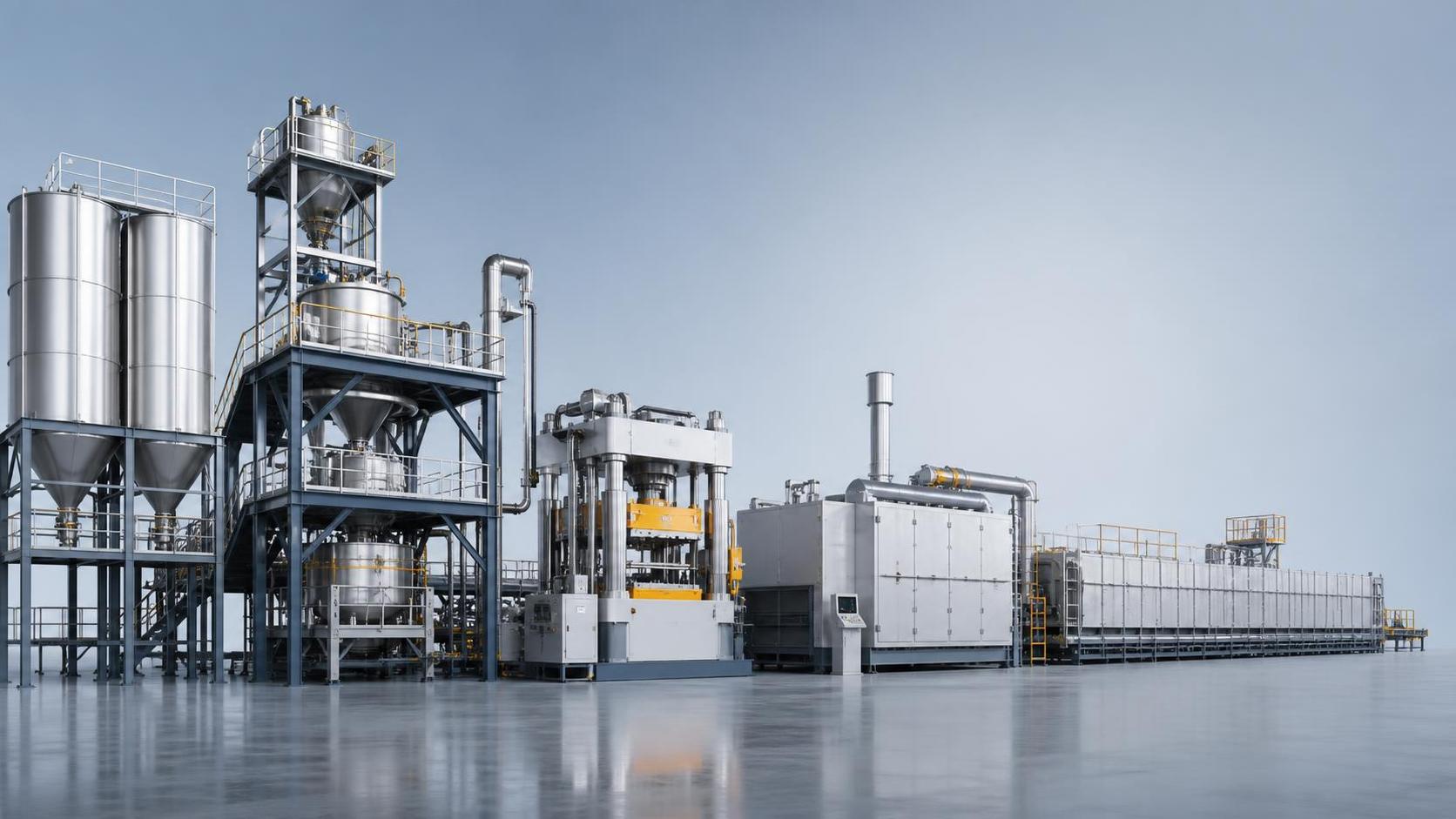
After exiting the die, the green body enters cutting, support transfer, drying, firing, curing, or sintering steps.
In high-temperature sectors, that downstream sequence often decides commercial success more than the extruder alone.
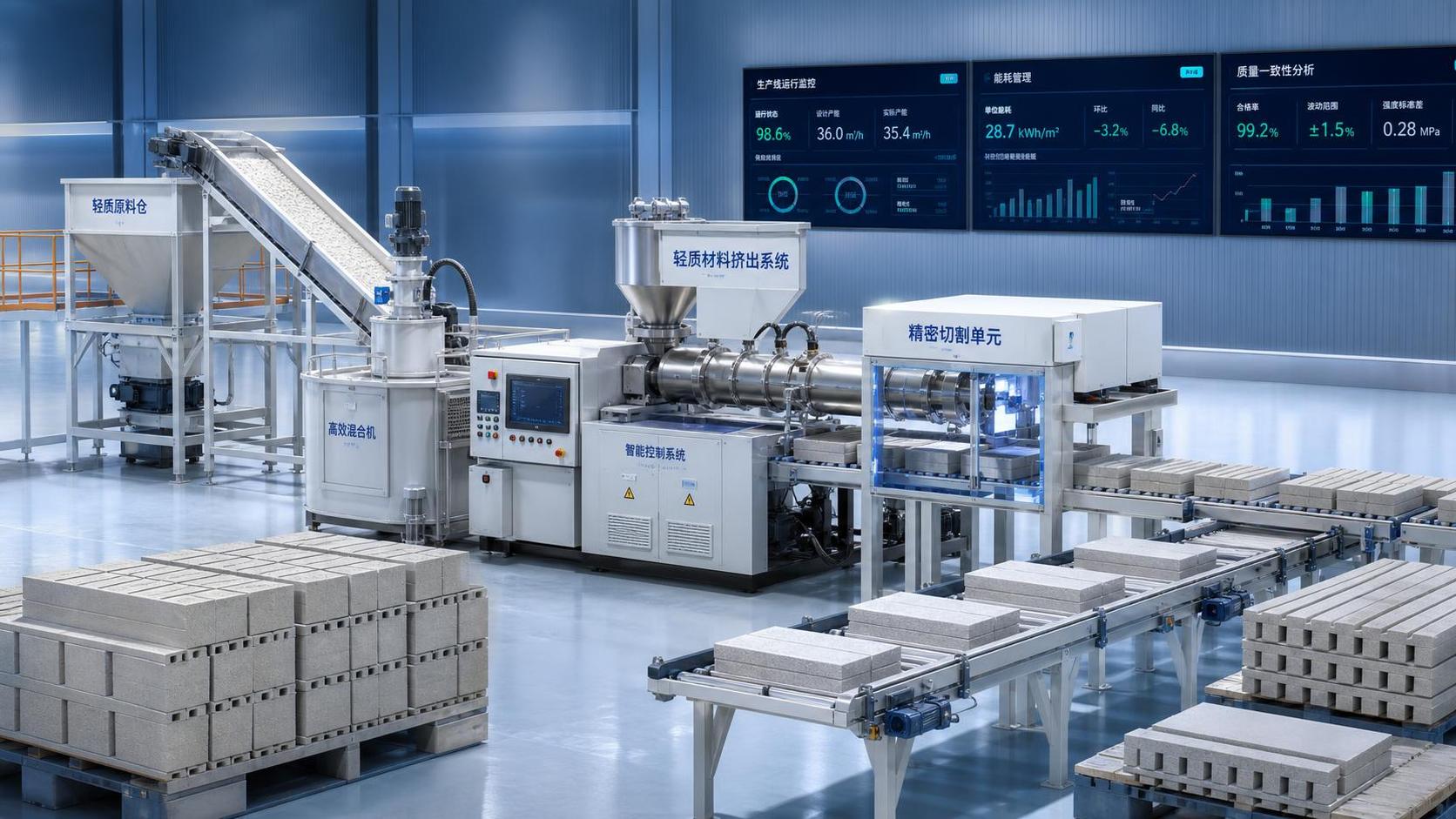
This is where line intelligence matters.
Vacuum de-airing, pressure sensors, torque tracking, online dimensional monitoring, and digital twin models reduce trial-and-error losses.
For decision makers, advanced material extrusion should be reviewed as a full process system, not an isolated machine.
Key Process Variables
- Feed moisture and binder ratio define plasticity and shape retention.
- Particle size distribution affects pressure demand and die wear.
- Vacuum quality influences porosity, cracks, and internal defects.
- Screw speed or ram force changes throughput and shear heating.
- Die geometry controls flow balance, surface finish, and dimensional tolerance.
- Drying or firing schedule determines final strength and deformation risk.
Process Limits: Where Advanced Material Extrusion Struggles
Every forming technology has a performance envelope.
Advanced material extrusion is highly capable, but it is not infinitely flexible.
The first limit is rheology.
If the mass is too stiff, pressure rises fast, die wear accelerates, and throughput drops.
If it is too soft, the profile may slump before drying or setting.
The second limit is geometry complexity.
Long hollow sections and thin webs are possible, but only within a stable pressure and support range.
Very sharp corners and abrupt wall transitions usually create uneven flow paths.
Another constraint is material sensitivity during drying and thermal treatment.
A profile that looks perfect at extrusion can fail later from shrinkage mismatch or thermal stress.
This is especially relevant for silicates, refractories, and mineral blends with complex phase changes.
Then there is scale.
Lab results often look promising, but industrial lines expose issues in wear, cleaning, stability, and energy use.
In other words, advanced material extrusion works best when formulation, die design, and thermal treatment are developed together.
Common Failure Modes to Watch
- Die swell that pushes sections outside tolerance.
- Edge tearing from excessive shear or poor lubrication.
- Lamination caused by trapped air or weak mixing.
- Post-extrusion collapse during transfer or early drying.
- Thermal cracking linked to uneven moisture removal.
- Rapid component wear under abrasive mineral formulations.
Material Options: What Can Be Processed Successfully
The most useful way to review advanced material extrusion is by material family.
Different systems demand different pressure windows, binder strategies, and thermal routes.
Clay and silicate blends remain the most established group.
They are widely used for bricks, hollow blocks, decorative profiles, and special building envelopes.
Cementitious mixes are also growing, especially where low-temperature curing and lightweight structures are prioritized.
Refractory masses are another important category.
These include alumina-rich, silica-based, and specialty insulating compositions for thermal barriers and furnace internals.
Ceramic honeycomb formulations are especially relevant in filtration and catalytic support applications.
They require very fine control of wall thickness and green strength.
More recently, advanced material extrusion has expanded into composite and engineered mineral systems.
These may combine fillers, fibers, pore-formers, or recycled industrial inputs.
That trend supports carbon reduction goals, but it also increases formulation complexity.
Typical Material Fit by Process Need
Best-Fit Applications for Advanced Material Extrusion
Not every product should be extruded.
The best-fit applications share a few clear traits.
They need continuous profiles, repeatable cross-sections, and scalable output.
That is why advanced material extrusion performs well in lightweight wall systems, hollow construction units, kiln furniture, refractory channels, and porous ceramic supports.
In building materials, the process supports greener structures through void design and mass reduction.
In thermal industries, it enables controlled insulation geometry and longer service life when formulations are matched correctly.
Filtration and catalyst sectors also benefit because advanced material extrusion can create fine, high-surface-area channels at industrial speed.
From a business view, the strongest cases are usually products with stable demand and costly manual forming alternatives.
That is the point where automation, yield improvement, and energy savings start to compound.
Where It Usually Delivers the Most Value
- Lightweight blocks and panels for lower transport and installation loads.
- Refractory sections for kilns, furnaces, and heat-processing systems.
- Ceramic honeycombs for filtration, emissions control, and catalytic functions.
- Decorative or functional architectural profiles with repeatable geometry.
- Specialty mineral products using recycled or low-carbon input streams.
Evaluation Checklist for Equipment and Line Strategy
From recent market shifts, a clearer signal is emerging.
Advanced material extrusion decisions are moving away from simple capacity comparisons.
Operators now compare full lifecycle efficiency, digital control depth, carbon impact, and raw material flexibility.
That means equipment screening should be practical and cross-functional.
- Define the target product window, including section size, tolerance, and surface quality.
- Test feedstock variability, not just ideal lab batches.
- Check die service life, wear parts cost, and cleaning downtime.
- Review drying, curing, or firing compatibility before approving line speed.
- Measure energy use per qualified output, not per nameplate capacity.
- Assess whether sensors and data systems support stable long-cycle operation.
- Validate environmental compliance for dust, waste heat, and material reuse.
In real projects, these checks reduce the risk of buying a fast extruder for a slow downstream line.
They also help separate true advanced material extrusion capability from basic forming hardware with limited process control.
Final Takeaway
Advanced material extrusion is most powerful when it is treated as a linked system.
Process limits, material options, and end-use demands must be aligned from the start.
For silicate plants, refractory lines, and green building materials, that alignment can unlock better yield, lower energy use, and more resilient product quality.
The practical next step is simple.
Map the material behavior, die constraints, and thermal pathway together before comparing suppliers or scaling output targets.
That is usually where a strong advanced material extrusion strategy begins to outperform standard forming choices.
Related News
 Optical Glass Tech FellowHow to Evaluate a Glass Annealing Equipment Manufacturer for Production StabilityChoose a glass annealing equipment manufacturer with proven thermal uniformity, reliable controls, lifecycle value, and responsive service for stable production.Sep 08, 2026
 Prof. Marcus ChenThermal Energy Architecture in North America: Strategies for Lower Building Energy UseThermal energy architecture North America helps project leaders cut building energy use through stronger envelopes, right-sized HVAC, storage, and smart commissioning.Sep 07, 2026
 Ms. Elena RodriguezHow Should Buyers Evaluate Building Material Industry Intelligence Pricing?Building material industry intelligence pricing: learn how to compare coverage, technical depth, and ROI to choose intelligence that reduces procurement risk.Sep 07, 2026
 Ms. Elena RodriguezHow to Use Building Material Intelligence Data for Market and Investment DecisionsBuilding material industry intelligence data helps leaders evaluate demand, costs, regulation, capacity, and technology to make smarter market and investment decisions.Sep 05, 2026
 Thermal Energy ArchitectHow PLC Control Improves Energy Efficiency and Temperature Stability in KilnsEnergy efficient kilns PLC control improves temperature stability, cuts fuel waste, and optimizes combustion, draft, and material flow. Explore proven strategies for smarter kiln modernization.Sep 04, 2026
 Optical Glass Tech FellowEuropean Glass Melting Processes: Furnace Choices, Energy Use, and Quality ControlGlass melting process Europe: explore furnace choices, energy efficiency, cullet strategy, and quality control to improve output, compliance, and long-term glass performance.Sep 03, 2026
 Thermal Energy ArchitectWhat Determines Refractory Lining Monitoring Price for Industrial Kilns?Refractory lining monitoring price depends on kiln size, sensor technology, installation, software, and support. Compare total lifecycle costs and choose the right solution.Sep 02, 2026
 Silicate Process EngineerCement Production System Costs: A Plant Buyer’s Guide to Budgeting and ROICement production systems cost planning made clear: compare CAPEX, operating costs, compliance, and ROI to build a resilient, profitable cement plant investment.Sep 01, 2026
 Dr. Alistair VaughnWhat Should a Process Technology Database Track for High-Temperature Plants?Process technology database essentials for high-temperature plants: track thermal profiles, feed chemistry, refractory wear, emissions, energy, and maintenance for safer, data-driven decisions.Aug 31, 2026
 Ms. Elena RodriguezHow to Evaluate a Silicate Processing Equipment Manufacturer for Plant ProjectsSilicate processing equipment manufacturer selection: assess process fit, guarantees, energy, compliance, delivery risk, and lifecycle support for dependable plant performance.Aug 30, 2026
 Dr. Alistair VaughnHow to Specify Custom Agricultural Processing Equipment for Throughput and HygieneEquipment customization services for agricultural processing: learn to specify hygienic, high-throughput lines that improve yield, reliability, and long-term efficiency.Aug 29, 2026
 Dr. Alistair VaughnHow to Select Process Plant Equipment for High-Temperature, Abrasive Production LinesProcess plant equipment selection for high-temperature, abrasive lines: reduce downtime, improve durability, and optimize lifecycle performance.Aug 28, 2026
 Silicate Process EngineerHow Kiln Heat Recovery Systems Cut Fuel Use in Cement and Lime ProductionKiln heat recovery helps cement and lime plants cut fuel use, improve thermal stability, and build practical, reliable decarbonization strategies.Aug 27, 2026
 Ms. Elena RodriguezProcess Equipment Comparison: Which Metrics Matter Most for Reliable Selection?Process equipment comparison made practical: discover which metrics truly drive reliable selection, from energy efficiency and control stability to wear life, maintainability, and uptime.Aug 26, 2026
 Ms. Elena RodriguezWhat Buyers Should Check Before Sourcing Precision Alloy Bars for Critical PartsPrecision Alloy Bars buyers should verify grade, chemistry, tolerances, surface quality, traceability, and lead time before sourcing for critical parts. Learn what prevents costly machining and reliability risks.Aug 27, 2026
 Ms. Elena RodriguezHow to Evaluate Thermal Management Solutions Insulation for High-Heat Industrial SystemsThermal management solutions insulation: learn how to assess high-heat industrial systems by thermal performance, durability, lifecycle cost, and supplier data for smarter decisions.Aug 25, 2026
 Ms. Elena RodriguezWhat Drives Waste Recycling Cost in Industrial Projects and How to Estimate It?Waste recycling cost in industrial projects depends on composition, moisture, transport, pre-treatment, and compliance. Learn how to estimate it accurately and compare suppliers with confidence.Aug 24, 2026
 Silicate Process EngineerHow to Evaluate Cement Production Plants in the Middle East for Capacity, Fuel Flexibility, and ROIcement production plants Middle East: Learn how to assess true capacity, fuel flexibility, and ROI risks to identify resilient assets and smarter investment opportunities.Aug 23, 2026
 Structural Material AnalystHow to Evaluate Lightweight Material Machinery for Output, Energy Use, and Product QualityLightweight material machinery evaluation guide: compare stable output, energy use, and product quality to choose equipment that cuts waste, lowers costs, and improves production confidence.Aug 22, 2026
 Material Heat-Resist ExpertWhat Determines Refractory Production Line Price in a Turnkey Plant Project?Refractory production line price depends on raw materials, forming method, kiln and drying design, automation, utilities, and scope. Learn what really drives turnkey plant cost before you invest.Aug 21, 2026

Related News
- 00
0000-00
What Should a Process Technology Database Track for High-Temperature Plants? - 00
0000-00
How to Specify Custom Agricultural Processing Equipment for Throughput and Hygiene - 00
0000-00
How to Select Process Plant Equipment for High-Temperature, Abrasive Production Lines - 00
0000-00
What Causes Thermal Shock Failure in Heat-Resistant Materials During Development? - 00
0000-00
How Digital Twin Simulations Improve Process Plant Design, Safety, and Uptime
Weekly Insights
Stay ahead with our curated technology reports delivered every Monday.