
How to Evaluate a Refractory Production Line in Southeast Asia: Capacity, Fuel, and Raw Material Factors




How to Evaluate a Refractory Production Line in Southeast Asia: Capacity, Fuel, and Raw Material Factors
Evaluating a refractory production line in Southeast Asia requires more than comparing equipment sizes or project costs.
The better question is whether the line can stay efficient, stable, and compliant for years.
That is the core issue in refractory production Southeast Asia projects today.
Demand is growing with steel, cement, foundry, and glass investment across the region.
At the same time, fuel volatility, uneven raw material quality, and environmental pressure are reshaping investment decisions.
A useful evaluation framework should connect process design with market access, energy resilience, and operating risk.
In practical terms, three factors matter most: capacity, fuel, and raw material stability.
When these are aligned, refractory production Southeast Asia investments are easier to scale and defend.
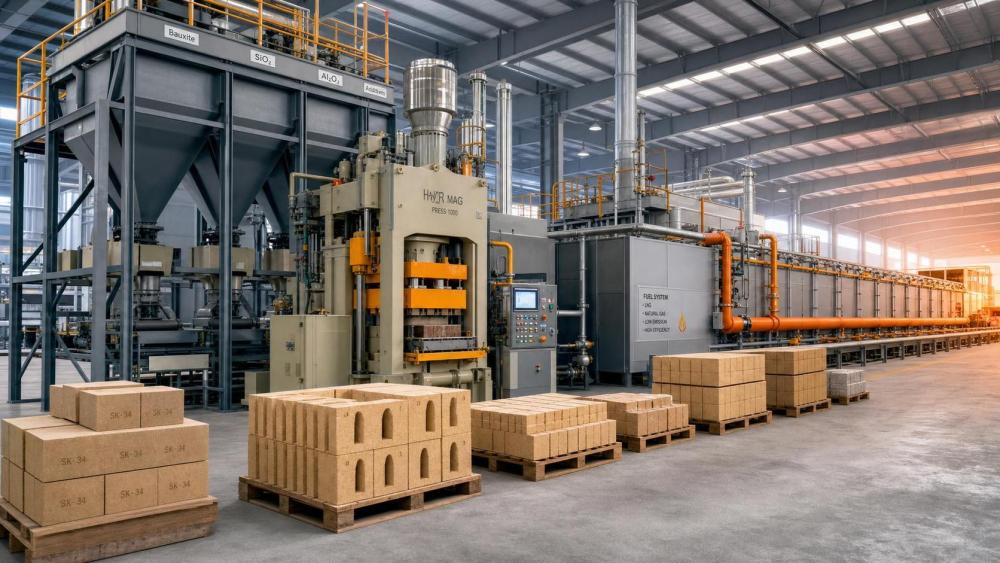
Start with Capacity That Fits Real Market Demand
Capacity is usually the first number investors compare, but it should never stand alone.
For refractory production Southeast Asia projects, oversized lines can become expensive and slow to stabilize.
Undersized lines can limit product range, raise unit costs, and weaken customer response times.
The right capacity depends on product mix, not only annual tonnage.
Dense bricks, castables, insulating products, and shaped specialty blocks create different bottlenecks.
Pressing, drying, firing, and packaging may each limit throughput at different times.
From recent market shifts, the clearer signal is flexibility over headline scale.
A line that can switch faster between grades often creates more value than a larger fixed-volume system.
This matters because refractory production Southeast Asia demand is fragmented across many industrial users.
What to check in capacity planning
- Nameplate output versus stable commercial output after six to twelve months.
- Shift pattern assumptions, labor availability, and maintenance downtime.
- Product changeover time between high-alumina, magnesia, and insulating grades.
- Drying and firing cycle length for the target quality standard.
- Warehouse and dispatch capacity during seasonal demand peaks.
A sound investment model should include utilization scenarios at 60%, 75%, and 90%.
That reveals whether refractory production Southeast Asia economics still hold during slower market cycles.
Evaluate Fuel Strategy Beyond Current Energy Prices
Fuel choice has a direct effect on operating cost, thermal stability, and emission compliance.
That is especially true for refractory production Southeast Asia, where regional energy structures vary sharply.
Natural gas may be attractive in one country and structurally limited in another.
Coal, LPG, fuel oil, biomass blending, or electric heating each change the project profile.
The wrong decision can lock a plant into unstable margins for years.
A better approach is to test fuel availability, price volatility, combustion performance, and local regulation together.
This also means looking at burner design and kiln control logic early in the evaluation process.
In actual operations, fuel flexibility often protects profitability more than a low starting tariff.
Key fuel questions for line selection
- Can the kiln or tunnel furnace handle more than one primary fuel?
- How stable is the temperature profile during fuel switching?
- What are the expected NOx, SOx, and particulate control costs?
- Is there reliable utility infrastructure near the plant site?
- How sensitive is finished quality to flame characteristics and heat distribution?
For refractory production Southeast Asia, this analysis should include a three to five year energy outlook.
Carbon policies are tightening, and customers are asking harder questions about embodied emissions.
That makes fuel efficiency, waste heat use, and emissions reporting part of commercial competitiveness.
Raw Material Security Often Decides Long-Term Plant Performance
Raw material planning is where many refractory projects quietly succeed or fail.
For refractory production Southeast Asia, stable ore chemistry matters as much as delivered price.
Bauxite, alumina, magnesia, chamotte, silica, binders, and additives can differ widely by source.
Small changes in Fe2O3, alkali content, particle size, or moisture can disrupt firing behavior.
They can also reduce refractoriness, dimensional accuracy, or thermal shock resistance.
That is why supply security must be treated as a technical issue, not only a purchasing issue.
The more advanced the product, the less tolerance there is for inconsistency.
This is increasingly relevant as refractory production Southeast Asia moves toward higher-performance industrial applications.
Raw material checks before final investment
- Map at least two qualified suppliers for every critical mineral input.
- Verify chemical composition consistency across different shipment lots.
- Check import duties, port handling limits, and inland logistics risk.
- Test how raw material variation affects pressing density and firing shrinkage.
- Review storage design for humidity control and contamination prevention.
A pilot production trial is often more useful than a spreadsheet comparison.
It shows whether the chosen line can absorb raw material variation without hurting quality or output.
Compare the Full Process, Not Isolated Equipment
A refractory plant performs as a system, not as a list of machines.
That sounds obvious, but it is often missed in refractory production Southeast Asia evaluations.
Mixing accuracy, molding pressure, dryer uniformity, kiln control, and quality inspection are tightly linked.
A strong kiln cannot compensate for poor batching or unstable green body density.
Likewise, advanced pressing equipment loses value if the raw feed preparation is inconsistent.
This also affects automation investment decisions.
Digital controls, recipe management, and online monitoring can improve repeatability and traceability.
But they only pay back if the process architecture is coherent from the start.
Include Local Compliance, Service, and Expansion Potential
A technically strong line can still become a weak investment if local execution is ignored.
For refractory production Southeast Asia, permitting, utilities, spare parts access, and technical service matter early.
Environmental approvals may affect burner choice, dust collection design, and wastewater handling.
Local maintenance capability also affects ramp-up speed and long-term uptime.
More importantly, expansion should be designed before the first civil work begins.
A line that supports future kiln addition, storage growth, or automation upgrades is easier to finance later.
This creates a stronger path for refractory production Southeast Asia operations facing changing customer demand.
A practical decision checklist
- Match designed output to sellable product mix, not optimistic forecasts.
- Prefer fuel-flexible thermal systems where regional energy risk is high.
- Validate raw materials through lab and pilot trials before final supplier lock-in.
- Review emissions, dust, and safety compliance with local advisors.
- Check after-sales support response time, spare strategy, and operator training plan.
- Reserve land, utilities, and controls architecture for future expansion.
The strongest refractory production Southeast Asia projects are rarely the cheapest on paper.
They are the ones built around realistic throughput, resilient fuel strategy, and dependable raw material inputs.
That combination improves quality consistency, protects margins, and reduces operational surprises.
In a market shaped by cost pressure and stricter environmental expectations, that is a serious competitive advantage.
When evaluating refractory production Southeast Asia opportunities, use capacity, fuel, and raw materials as one integrated decision model, then test every assumption against local operating reality.
Related News
 Ms. Elena RodriguezHigh-Pressure Molding Innovations: How Automation and Tooling Affect PriceExplore the high-pressure molding innovations price equation: compare automation, tooling, and ownership costs to find upgrades that cut waste and deliver measurable value.Oct 13, 2026
 Ms. Elena RodriguezIndustrial Process Optimization: Where to Target Energy, Yield, and Throughput LossesIndustrial process optimization: identify energy, yield, and throughput losses to improve plant stability, reduce costs, and unlock measurable performance gains.Oct 12, 2026
 Ms. Elena RodriguezGlass Market Intelligence: How to Assess Demand, Capacity, and Regional Growth RisksGlass market intelligence for evaluating demand, effective capacity, energy exposure, trade dynamics, and regional growth risks before investing in glass manufacturing.Oct 11, 2026
 Ms. Elena RodriguezAre Green Building Materials More Expensive to Manufacture?Are green building materials more expensive to manufacture? Explore cost drivers, savings opportunities, and how sustainable production can strengthen long-term competitiveness.Oct 13, 2026
 Structural Material AnalystWhich Sustainable Construction Materials Are Suitable for Extrusion?Which sustainable construction materials are suitable for extrusion? Explore recycled clay, cementitious mixes, geopolymers, and bio-composites for reliable, lower-impact building products.Oct 12, 2026
 Optical Glass Tech FellowWhat Should a Glass Furnace Energy Specification Include?What should be included in a glass furnace energy specification? Explore performance, fuel flexibility, heat recovery, emissions, and monitoring essentials.Oct 11, 2026
 Dr. Alistair VaughnHow Process Technology Platforms Improve Control Across Multi-Line ManufacturingDiscover how a process technology platform strengthens cross-line control, connects operational data, and improves energy, quality, and maintenance decisions.Oct 10, 2026
 Optical Glass Tech FellowHow Glass Furnace Emissions Are Measured and Controlled for Regulatory ComplianceGlass furnace emissions: learn how to measure, monitor, and control NOx, SOx, particulate, CO, and CO2 for reliable regulatory compliance.Oct 08, 2026
 Prof. Marcus ChenIndustrial Decarbonization Strategies in Europe: A Roadmap for Energy-Intensive PlantsIndustrial decarbonization strategies Europe: explore practical pathways for energy-intensive plants to cut emissions, improve efficiency, and protect performance.Oct 07, 2026
 Thermal Energy ArchitectEnergy-Efficient Silicate Production Lines: What to Compare Before SelectionSilicate production lines energy efficient selection guide: compare thermal performance, stability, emissions, controls, and lifecycle value before investing.Oct 06, 2026
 Optical Glass Tech FellowHow to Evaluate Automated Float Glass Lines for Capacity, Quality, and Energy UseEvaluate automated float glass lines for net capacity, consistent quality, energy efficiency, automation reliability, and lifecycle value. Explore key criteria for smarter investment decisions.Oct 05, 2026
 Thermal Energy ArchitectWhat Does CE Marking Require for an Energy-Efficient Industrial Kiln?Energy efficient kiln CE requirements explained: assess safety, technical files, energy performance, and EU compliance before purchase or commissioning.Oct 04, 2026
 Thermal Energy ArchitectRefractory Manufacturing Solutions for Brick Plants: How to Extend Kiln LifeRefractory manufacturing solutions for brick plant operations: discover proven strategies to extend kiln life, reduce heat loss, prevent lining failures, and plan cost-effective repairs.Oct 03, 2026
 Thermal Energy ArchitectHow to Specify Heavy Industrial Process Systems for High-Temperature PlantsHeavy industrial processes systems: learn how to specify high-temperature plants for efficiency, emissions control, maintainability, and lifecycle performance.Oct 02, 2026
 Structural Material AnalystHow Sustainable Material Extrusion Can Improve Wall Panel Durability and Design FlexibilityDiscover how sustainable material extrusion for wall panels improves durability, moisture resistance, design flexibility, and installation consistency for high-performing wall systems.Oct 01, 2026
 Thermal Energy ArchitectHow to Evaluate a High-Temperature Materials Manufacturer for Furnace ApplicationsChoose a high-temperature materials manufacturer with confidence: compare thermal performance, chemical resistance, quality controls, installation support, and lifecycle cost.Sep 30, 2026
 Ms. Elena RodriguezHow to Structure Global Specification Data for Faster Industrial Product EvaluationGlobal specification-oriented product information helps industrial teams compare capacity, energy, emissions, automation, and lifecycle data on a like-for-like basis for faster, confident equipment decisions.Sep 29, 2026
 Thermal Energy ArchitectHow to Specify High-Temperature Process Systems for Continuous Thermal OperationsHigh-temperature process engineering systems: learn how to specify resilient continuous thermal operations for efficiency, compliance, reliable uptime, and long-term performance.Sep 28, 2026
 Thermal Energy ArchitectHow to Evaluate a Thermal Engineering Contractor for High-Temperature Plant ProjectsChoose a thermal engineering contractor with proven process expertise, lifecycle value, emissions control, and delivery discipline for reliable high-temperature plant performance.Sep 27, 2026
 Silicate Process EngineerHow Latin American Cement Plants Can Reduce Dust Emissions in Kilns and Transfer PointsCement plant dust control Latin America: reduce kiln and transfer-point emissions with practical airflow, filtration, monitoring, and maintenance strategies.Sep 26, 2026

Related News
- 00
0000-00
How to Evaluate Refractory Production Lines for Output, Quality, and Energy Use - 00
0000-00
What Determines Refractory Production Line Price in a Turnkey Plant Project? - 00
0000-00
How to Evaluate a Silicate Production Line for Capacity, Energy Use, and Product Quality - 00
0000-00
Silicate Production Line Process Explained: Key Stages, Equipment, and Quality Control - 00
0000-00
How to Evaluate a Refractory Production Line in Southeast Asia: Capacity, Fuel, and Raw Material Factors
Weekly Insights
Stay ahead with our curated technology reports delivered every Monday.