
How Refractory Production Lines Are Configured for Brick, Castable, and Precast Output




How Refractory Production Lines Are Configured for Brick, Castable, and Precast Output
For project teams planning new capacity, refractory production lines are rarely built around one machine alone.
They are configured as linked process systems.
The real challenge is matching raw material behavior, product geometry, curing logic, firing demand, and future output changes.
That is why refractory production lines for brick, castable, and precast output often share some utilities, yet differ sharply in core processing sections.
In practical terms, the best configuration is not the biggest line.
It is the one that keeps quality stable, energy use predictable, and changeovers manageable.
Why Configuration Starts with Product Form
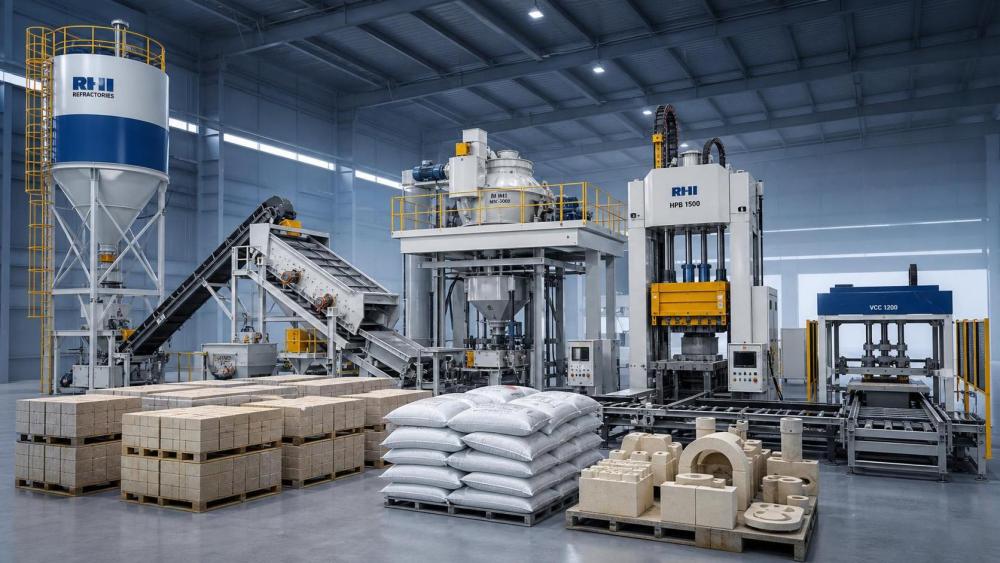
The first step in configuring refractory production lines is deciding what the plant must ship most often.
Dense brick, monolithic castable, and shaped precast pieces behave very differently on the shop floor.
Brick production depends on tight particle grading, high forming pressure, drying control, and kiln stability.
Castable output focuses more on accurate batching, mixing uniformity, additive dosing, and moisture protection.
Precast output adds mold design, vibration or casting stations, curing areas, demolding logistics, and often machining or finishing.
This means a single investment model rarely serves all three outputs efficiently without careful modular planning.
A flexible layout usually begins with shared raw material preparation and storage.
After that point, material flow should split into dedicated paths.
That separation reduces contamination risk and protects product consistency across the full refractory production line.
The Shared Core of Modern Refractory Production Lines
Even when outputs differ, most refractory production lines start with the same backbone.
This usually includes raw material receiving, crushing, grinding, screening, storage silos, batching, dust collection, and plant automation.
The quality of this backbone strongly shapes downstream performance.
If aggregate sizing fluctuates, brick density can drift.
If batching accuracy slips, castable flowability and setting behavior may change.
If moisture enters storage, precast strength can become unpredictable.
A strong base configuration often includes the following:
- Separate bins for fused, sintered, and fine powder materials.
- Closed conveying for dust-sensitive ingredients and microsilica.
- High-accuracy weighing for binders, additives, and moisture inputs.
- Central dust collection linked to environmental compliance targets.
- MES or PLC systems for recipe control, traceability, and maintenance alerts.
From a project perspective, this is where long-term operating discipline starts.
Good shared infrastructure makes future expansion faster and less disruptive.
How Brick Lines Are Typically Structured
Brick-focused refractory production lines are usually the most equipment-intensive.
They need controlled powder preparation, mixing, shaping, drying, firing, and sorting.
A standard sequence often looks like this:
- Crush and classify aggregates to the target particle curve.
- Batch and mix with binders or temporary moisture.
- Form shapes using friction press, hydraulic press, or isostatic pressing.
- Dry green bodies under controlled temperature and airflow.
- Fire in shuttle kilns or tunnel kilns.
- Inspect, sort, palletize, and trace finished lots.
Press selection depends on product density, dimensional tolerance, and shape complexity.
Tunnel kilns favor high and stable volume.
Shuttle kilns support frequent grade changes and smaller specialty batches.
For many plants, the biggest risk is designing kiln capacity without matching upstream forming and drying rates.
That mismatch creates hidden bottlenecks and excess work-in-process inventory.
So, when configuring refractory production lines for brick, balance each stage by hourly throughput, not nameplate capacity alone.
How Castable Lines Prioritize Accuracy and Clean Handling
Castable-oriented refractory production lines are less dependent on firing equipment.
Instead, they rely on recipe control and packaging discipline.
In many cases, dry mixing is the heart of the line.
The system must disperse fine powders evenly while avoiding segregation.
That is especially important for low-cement and ultra-low-cement formulations.
Typical configuration points include:
- Multi-bin batching for coarse, medium, fine, and reactive powder fractions.
- Precision feeders for calcium aluminate cement, dispersants, fibers, and additives.
- High-efficiency mixers sized to batch cycle, not just total tonnage.
- Moisture-proof storage and valve-sealed transfer points.
- Automatic bagging or jumbo bag stations with lot coding.
More importantly, castable refractory production lines should minimize manual handling.
Fine powders are sensitive to humidity, contamination, and dosing error.
A clean enclosed system supports both product quality and worker safety.
This also aligns with stricter plant environmental targets and carbon-aware operating standards.
How Precast Output Changes the Line Design
Precast refractory production lines sit between brick and castable systems.
They use monolithic material logic, but add shape manufacturing and curing control.
This is common for burner blocks, launders, well blocks, delta sections, and custom furnace parts.
A good precast setup usually includes mold preparation, mixing, casting, vibration, curing, demolding, drying, finishing, and inspection.
The line should be built around takt time and mold turnover.
That is often where schedules fail.
If curing takes longer than expected, mold inventory becomes the hidden capacity constraint.
For that reason, many refractory production lines for precast use modular curing rooms and flexible mold platforms.
Some plants also add CNC finishing or drilling stations for tight-installation applications.
In real operations, precast value comes from dimensional accuracy and installation savings, not just tonnage.
Choosing Between Dedicated and Hybrid Refractory Production Lines
A common investment question is whether to build separate lines or a hybrid system.
The answer depends on volume, product volatility, and market mix.
Dedicated refractory production lines usually win when output is stable and scale is high.
Hybrid refractory production lines are attractive when customers demand mixed products and shorter lead times.
A practical comparison is useful:
In many recent projects, a shared raw material hub plus separate finishing modules offers the best compromise.
What to Evaluate Before Final Equipment Selection
Before freezing the layout, several checkpoints should be tested against business reality.
- Capacity balance: Check hourly flow from preparation to final packing or firing.
- Recipe range: Confirm whether the line must handle premium, standard, and trial products.
- Energy profile: Compare electrical load, drying fuel, kiln fuel, and compressed air demand.
- Changeover logic: Estimate cleanup time between alumina, magnesia, silica, or carbon-bearing grades.
- Quality checkpoints: Define testing for bulk density, strength, flow, dimensional tolerance, and thermal shock behavior.
- Expansion path: Leave room for extra silos, mixers, molds, or a second packaging station.
This is also where digital tools matter more than many expect.
Production data, batch traceability, online energy monitoring, and maintenance alerts reduce risk over the plant life cycle.
For refractory production lines, intelligence is no longer an optional extra.
It is part of operational resilience.
A Practical Configuration Approach
The most effective refractory production lines are configured backward from the market, not forward from a catalog.
Start with the dominant product mix.
Then map process needs, utility loads, quality points, and future flexibility.
If brick drives revenue, prioritize pressing, drying, and kiln balance.
If castable growth is stronger, invest in enclosed batching, mixing accuracy, and packaging speed.
If engineered precast is the value engine, focus on mold flow, curing turnover, and finishing precision.
In each case, the right refractory production line is the one that supports product reliability and commercial agility at the same time.
A clear process map, realistic capacity model, and modular equipment plan usually deliver the strongest long-term result.
Related News
 Optical Glass Tech FellowHow to Specify Glass Annealing Equipment for European Quality and Energy RequirementsGlass annealing equipment Europe: learn how to specify lehrs for consistent glass quality, energy efficiency, compliance, automation, and reliable long-term performance.Sep 23, 2026
 Optical Glass Tech FellowSilicate Process Automation: Improving Batch Consistency and Energy ControlSilicate process automation improves batch consistency, energy control, traceability, and operator confidence across high-temperature manufacturing operations.Sep 22, 2026
 Optical Glass Tech FellowHow Silicate Industrial Processes Control Viscosity, Energy Use, and Product QualitySilicate industrial processes: learn how viscosity, chemistry, heat transfer, and atmosphere control reduce energy use, improve stability, and protect product quality.Sep 21, 2026
 Thermal Energy ArchitectHow European Plants Can Evaluate Energy Recovery Equipment for High-Temperature ProcessesIndustrial energy recovery equipment Europe: learn how high-temperature plants can assess waste-heat sources, integration risks, lifecycle value, and reliable recovery routes.Sep 20, 2026
 Thermal Energy ArchitectIndustrial Furnace Process Optimization: Reducing Fuel Use Without Sacrificing ThroughputIndustrial process optimization furnace strategies that cut fuel use while protecting throughput. Explore combustion control, heat recovery, refractory performance, and data-driven efficiency gains.Sep 19, 2026
 Ms. Elena RodriguezWhat Drives High-Pressure Extrusion Equipment Cost in Industrial Projects?High pressure extrusion equipment cost explained: compare pressure, die design, automation, wear, energy, and installation factors for smarter industrial investments.Sep 18, 2026
 Thermal Energy ArchitectHow to Size a Waste Heat Recovery Exchanger for High-Temperature Kiln Exhaust?Waste heat recovery exchanger sizing for high-temperature kiln exhaust: balance recoverable duty, fouling, corrosion limits, pressure drop, and reliable heat use.Sep 17, 2026
 Thermal Energy ArchitectWhy Heat-Resistant Materials Lose Abrasion Resistance at High TemperaturesHeat-resistant materials abrasion resistance can decline at high temperatures. Discover the thermal, chemical, and mechanical causes of wear—and how to choose longer-lasting linings.Sep 16, 2026
 Thermal Energy ArchitectHow to Evaluate a Thermal Energy Optimization Company for High-Temperature PlantsChoose a thermal energy optimization company with proven process expertise, measurable savings, and reliable delivery for high-temperature plants. Learn what to assess.Sep 15, 2026
 Thermal Energy ArchitectRotary Kiln Efficiency: How Feed Rate, Fuel Use, and Heat Loss Affect OutputRotary kiln efficiency explained: discover how feed rate, fuel use, heat loss, combustion, and cooling performance shape output, quality, and energy costs.Sep 14, 2026
 Thermal Energy ArchitectHow to Select Heat-Resistant Materials That Maintain Abrasion Resistance in KilnsHeat-resistant materials abrasion resistance: learn how to select kiln linings that withstand heat, wear, thermal cycling, and chemical attack for longer service life.Sep 13, 2026
 Thermal Energy ArchitectHow Rotary Kiln Automation Improves Temperature Control and Fuel EfficiencyRotary kiln technology automation enhances temperature control, stabilizes combustion, and improves fuel efficiency with smarter data, predictive control, and safer operations.Sep 12, 2026
 Silicate Process EngineerCement Plant Emission Control: Selecting Systems for Dust, NOx, and SO2 LimitsCement plant emission control guide: compare dust collectors, NOx reduction, and SO2 systems for reliable compliance across kiln modes, fuel changes, and operating upsets.Sep 11, 2026
 Thermal Energy ArchitectSelecting Abrasion-Resistant High-Temperature Materials for Kiln and Conveyor Wear ZonesHigh-temp material engineering guide to abrasion-resistant kiln and conveyor solutions—match wear, heat, chemistry, and installation design for longer service life.Sep 10, 2026
 Dr. Alistair VaughnIndustrial Process Engineering: How to Map Processes for Safer, More Efficient PlantsIndustrial process engineering reveals bottlenecks, safety risks, and energy losses through practical process mapping for safer, more efficient plants.Sep 09, 2026
 Optical Glass Tech FellowHow to Evaluate a Glass Annealing Equipment Manufacturer for Production StabilityChoose a glass annealing equipment manufacturer with proven thermal uniformity, reliable controls, lifecycle value, and responsive service for stable production.Sep 08, 2026
 Prof. Marcus ChenThermal Energy Architecture in North America: Strategies for Lower Building Energy UseThermal energy architecture North America helps project leaders cut building energy use through stronger envelopes, right-sized HVAC, storage, and smart commissioning.Sep 07, 2026
 Ms. Elena RodriguezHow Should Buyers Evaluate Building Material Industry Intelligence Pricing?Building material industry intelligence pricing: learn how to compare coverage, technical depth, and ROI to choose intelligence that reduces procurement risk.Sep 07, 2026
 Ms. Elena RodriguezHow to Use Building Material Intelligence Data for Market and Investment DecisionsBuilding material industry intelligence data helps leaders evaluate demand, costs, regulation, capacity, and technology to make smarter market and investment decisions.Sep 05, 2026
 Thermal Energy ArchitectHow PLC Control Improves Energy Efficiency and Temperature Stability in KilnsEnergy efficient kilns PLC control improves temperature stability, cuts fuel waste, and optimizes combustion, draft, and material flow. Explore proven strategies for smarter kiln modernization.Sep 04, 2026



Related News
- 00
0000-00
What Determines Refractory Production Line Price in a Turnkey Plant Project? - 00
0000-00
How to Evaluate a Silicate Production Line for Capacity, Energy Use, and Product Quality - 00
0000-00
Silicate Production Line Process Explained: Key Stages, Equipment, and Quality Control - 00
0000-00
How to Evaluate a Refractory Production Line in Southeast Asia: Capacity, Fuel, and Raw Material Factors - 00
0000-00
How to Evaluate a Silicate Production Lines Supplier for Capacity, Automation, and Raw Material Fit
Weekly Insights
Stay ahead with our curated technology reports delivered every Monday.