
Choosing an Extrusion Equipment Supplier: Output Tests and After-Sales Support




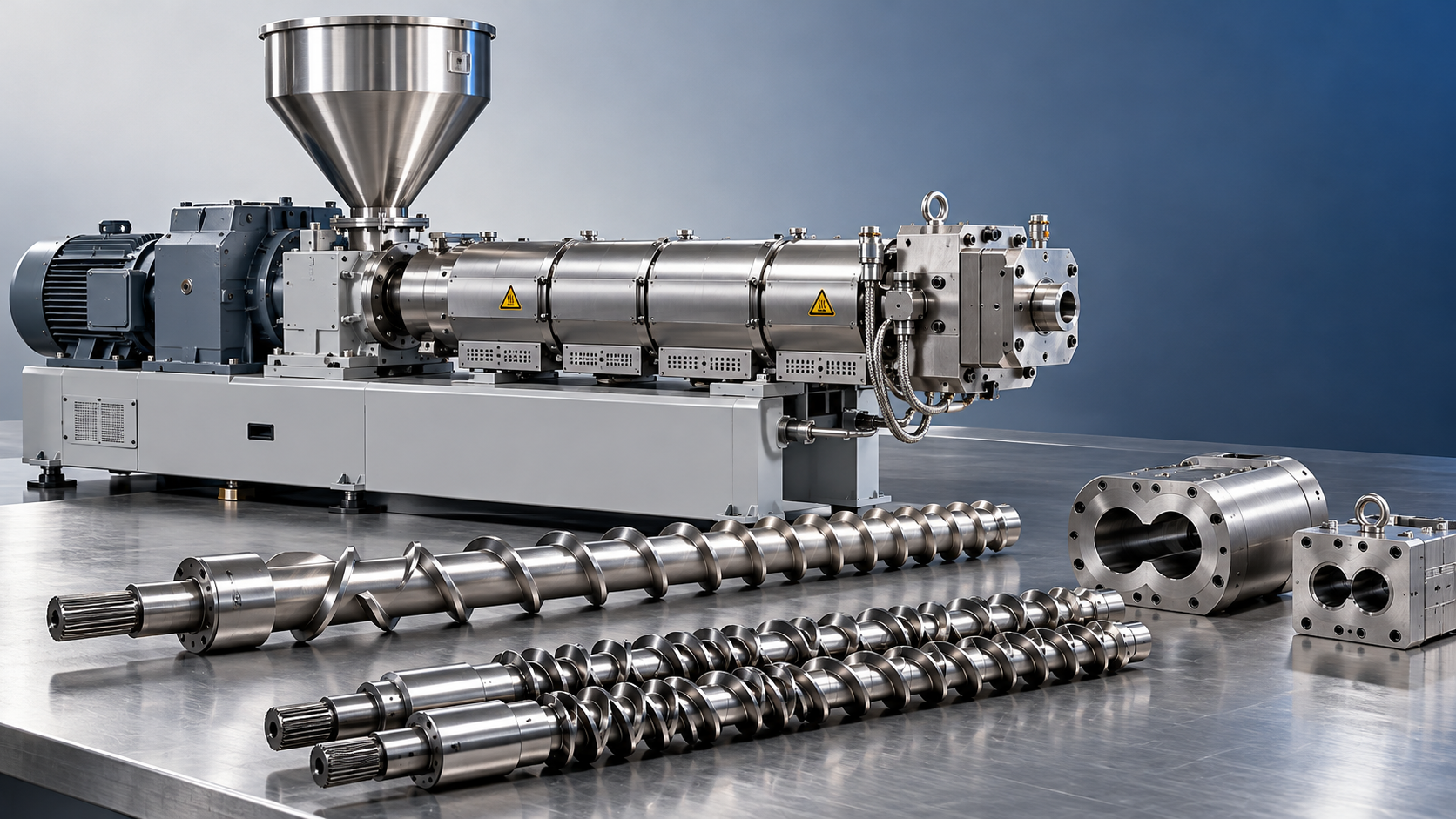
A competitive quote offers little comfort when an extrusion line misses its production target or a breakdown leaves operators waiting for help. Choosing an extrusion equipment supplier means looking beyond rated capacity to evidence: trials with representative materials, saleable product quality, measured energy consumption, and service commitments that remain useful after installation.
For procurement teams buying equipment for lightweight building materials, refractory bodies, or other mineral-based products, the challenge is comparing offers built on different assumptions. One supplier quotes extruder throughput; another quotes finished output. One includes commissioning; another charges separately for every site visit. A sound purchasing decision makes those differences visible before the contract is signed.
Define the production promise before comparing prices
“Required capacity” is not a complete specification. An extruder may move material at the advertised rate while producing profiles that crack during drying, exceed dimensional tolerances, or require excessive trimming. The purchasing requirement should therefore describe a usable production result, not simply a machine speed.
Build a common specification with production, maintenance, quality, and utilities teams. It should establish:
- Material envelope: composition, particle-size distribution, moisture range, bulk density, abrasive constituents, and expected recycled content.
- Product range: profile geometry, dimensions, tolerances, surface requirements, and handling strength.
- Output basis: wet extrudate, dry-solids throughput, accepted green product, or finished saleable product.
- Operating conditions: planned shifts, available utilities, ambient conditions, and upstream feed consistency.
- Supply boundary: whether the offer includes preparation, mixing, feeding, vacuum equipment, tooling, cutting, conveying, and controls.
Keep responsibility aligned with scope. A supplier providing only an extruder cannot reasonably guarantee the performance of an uncontrolled dryer or kiln. However, it should define the extrudate properties needed for downstream processing and identify interface conditions. Otherwise, a quality problem can turn into a prolonged dispute between equipment vendors.
What an extrusion equipment supplier should prove in a trial
A demonstration with an easy-running formulation shows that a machine operates. It does not necessarily establish that it will process your material economically. Ask for a written trial protocol before sending samples or booking travel.
Use material that represents normal production
Submit sufficient material to reach stable operation and collect meaningful samples. Record its source, preparation method, moisture, particle size, and storage condition. For mineral formulations, changes in plasticity, binder content, or recycled fines can materially affect extrusion pressure, wear, and green strength.
If the supplier adjusts the recipe, document every addition. Extra water or a processing aid may improve apparent throughput while increasing drying demand or changing product properties. A successful trial should not depend on a formulation that the buyer cannot consistently obtain or afford.
Where feedstock variability is significant, agree on additional trials representing the expected operating range. Testing only the most favorable batch leaves the buyer carrying the risk of everyday production.
Separate peak output from sustainable output
Request a defined stabilization period followed by a continuous measurement window. During that window, log output, motor load, extrusion pressure, vacuum level where applicable, material temperature, stoppages, and adjustments. Record startup losses separately rather than quietly excluding them from the production picture.
The test should run long enough to reveal relevant operating effects, such as temperature drift, feed instability, die buildup, or repeated cleaning. There is no universal trial duration suitable for every formulation and line. The duration must reflect the process risks, not the time available for a showroom visit.
Also confirm whether the demonstration machine matches the quoted configuration. Differences in screw geometry, drive capacity, wear protection, die design, or vacuum arrangement can limit how confidently trial results transfer to the purchased equipment.
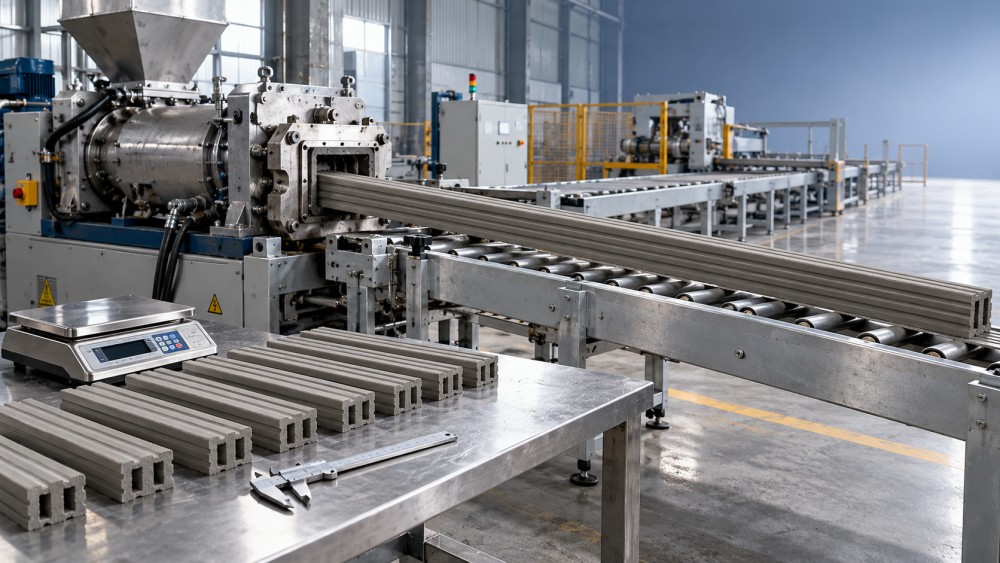
Measure accepted output, not just discharged mass
Weigh material over a defined period and assess it against agreed quality criteria. Depending on the product, checks may include dimensions, density, surface tearing, laminations, internal voids, cut quality, and handling strength.
For products that undergo drying or firing, retain traceable samples for downstream evaluation. A smooth-looking green profile may still develop cracks or distortion later. Where those stages cannot be included in the supplier’s trial, make their validation a separate acceptance step with clearly assigned responsibilities.
Accepted output = total output produced during the measurement period − material rejected against the agreed criteria.
Record whether rejected material is recoverable, requires reprocessing, or becomes waste. Recyclable scrap still consumes handling capacity and energy; it is not economically invisible.
Make the test report useful for purchasing
A short video and a production-rate claim are weak evidence for a capital purchase. Request a signed report supported by raw measurements, sample identification, instrument details, and a record of any deviations from the protocol.
Energy comparisons require particular care. A main-drive reading cannot be compared directly with a figure covering the mixer, vacuum pump, feeder, and conveyors. Use the same electrical boundary and distinguish measured consumption from installed motor power.
Moisture also matters. Higher wet-tonnage output does not necessarily mean higher solids throughput. For silicate and building-material production, assess extrusion energy alongside the downstream drying or thermal burden. A lower extrusion reading achieved through additional water may simply move cost to another part of the plant.
Turn trial results into contractual acceptance criteria
A promising trial is only the beginning. The purchase agreement should connect the tested configuration to the equipment delivered, the installation conditions, and the final acceptance procedure.
A factory acceptance test, or FAT, checks the agreed scope before shipment. Depending on available facilities, it may include material trials, mechanical operation, controls, safety functions, and document review. A site acceptance test, or SAT, then verifies performance after installation under agreed site conditions.
Define what happens when the factory cannot reproduce the complete production environment. Some performance checks may need to move to site, but that transfer should be explicit rather than left to interpretation.
- State the product, formulation range, utilities, and upstream conditions required for testing.
- Define measurement methods, sampling frequency, tolerances, and who witnesses results.
- List prerequisites for starting the test, including calibration and operator readiness.
- Specify corrective-action responsibilities, retest arrangements, and associated costs.
- Link appropriate payment milestones to documented delivery and acceptance obligations.
Contract terms should also explain how buyer-caused delays, unsuitable feedstock, or unavailable utilities affect the test schedule. Balanced provisions protect both parties and reduce the temptation to argue about responsibility only after commissioning has stalled.
After-sales support: examine the route back to production
“Global service available” says little about what happens when a line stops overnight. Evaluate the actual support route for your plant location, language, shift pattern, and maintenance capability.
Commissioning must include knowledge transfer
Clarify whether installation supervision, commissioning, and production ramp-up are separate services. Establish included site days, travel costs, overtime rates, and responsibility for lifting equipment, alignment, wiring, and utility connections.
Training should cover more than startup and shutdown. Operators need guidance on recognizing unstable feed, pressure changes, vacuum deterioration, and quality defects. Maintenance personnel need procedures for wear inspection, tooling changes, lubrication, isolation, and safe access. Request usable manuals, electrical drawings, maintenance schedules, and backups of applicable control parameters.
Distinguish response time from restoration time
An acknowledgment within an agreed period does not mean that production will restart within that period. Ask the supplier to distinguish initial response, technical diagnosis, parts dispatch, and on-site attendance. Confirm service hours, escalation contacts, and exclusions.
Remote access may shorten diagnosis, but it requires plant approval and suitable cybersecurity controls. Agree on authorization, access logging, backup procedures, and whether troubleshooting remains possible when external connectivity is unavailable.
Check parts availability at component level
Request a recommended spare-parts list divided into startup, routine wear, and production-critical items. For each critical component, ask about stocking location, normal lead time, interchangeability, and replacement procedure.
In abrasive mineral service, screws, barrels or liners, dies, and seals deserve close attention. Wear-life statements should identify the material and operating assumptions behind them. A generic claim cannot reliably predict performance with a different mineral blend.
Finally, establish how long proprietary controls and mechanical parts will be supported, and what happens when components become obsolete. Warranty coverage alone does not answer those questions.
Compare lifecycle cost without hiding uncertainty
The lowest purchase price may still be the right choice—but only after costs and risks have been made comparable. Build the evaluation around expected production conditions rather than the best trial result.
Evaluated lifecycle cost = purchase and integration costs + energy + wear parts + maintenance and service + expected downtime costs − applicable residual value.
Use a common evaluation period and consistent financial assumptions. Include freight, duties where relevant, foundations, utilities, tooling, training, and planned refurbishment. Avoid double-counting production losses across reject, downtime, and capacity calculations.
Downtime estimates are uncertain, so test more than one scenario. Compare the effect of a delayed critical part, faster wear, or lower accepted output. If a small change reverses the supplier ranking, the decision depends on an assumption that deserves stronger evidence or contractual protection.
For energy-intensive material plants, this whole-line view is particularly important. Extrusion, drying, firing, and material recovery interact. Procurement should reward lower cost per accepted product, not an isolated efficiency figure that transfers consumption elsewhere.
Make the final decision on evidence and recoverability
Before awarding the order, separate mandatory requirements from weighted preferences. A supplier should not compensate for an unresolved safety issue or failed product-quality test by scoring well on price.
Then compare qualified offers on demonstrated output, energy boundaries, integration responsibility, maintainability, parts logistics, and enforceable support terms. Where possible, speak with users processing comparable materials and ask about commissioning difficulties, recurring faults, and parts delivery—not simply whether they are satisfied.
The strongest extrusion equipment supplier is not necessarily the one promising the highest capacity. It is the one whose performance can be reproduced, whose costs can be understood, and whose support arrangements give your team a credible route back to production when something goes wrong.
Related News
 Ms. Elena RodriguezProcess Equipment Pricing: How to Compare Quotes and Total CostsMaster process equipment comparison pricing: compare supplier quotes, uncover hidden costs, and evaluate lifetime expenses to make a confident buying decision.Nov 17, 2026
 Prof. Marcus ChenGlobal Cement Industry Decarbonization: Key Technologies and Cost BarriersExplore global cement industry decarbonization technologies, cost barriers, and practical investment strategies to cut emissions while protecting competitiveness.Nov 16, 2026
 Structural Material AnalystChoosing Specification Preparation Support for North American ProjectsChoose specification preparation support North America projects can rely on. Compare technical expertise, compliance, interfaces, and supplier acceptance criteria.Nov 14, 2026
 Structural Material AnalystSpecialty Ceramic Extrusion: How Material Properties Affect FormingExplore how ceramic specialized material extrusion is shaped by particle size, binders, and solids loading—and learn to improve forming and reduce defects.Nov 13, 2026
 Ms. Elena RodriguezHigh-Pressure Molding Equipment Prices in Europe: What Affects the Total Cost?Explore high pressure molding equipment price Europe buyers can expect to assess, from tooling and installation to running costs. Compare quotes with confidence.Nov 12, 2026
 Structural Material AnalystChoosing a Vacuum Extrusion System: Capacity, Materials and Vacuum LevelsChoosing a vacuum extrusion system? Compare capacity, material behavior and vacuum levels to improve product quality and select the right equipment.Nov 11, 2026
 Optical Glass Tech FellowGlass Melting Innovations: Comparing Electric and Hybrid Furnace TechnologiesExplore glass melting innovations and compare electric and hybrid furnaces by energy use, emissions, glass quality and operating costs to find the right fit.Nov 10, 2026
 Thermal Energy ArchitectHow Thermal Barrier Technology for Kilns Reduces Heat LossDiscover how thermal barrier technology for kilns reduces heat loss, and learn how to select insulation and assess savings without compromising lining durability.Nov 09, 2026
 Prof. Marcus ChenGlobal Materials Trends: What North American Manufacturers Need to KnowExplore global material trends North America manufacturers need to know, from energy costs and supply chains to lower-carbon materials and smarter investment decisions.Nov 08, 2026
 Thermal Energy ArchitectSelecting Abrasion-Resistant Refractories for High-Wear Kiln LiningsExplore advanced refractory materials abrasion resistant enough for high-wear kiln linings. Compare wear mechanisms, thermal stability, installation and lifecycle costs.Nov 06, 2026
 Dr. Alistair VaughnIndustrial Energy Efficiency Certification: ISO 50001 Requirements for PlantsExplore industrial energy efficiency certification with ISO 50001. Learn how plants define scope, measure performance and prepare credible evidence for audits.Nov 05, 2026
 Ms. Elena RodriguezWhat Is an Industrial Intelligence Database and How Is It Used?Discover how an industrial intelligence database helps researchers map markets, track projects, compare technologies, and assess evidence with confidence.Nov 04, 2026
 Ms. Elena RodriguezIndustrial Material Pricing: How Freight and Order Volume Affect QuotesExplore industrial material pricing and learn how freight, order volume, and inventory costs affect quotes. Compare suppliers and make smarter purchasing decisions.Nov 03, 2026
 Structural Material AnalystSingle- vs. Twin-Screw Extrusion Systems: Which Suits Your Material?Choose the right specialized extrusion systems screw type for your material. Compare single- and twin-screw options to improve quality and control costs.Nov 02, 2026
 Thermal Energy ArchitectChoosing Thermal Barrier Materials for Kilns: Temperature and Heat LossExplore thermal barrier materials for kilns and learn how to balance temperature resistance, heat loss, durability and operating costs when selecting a lining.Nov 01, 2026
 Ms. Elena RodriguezSupplier Reference Platform Pricing: Fees and Contract Terms to CompareCompare supplier reference platform pricing, hidden fees, verification costs and contract terms to choose the right solution for your sourcing team.Oct 31, 2026
 Ms. Elena RodriguezSupplier Comparison Metrics: How to Score Cost, Quality, and DeliveryUse supplier comparison metrics to score cost, quality, and delivery with a practical weighted scorecard. Make more confident equipment sourcing decisions.Oct 30, 2026
 Ms. Elena RodriguezWhat Does Industrial Waste Heat Recovery Cost, and When Does It Pay Back?Understand industrial waste heat recovery cost, from equipment and installation to net savings. Learn how to compare quotes, assess risks, and calculate realistic payback before investing.Oct 29, 2026
 Thermal Energy ArchitectChoosing Industrial Waste-to-Energy Equipment by Waste Moisture and Heating ValueChoose industrial waste to energy equipment by moisture and heating value. Compare technologies, fuel needs, and supplier guarantees to make a confident investment.Oct 28, 2026
 Thermal Energy ArchitectChoosing Industrial Kiln Insulation for High Heat and Repeated Thermal CyclingExplore high temperature industry solutions for kiln insulation under repeated thermal cycling. Compare materials, reduce heat loss, and select the right lining for your operating conditions.Oct 27, 2026




Related News
- 00
0000-00
Process Equipment Pricing: How to Compare Quotes and Total Costs - 00
0000-00
High-Pressure Molding Equipment Prices in Europe: What Affects the Total Cost? - 00
0000-00
What Is an Industrial Intelligence Database and How Is It Used? - 00
0000-00
Industrial Material Pricing: How Freight and Order Volume Affect Quotes - 00
0000-00
Supplier Reference Platform Pricing: Fees and Contract Terms to Compare
0000-00
Weekly Insights
Stay ahead with our curated technology reports delivered every Monday.