
Choosing a High-Temperature Materials Supplier: Test Data and Traceability




Choosing a high-temperature materials supplier takes more than comparing prices and maximum service temperatures. For procurement teams sourcing refractories for cement kilns, glass furnaces, or industrial incinerators, the real question is whether documented performance matches operating conditions—and whether each shipment can be traced to the batch that produced it.
A datasheet may look reassuring until you ask what was tested, how the specimen was prepared, and whether the result represents the material arriving at your site. Those questions matter when a lining failure can turn a planned maintenance window into an extended shutdown.
The strongest purchasing decisions connect three things: the operating environment, relevant test evidence, and verifiable production records. Price becomes meaningful only when those connections are clear.
Define the duty before comparing suppliers
“Suitable for 1,600°C” is not a complete specification. A temperature rating does not establish resistance to alkali attack, mechanical abrasion, repeated cycling, or contact with molten glass. Nor does it explain how a material behaves under sustained load.
Before issuing an RFQ, prepare a service-condition brief with input from operations, maintenance, and process engineering. Include:
- Thermal conditions: normal hot-face temperature, credible excursions, temperature gradients, and heating or cooling frequency.
- Chemical exposure: fuel ash, alkalis, chlorides, sulfur compounds, slag, molten glass, or variable waste-feed constituents.
- Mechanical demands: abrasion, impact, vibration, structural loading, and equipment movement.
- Installation constraints: lining geometry, anchoring, application method, water quality, curing, and available dry-out time.
- Existing failure history: wear location, service duration, photographs, and any post-service material analysis.
Different furnace zones often need different specifications. A cement kiln transition zone should not automatically receive the same evaluation as a cooler lining. Glass-contact refractories face concerns about corrosion and glass defects that may not apply to backup insulation. Incinerator linings require particular attention to changing feed chemistry.
A supplier should explain why its proposed grade fits the defined duty—not simply recommend its highest-temperature product.
What test data should a high-temperature materials supplier provide?
Request a technical evidence package rather than a collection of headline values. Each reported result should identify the test method, specimen condition, test temperature where relevant, and material grade. Ask whether values are typical development data, guaranteed acceptance limits, or actual batch-release results.
These categories serve different purposes. A typical value helps compare products; an agreed acceptance limit determines conformity. Confusing them leaves procurement teams with little leverage when delivered material differs from expectations.
Recognized methods help make results interpretable. For example, ASTM C133 addresses cold crushing strength and modulus of rupture of refractories, while ASTM C20 covers specified physical properties of burned refractory brick and shapes. Neither reference should be applied indiscriminately to every refractory product. Relevant ISO, EN, or other agreed methods may also be appropriate.
Specify the applicable method and edition in the purchase specification. Results obtained using different specimen geometries or conditioning schedules should not be treated as directly comparable without technical review.
Room-temperature strength does not establish furnace performance
A high cold crushing strength can look impressive in a quotation table. It does not, by itself, establish resistance to creep, thermal spalling, or chemical penetration. Similarly, low apparent porosity may limit some infiltration pathways, but it does not prove compatibility with a particular slag or glass composition.
Ask the supplier to identify the likely failure mechanism and the evidence addressing it. If alkali attack ended the previous campaign, an additional cold-strength report will not resolve the central uncertainty.
For castables, specimen preparation is part of the result
Castable performance depends on mixing, water addition, curing, drying, and firing history. A laboratory specimen prepared under controlled conditions may perform differently from material installed during a tight shutdown.
Request the water addition, mixing procedure, curing conditions, and heat-treatment schedule behind the reported values. Where installation sensitivity is significant, consider trials using the intended equipment and application method. Approval should cover both the material and a workable installation procedure.
Check whether the evidence represents what you will receive
A technically valid report can still be weak purchasing evidence if it concerns a different formulation, an old development batch, or an unidentified specimen.
Ask who selected the samples, when they were taken, and how they connect to production records. Distinguish among type testing, periodic verification, and routine batch-release testing. Not every specialized test needs to be repeated on every lot, but the supplier should explain its testing frequency and the controls used between tests.
For critical orders, agree on sampling responsibilities before production. The plan should define lot boundaries, sample quantities, selection locations, identification, retention, and procedures for disputed results. Avoid a situation in which the supplier and buyer test differently prepared specimens and then argue over whose number is correct.
Independent testing can strengthen confidence, particularly for a new grade or unfamiliar source. Where ISO/IEC 17025 accreditation is requested, verify that the laboratory’s accredited scope covers the relevant test. Accreditation alone does not establish that every reported activity is within scope or that a sample represents the shipment.
Traceability should survive beyond the delivery label
Useful material traceability connects the delivered product to its manufacturing history and release evidence. A batch number printed on a bag is only the visible starting point.
Ask the supplier to demonstrate one complete record chain:
Purchase specification → approved grade and revision → production lot → relevant raw-material records → manufacturing and inspection records → release results → package or pallet identification → shipment documents.
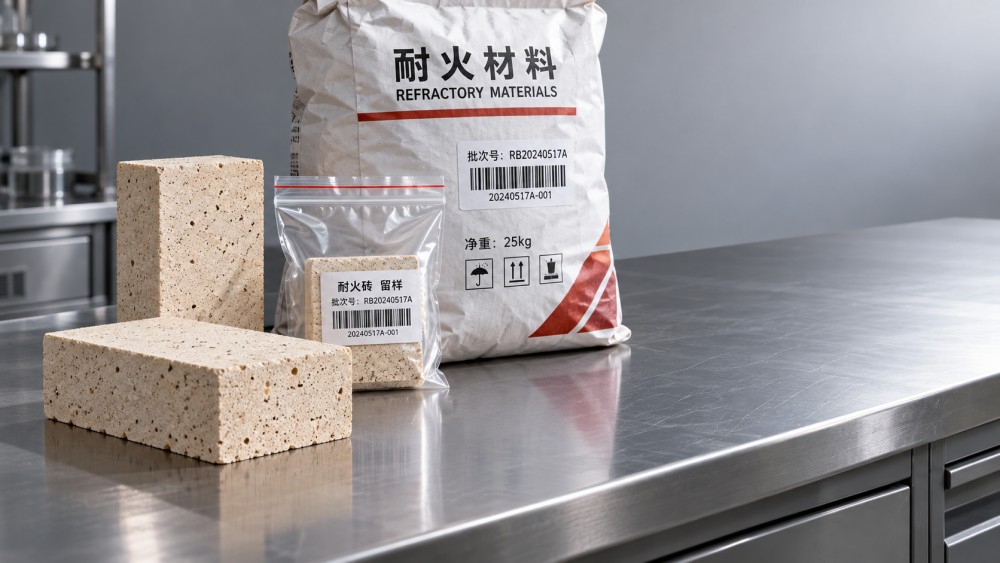
The detail required depends on risk. A critical hot-face refractory may justify tighter controls than a readily replaceable backup component. Nevertheless, buyers should be able to establish which lot was delivered, whether it met the agreed requirements, and where it was installed.
Review a sample certificate of analysis before placing the order. It should distinguish actual measured results from specification limits and typical values, identify the applicable lot, and show release authorization. A certificate of conformity may confirm compliance without providing numerical results; decide which document your application requires.
Ask practical questions that reveal whether traceability works under pressure:
- Can one shipment contain several manufacturing lots, and how are they identified?
- If a lot is split across deliveries, can every destination be located?
- How are relabeled, repacked, or distributor-held materials linked to the original manufacturer?
- What records and retained samples are kept, and for how long?
- How are formulation changes, raw-material substitutions, and production-site changes controlled?
Traceability also needs a site-side process. Record lot numbers against installation zones, dates, contractors, and relevant application conditions. If unused bags from several lots are mixed without documentation, even excellent supplier records may not explain a later failure.
Compare total installed cost, not just the quotation
A lower unit price is attractive when maintenance budgets are tight. But two offers are not economically equivalent if one excludes freight, requires longer dry-out, generates more installation waste, or carries greater replacement uncertainty.
Compare quotations on the same basis: required lining volume, installed density, expected consumption, delivery terms, installation support, testing, and commissioning requirements. Price per tonne can be misleading when materials have different densities or application yields.
A practical evaluation separates costs into three groups:
- Committed costs: material, transport, duties where applicable, installation, inspection, and dry-out.
- Operating effects: heat loss, maintenance frequency, repairability, and possible process-quality consequences.
- Risk exposure: uncertain service life, replacement lead time, disruption, and the consequences of premature failure.
Use cost per operating hour or per unit of production where credible service-life evidence exists. If it does not, compare conservative, expected, and unfavorable scenarios rather than presenting a single precise forecast.
Energy claims deserve similar scrutiny. Lower conductivity in a backup layer may reduce heat loss, but the result depends on the full lining design, thicknesses, boundary conditions, and operating temperature. Request a documented calculation rather than accepting a generic percentage saving. Carbon comparisons likewise need consistent boundaries and a comparable service basis.
Turn the shortlist into a controlled purchasing decision
A supplier scorecard is most useful when it separates mandatory requirements from weighted preferences. Missing critical traceability or unresolved chemical compatibility should not be offset by a strong delivery score.
For shortlisted suppliers, establish approval gates:
- Technical fit: confirm the proposed grade against the service brief and dominant failure mechanisms.
- Evidence review: resolve missing methods, unclear specimen conditions, and differences between typical and guaranteed values.
- Quality verification: examine representative lot records, change controls, and nonconformance procedures.
- Commercial alignment: agree delivery identification, document requirements, acceptance criteria, and remedies for nonconforming supply.
- Qualification where needed: conduct laboratory comparison, installation trials, or a controlled service trial with predefined evaluation criteria.
Warning signs include interchangeable reports for different grades, unexplained changes in test methods, certificates without lot references, and resistance to discussing previous failure mechanisms. None proves that a product is unsuitable, but each calls for clarification before approval.
At CF-Elite, the connection between material properties, thermal management, and operating economics is central to evaluating high-temperature industry decisions. Procurement benefits from that same perspective: a refractory is not simply a consumable, but part of a larger production and energy system.
The defensible choice is the supplier that can connect its recommendation to your duty, support it with relevant evidence, and preserve that connection through delivery. When those fundamentals are documented, price negotiations become clearer—and the maintenance team receives more than a promising datasheet.
Related News
 Ms. Elena RodriguezProcess Equipment Pricing: How to Compare Quotes and Total CostsMaster process equipment comparison pricing: compare supplier quotes, uncover hidden costs, and evaluate lifetime expenses to make a confident buying decision.Nov 17, 2026
 Prof. Marcus ChenGlobal Cement Industry Decarbonization: Key Technologies and Cost BarriersExplore global cement industry decarbonization technologies, cost barriers, and practical investment strategies to cut emissions while protecting competitiveness.Nov 16, 2026
 Structural Material AnalystChoosing Specification Preparation Support for North American ProjectsChoose specification preparation support North America projects can rely on. Compare technical expertise, compliance, interfaces, and supplier acceptance criteria.Nov 14, 2026
 Structural Material AnalystSpecialty Ceramic Extrusion: How Material Properties Affect FormingExplore how ceramic specialized material extrusion is shaped by particle size, binders, and solids loading—and learn to improve forming and reduce defects.Nov 13, 2026
 Ms. Elena RodriguezHigh-Pressure Molding Equipment Prices in Europe: What Affects the Total Cost?Explore high pressure molding equipment price Europe buyers can expect to assess, from tooling and installation to running costs. Compare quotes with confidence.Nov 12, 2026
 Structural Material AnalystChoosing a Vacuum Extrusion System: Capacity, Materials and Vacuum LevelsChoosing a vacuum extrusion system? Compare capacity, material behavior and vacuum levels to improve product quality and select the right equipment.Nov 11, 2026
 Optical Glass Tech FellowGlass Melting Innovations: Comparing Electric and Hybrid Furnace TechnologiesExplore glass melting innovations and compare electric and hybrid furnaces by energy use, emissions, glass quality and operating costs to find the right fit.Nov 10, 2026
 Thermal Energy ArchitectHow Thermal Barrier Technology for Kilns Reduces Heat LossDiscover how thermal barrier technology for kilns reduces heat loss, and learn how to select insulation and assess savings without compromising lining durability.Nov 09, 2026
 Prof. Marcus ChenGlobal Materials Trends: What North American Manufacturers Need to KnowExplore global material trends North America manufacturers need to know, from energy costs and supply chains to lower-carbon materials and smarter investment decisions.Nov 08, 2026
 Thermal Energy ArchitectSelecting Abrasion-Resistant Refractories for High-Wear Kiln LiningsExplore advanced refractory materials abrasion resistant enough for high-wear kiln linings. Compare wear mechanisms, thermal stability, installation and lifecycle costs.Nov 06, 2026
 Dr. Alistair VaughnIndustrial Energy Efficiency Certification: ISO 50001 Requirements for PlantsExplore industrial energy efficiency certification with ISO 50001. Learn how plants define scope, measure performance and prepare credible evidence for audits.Nov 05, 2026
 Ms. Elena RodriguezWhat Is an Industrial Intelligence Database and How Is It Used?Discover how an industrial intelligence database helps researchers map markets, track projects, compare technologies, and assess evidence with confidence.Nov 04, 2026
 Ms. Elena RodriguezIndustrial Material Pricing: How Freight and Order Volume Affect QuotesExplore industrial material pricing and learn how freight, order volume, and inventory costs affect quotes. Compare suppliers and make smarter purchasing decisions.Nov 03, 2026
 Structural Material AnalystSingle- vs. Twin-Screw Extrusion Systems: Which Suits Your Material?Choose the right specialized extrusion systems screw type for your material. Compare single- and twin-screw options to improve quality and control costs.Nov 02, 2026
 Thermal Energy ArchitectChoosing Thermal Barrier Materials for Kilns: Temperature and Heat LossExplore thermal barrier materials for kilns and learn how to balance temperature resistance, heat loss, durability and operating costs when selecting a lining.Nov 01, 2026
 Ms. Elena RodriguezSupplier Reference Platform Pricing: Fees and Contract Terms to CompareCompare supplier reference platform pricing, hidden fees, verification costs and contract terms to choose the right solution for your sourcing team.Oct 31, 2026
 Ms. Elena RodriguezSupplier Comparison Metrics: How to Score Cost, Quality, and DeliveryUse supplier comparison metrics to score cost, quality, and delivery with a practical weighted scorecard. Make more confident equipment sourcing decisions.Oct 30, 2026
 Ms. Elena RodriguezWhat Does Industrial Waste Heat Recovery Cost, and When Does It Pay Back?Understand industrial waste heat recovery cost, from equipment and installation to net savings. Learn how to compare quotes, assess risks, and calculate realistic payback before investing.Oct 29, 2026
 Thermal Energy ArchitectChoosing Industrial Waste-to-Energy Equipment by Waste Moisture and Heating ValueChoose industrial waste to energy equipment by moisture and heating value. Compare technologies, fuel needs, and supplier guarantees to make a confident investment.Oct 28, 2026
 Thermal Energy ArchitectChoosing Industrial Kiln Insulation for High Heat and Repeated Thermal CyclingExplore high temperature industry solutions for kiln insulation under repeated thermal cycling. Compare materials, reduce heat loss, and select the right lining for your operating conditions.Oct 27, 2026








Related News
- 00
0000-00
Process Equipment Pricing: How to Compare Quotes and Total Costs - 00
0000-00
High-Pressure Molding Equipment Prices in Europe: What Affects the Total Cost? - 00
0000-00
What Is an Industrial Intelligence Database and How Is It Used? - 00
0000-00
Industrial Material Pricing: How Freight and Order Volume Affect Quotes - 00
0000-00
Supplier Reference Platform Pricing: Fees and Contract Terms to Compare
0000-00
Weekly Insights
Stay ahead with our curated technology reports delivered every Monday.