
How Waste to Energy Plants Work: Process Steps, Feedstocks, and Output Metrics




Waste to energy sits where thermal engineering, waste handling, and carbon management meet. That is why it draws attention far beyond municipal utilities.
For industrial intelligence platforms such as CF-Elite, the subject matters because incineration performance depends on heat balance, feedstock quality, refractory reliability, and emissions control.
A clear view of process steps, usable feedstocks, and output metrics helps separate efficient plants from facilities that only move waste without creating stable energy value.
Why waste to energy remains a strategic topic
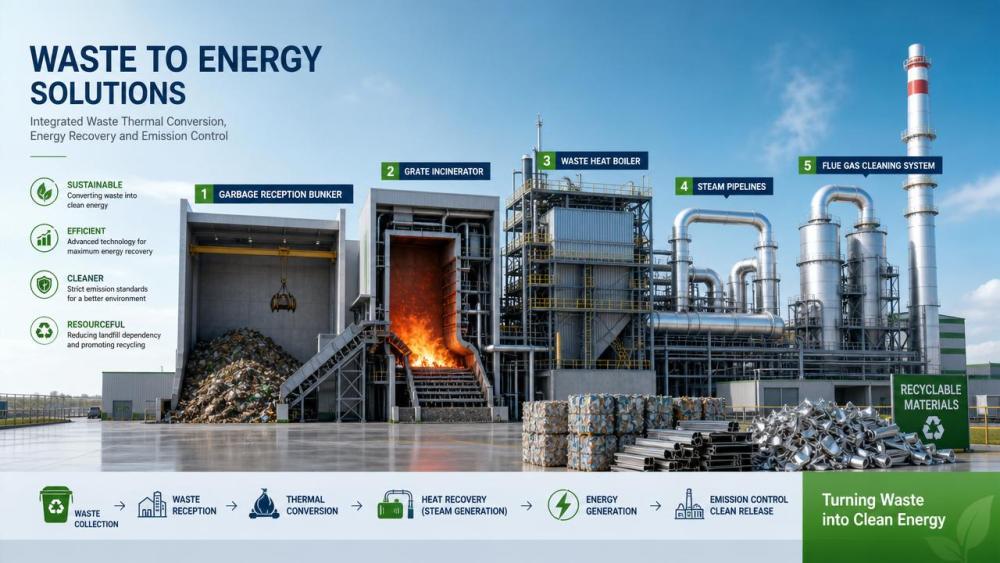
The basic idea is simple. Waste to energy plants convert non-recyclable waste into electricity, steam, district heat, or recovered materials through controlled thermal treatment.
The business logic is less simple. A plant must destroy waste safely, recover energy efficiently, and keep emissions within strict regulatory limits at the same time.
This explains the rising interest from heavy industry, public infrastructure, and carbon strategy teams. Landfill pressure is increasing, grid flexibility matters more, and circularity targets are getting harder to ignore.
From the perspective of CF-Elite’s coverage, waste to energy also connects naturally with kilns, refractory systems, combustion control, and online monitoring. It is not an isolated waste topic.
How a waste to energy plant actually works
Most facilities follow a practical chain rather than a single combustion event. Performance depends on how smoothly each link supports the next.
Waste reception and pre-treatment
Incoming waste is weighed, sampled, and inspected. Operators look for moisture swings, oversized items, metals, hazardous contamination, and calorific variability.
Some plants use little pre-processing. Others shred, mix, dry, or blend feedstocks to create more stable combustion conditions.
Thermal conversion inside the furnace
The most common route is mass-burn incineration on moving grates. Other systems use fluidized beds, gasification units, or dedicated lines for refuse-derived fuel.
At this stage, temperature profile, residence time, oxygen supply, and turbulence determine burnout quality. Poor control reduces energy recovery and raises downstream treatment burden.
Heat recovery and power generation
Combustion gases pass through a boiler. Heat converts water into steam, which drives a turbine for electricity or supports industrial heat users.
In cogeneration settings, waste to energy performs better because both electricity and thermal output are monetized. Heat-only losses become less severe.
Flue gas cleaning and residue handling
No serious evaluation of waste to energy is complete without emissions treatment. Acid gases, particulates, heavy metals, dioxins, and NOx require dedicated control systems.
Bottom ash, fly ash, and recovered metals are then separated and managed. In stronger operations, residue handling is treated as a resource stream, not only a disposal cost.
Feedstocks define plant behavior more than many summaries admit
A waste to energy plant is only as stable as the waste entering it. Feedstock chemistry and physical form shape furnace behavior, corrosion risk, ash profile, and energy yield.
Common feedstock groups
This is one reason plant comparisons can be misleading. Two facilities may share equipment labels but show very different output because their waste profiles are not alike.
In practice, feedstock blending strategy often matters as much as furnace design. Stable input improves steam consistency, refractory life, and maintenance planning.
The output metrics that actually matter
A useful waste to energy assessment goes beyond installed capacity. Nameplate numbers alone rarely show operating quality.
Core operational indicators
- Throughput, usually measured in tons per day or tons per year.
- Net electrical output after internal consumption.
- Steam output, pressure, and temperature stability.
- Overall energy efficiency, especially in combined heat and power mode.
- Availability, unplanned downtime, and maintenance interval length.
- Residue generation, metal recovery rate, and ash reuse potential.
Environmental and compliance indicators
Emissions performance is not a side issue. It is a central output metric because it shapes permit security, community acceptance, and long-term operating economics.
Key readings usually include NOx, SOx, HCl, dust, total organic carbon, heavy metals, and dioxin-related control performance. Continuous monitoring adds credibility.
For intelligence-led review, carbon intensity per unit of useful energy is becoming just as important. Plants are increasingly judged against landfill alternatives and fossil heat sources.
Where waste to energy creates practical value
The strongest case appears where waste volumes are steady and disposal routes are constrained. Urban clusters, industrial parks, and integrated utility systems are common examples.
Waste to energy also gains relevance when nearby demand exists for steam, hot water, or process heat. Selling only electricity can leave too much value unused.
From a broader industrial angle, these plants support resource circularity. Metals can be recovered from ash, landfill dependency can fall, and thermal assets can be linked to local infrastructure.
That alignment helps explain why platforms covering cement, kilns, refractory systems, and decarbonization watch this segment closely. The same high-temperature logic crosses sectors.
What deserves closer scrutiny before drawing conclusions
Not every waste to energy project delivers the same industrial value. Several issues deserve a closer reading before performance claims are accepted.
- Feedstock security: long-term waste supply contracts are as important as furnace size.
- Heat utilization: cogeneration often changes project economics more than headline capacity.
- Material durability: corrosion, slagging, and refractory wear can erode uptime.
- Regulatory fit: emission limits and ash classification vary sharply by region.
- Data quality: reported efficiency should distinguish gross output from net useful energy.
In many reviews, the most revealing question is not whether a plant burns waste. It is whether the full system converts unstable feedstock into dependable, compliant, monetizable energy.
A practical way to evaluate the next move
A structured assessment usually starts with three comparisons: waste composition, thermal conversion route, and local demand for power or heat.
Then it helps to examine output metrics in context, not in isolation. Throughput without stable emissions control says little. Capacity without feedstock quality control says even less.
For ongoing market tracking, it is useful to follow developments in incineration technology, refractory monitoring, carbon regulation, and co-processing links with other thermal industries.
That wider lens is where waste to energy becomes more than a disposal topic. It becomes a thermal systems question, a materials question, and increasingly, a strategic infrastructure question.
A good next step is to build a comparison framework around feedstock stability, net energy output, emissions control depth, and residue recovery potential. That foundation supports better long-range judgment.
Related News
 Thermal Energy ArchitectHow to Select Heat-Resistant Materials That Maintain Abrasion Resistance in KilnsHeat-resistant materials abrasion resistance: learn how to select kiln linings that withstand heat, wear, thermal cycling, and chemical attack for longer service life.Sep 13, 2026
 Thermal Energy ArchitectHow Rotary Kiln Automation Improves Temperature Control and Fuel EfficiencyRotary kiln technology automation enhances temperature control, stabilizes combustion, and improves fuel efficiency with smarter data, predictive control, and safer operations.Sep 12, 2026
 Silicate Process EngineerCement Plant Emission Control: Selecting Systems for Dust, NOx, and SO2 LimitsCement plant emission control guide: compare dust collectors, NOx reduction, and SO2 systems for reliable compliance across kiln modes, fuel changes, and operating upsets.Sep 11, 2026
 Thermal Energy ArchitectSelecting Abrasion-Resistant High-Temperature Materials for Kiln and Conveyor Wear ZonesHigh-temp material engineering guide to abrasion-resistant kiln and conveyor solutions—match wear, heat, chemistry, and installation design for longer service life.Sep 10, 2026
 Dr. Alistair VaughnIndustrial Process Engineering: How to Map Processes for Safer, More Efficient PlantsIndustrial process engineering reveals bottlenecks, safety risks, and energy losses through practical process mapping for safer, more efficient plants.Sep 09, 2026
 Optical Glass Tech FellowHow to Evaluate a Glass Annealing Equipment Manufacturer for Production StabilityChoose a glass annealing equipment manufacturer with proven thermal uniformity, reliable controls, lifecycle value, and responsive service for stable production.Sep 08, 2026
 Prof. Marcus ChenThermal Energy Architecture in North America: Strategies for Lower Building Energy UseThermal energy architecture North America helps project leaders cut building energy use through stronger envelopes, right-sized HVAC, storage, and smart commissioning.Sep 07, 2026
 Ms. Elena RodriguezHow Should Buyers Evaluate Building Material Industry Intelligence Pricing?Building material industry intelligence pricing: learn how to compare coverage, technical depth, and ROI to choose intelligence that reduces procurement risk.Sep 07, 2026
 Ms. Elena RodriguezHow to Use Building Material Intelligence Data for Market and Investment DecisionsBuilding material industry intelligence data helps leaders evaluate demand, costs, regulation, capacity, and technology to make smarter market and investment decisions.Sep 05, 2026
 Thermal Energy ArchitectHow PLC Control Improves Energy Efficiency and Temperature Stability in KilnsEnergy efficient kilns PLC control improves temperature stability, cuts fuel waste, and optimizes combustion, draft, and material flow. Explore proven strategies for smarter kiln modernization.Sep 04, 2026
 Optical Glass Tech FellowEuropean Glass Melting Processes: Furnace Choices, Energy Use, and Quality ControlGlass melting process Europe: explore furnace choices, energy efficiency, cullet strategy, and quality control to improve output, compliance, and long-term glass performance.Sep 03, 2026
 Thermal Energy ArchitectWhat Determines Refractory Lining Monitoring Price for Industrial Kilns?Refractory lining monitoring price depends on kiln size, sensor technology, installation, software, and support. Compare total lifecycle costs and choose the right solution.Sep 02, 2026
 Silicate Process EngineerCement Production System Costs: A Plant Buyer’s Guide to Budgeting and ROICement production systems cost planning made clear: compare CAPEX, operating costs, compliance, and ROI to build a resilient, profitable cement plant investment.Sep 01, 2026
 Dr. Alistair VaughnWhat Should a Process Technology Database Track for High-Temperature Plants?Process technology database essentials for high-temperature plants: track thermal profiles, feed chemistry, refractory wear, emissions, energy, and maintenance for safer, data-driven decisions.Aug 31, 2026
 Ms. Elena RodriguezHow to Evaluate a Silicate Processing Equipment Manufacturer for Plant ProjectsSilicate processing equipment manufacturer selection: assess process fit, guarantees, energy, compliance, delivery risk, and lifecycle support for dependable plant performance.Aug 30, 2026
 Dr. Alistair VaughnHow to Specify Custom Agricultural Processing Equipment for Throughput and HygieneEquipment customization services for agricultural processing: learn to specify hygienic, high-throughput lines that improve yield, reliability, and long-term efficiency.Aug 29, 2026
 Dr. Alistair VaughnHow to Select Process Plant Equipment for High-Temperature, Abrasive Production LinesProcess plant equipment selection for high-temperature, abrasive lines: reduce downtime, improve durability, and optimize lifecycle performance.Aug 28, 2026
 Silicate Process EngineerHow Kiln Heat Recovery Systems Cut Fuel Use in Cement and Lime ProductionKiln heat recovery helps cement and lime plants cut fuel use, improve thermal stability, and build practical, reliable decarbonization strategies.Aug 27, 2026
 Ms. Elena RodriguezProcess Equipment Comparison: Which Metrics Matter Most for Reliable Selection?Process equipment comparison made practical: discover which metrics truly drive reliable selection, from energy efficiency and control stability to wear life, maintainability, and uptime.Aug 26, 2026
 Ms. Elena RodriguezWhat Buyers Should Check Before Sourcing Precision Alloy Bars for Critical PartsPrecision Alloy Bars buyers should verify grade, chemistry, tolerances, surface quality, traceability, and lead time before sourcing for critical parts. Learn what prevents costly machining and reliability risks.Aug 27, 2026



Related News
- 00
0000-00
How to Select Heat-Resistant Materials That Maintain Abrasion Resistance in Kilns - 00
0000-00
How Rotary Kiln Automation Improves Temperature Control and Fuel Efficiency - 00
0000-00
Selecting Abrasion-Resistant High-Temperature Materials for Kiln and Conveyor Wear Zones - 00
0000-00
How PLC Control Improves Energy Efficiency and Temperature Stability in Kilns - 00
0000-00
What Determines Refractory Lining Monitoring Price for Industrial Kilns?
Weekly Insights
Stay ahead with our curated technology reports delivered every Monday.