
Furnace Thermal Control Selection Guide: Sensors, Response Time, and Temperature Stability




Selecting a furnace thermal control system is rarely a narrow instrumentation decision. It shapes firing consistency, fuel use, refractory life, and the stability of downstream quality results.
That is why furnace thermal control now draws closer review across cement plants, glass lines, incineration assets, refractory production, and extrusion-based building material systems.
In these sectors, temperature is not only a number on a screen. It is a moving process condition tied to combustion, airflow, residence time, material chemistry, and carbon performance.
For operations tracked by intelligence platforms such as CF-Elite, the real question is practical: which sensor mix, response profile, and control logic will hold temperature where the process actually needs it.
Why Furnace Thermal Control Has Become a Strategic Issue
High-temperature industries are under pressure from several directions at once. Energy cost volatility, emissions limits, and tighter product tolerances have raised the value of stable thermal performance.
A weak furnace thermal control setup can create hidden losses before alarms ever appear. Common examples include thermal overshoot, cold pockets, delayed burner correction, and uneven heat transfer across the chamber.
Those issues do not affect every process in the same way. In float glass, they can disturb melt behavior or annealing balance. In kilns, they can alter clinker quality or waste co-processing stability.
In refractory lines and specialized extrusion systems, temperature drift can also damage forming behavior, curing rhythm, or material strength consistency. The cost appears in scrap, fuel, maintenance, and process uncertainty.
What Furnace Thermal Control Really Covers
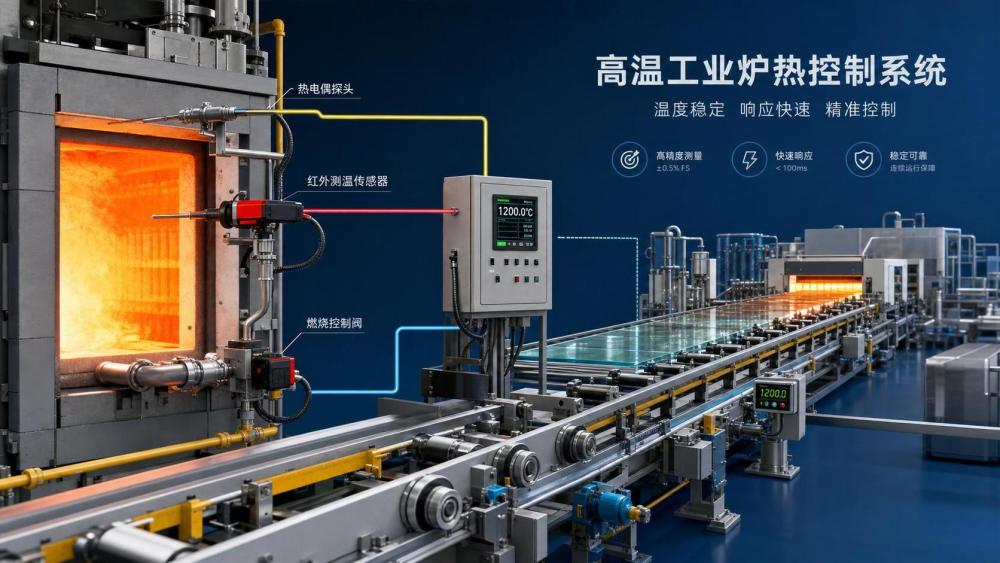
The term furnace thermal control includes more than a controller cabinet. It usually combines temperature sensing, signal transmission, control algorithms, combustion adjustment, actuator response, and operator visibility.
A reliable arrangement answers three linked questions. First, is the temperature measured correctly. Second, is the change detected quickly enough. Third, can the system hold a stable setpoint under load variation.
When one link is weak, the full furnace thermal control chain becomes misleading. Fast software cannot compensate for a poorly placed sensor. A premium sensor cannot fix slow valves or unstable combustion mixing.
The Measurement Layer
This layer includes thermocouples, RTDs in lower ranges, infrared pyrometers, thermal imaging support, and protective assemblies such as sheaths, wells, and mounting hardware.
Selection depends on process temperature, gas composition, contamination risk, installation space, and whether direct or indirect surface reading is acceptable.
The Control Layer
This covers PID strategy, multizone coordination, cascade control, feedforward compensation, alarm logic, and links to SCADA or digital twin tools.
In advanced plants, furnace thermal control is increasingly evaluated as part of a data environment, not as an isolated panel.
Sensor Choice Should Match the Thermal Reality
Sensor selection often gets reduced to maximum temperature rating. That is too narrow. Durability matters, but so do drift behavior, calibration frequency, response speed, and resistance to corrosive atmospheres.
For many furnace thermal control applications, thermocouples remain the practical default. Type K may fit general industrial heating, while Type S, R, or B often serve higher-temperature, high-stability environments.
Infrared devices become useful when contact sensors degrade too quickly, when products are moving, or when local hot spots matter more than bulk chamber averages.
Still, non-contact measurement introduces its own questions. Emissivity, dust, flame interference, viewing angle, and dirty optics can reduce confidence if not managed early.
In procurement review, the right question is not which sensor is best in general. It is which sensor remains trustworthy in the actual thermal, chemical, and maintenance conditions of the line.
Response Time Is About the Whole Loop
Response time is often misunderstood as sensor speed alone. In practice, furnace thermal control response includes sensor lag, signal filtering, controller tuning, valve travel, burner adjustment, and process thermal inertia.
A furnace can show delayed correction even when the thermocouple itself is acceptable. The bottleneck may sit in oversized protection tubes, conservative software damping, or slow combustion actuators.
This matters most where load changes are frequent. Incineration lines, mixed-fuel kilns, and specialty thermal equipment often face unstable calorific inputs or changing feed characteristics.
In those settings, slow furnace thermal control can widen temperature swings. That leads to overcorrection, excess fuel use, and wider deviation from target process windows.
What to check in specifications
- Sensor time constant under realistic mounting conditions
- Controller scan rate and filtering logic
- Actuator response under partial load, not only full stroke
- Combustion system coordination across multiple zones
- Recovery time after process disturbance
These points help separate brochure speed claims from usable process performance.
Temperature Stability Is the Business Outcome
Most investment decisions eventually return to stability. A furnace thermal control package earns value when it keeps thermal variation within a range the process can tolerate, hour after hour.
Temperature stability affects several cost lines at once. It influences product uniformity, emission behavior, burner efficiency, refractory wear, downtime frequency, and maintenance planning.
CF-Elite tracks this relationship across high-temperature sectors because thermal stability now connects directly with decarbonization and digital operations. Better control reduces unnecessary overheating and improves traceable energy management.
That connection is especially relevant where global regulations and carbon reporting are becoming less forgiving. Stable thermal control is increasingly a compliance and operating resilience issue, not only a quality issue.
Useful indicators beyond setpoint accuracy
A narrow focus on displayed temperature can hide instability. Better evaluation includes variance over time, zone-to-zone deviation, overshoot events, fuel consumed per thermal cycle, and temperature recovery after planned interruptions.
Different Applications Need Different Control Priorities
The same furnace thermal control philosophy should not be copied across every line. Process physics change the priority list.
This is where a sector-informed review becomes valuable. A generic furnace thermal control package may meet nominal specifications while missing the process behavior that actually drives cost.
How to Compare Options Without Losing the Technical Plot
When comparing suppliers or retrofit packages, documentation should move beyond component lists. The stronger proposals explain thermal logic, instrumentation layout, calibration access, and expected stability under realistic load conditions.
A disciplined review usually includes the following points.
- Map each measurement point to a real process objective
- Check sensor material compatibility with atmosphere and dust
- Review maintenance intervals and replacement complexity
- Ask for evidence of control stability after disturbances
- Confirm data integration with plant monitoring systems
- Estimate lifecycle cost, not only initial hardware price
In long-cycle heavy equipment markets, this approach reduces the risk of buying impressive parts that do not improve operating discipline.
Where the Next Decision Usually Starts
A sound furnace thermal control decision starts with process evidence, not catalog language. Historical drift, upset frequency, fuel shifts, quality variation, and maintenance records usually show where the control chain is weakest.
From there, it becomes easier to judge whether the next step is sensor replacement, control retuning, zoning redesign, better visibility, or a broader thermal system upgrade.
For organizations following CF-Elite’s view of thermal management, the more useful benchmark is not maximum temperature alone. It is how consistently the line converts heat into stable, efficient, lower-risk production.
That is the basis for a better shortlist: define the thermal objective, compare response behavior, verify stability data, and align furnace thermal control choices with the process conditions that matter most.
Related News
 Thermal Energy ArchitectHow to Evaluate a High-Temperature Materials Manufacturer for Furnace ApplicationsChoose a high-temperature materials manufacturer with confidence: compare thermal performance, chemical resistance, quality controls, installation support, and lifecycle cost.Sep 30, 2026
 Ms. Elena RodriguezHow to Structure Global Specification Data for Faster Industrial Product EvaluationGlobal specification-oriented product information helps industrial teams compare capacity, energy, emissions, automation, and lifecycle data on a like-for-like basis for faster, confident equipment decisions.Sep 29, 2026
 Thermal Energy ArchitectHow to Specify High-Temperature Process Systems for Continuous Thermal OperationsHigh-temperature process engineering systems: learn how to specify resilient continuous thermal operations for efficiency, compliance, reliable uptime, and long-term performance.Sep 28, 2026
 Thermal Energy ArchitectHow to Evaluate a Thermal Engineering Contractor for High-Temperature Plant ProjectsChoose a thermal engineering contractor with proven process expertise, lifecycle value, emissions control, and delivery discipline for reliable high-temperature plant performance.Sep 27, 2026
 Silicate Process EngineerHow Latin American Cement Plants Can Reduce Dust Emissions in Kilns and Transfer PointsCement plant dust control Latin America: reduce kiln and transfer-point emissions with practical airflow, filtration, monitoring, and maintenance strategies.Sep 26, 2026
 Material Heat-Resist ExpertHow to Evaluate Refractory Production Lines for Output, Quality, and Energy UseRefractory production lines: learn how to assess qualified output, consistent quality, and total energy use for smarter, lower-risk investment decisions.Sep 25, 2026
 Dr. Alistair VaughnHow Waste Recycling Technology Improves Material Recovery in Industrial PlantsWaste recycling technology improves material recovery through source segregation, smart separation, thermal treatment, and quality control for industrial plants.Sep 24, 2026
 Optical Glass Tech FellowHow to Specify Glass Annealing Equipment for European Quality and Energy RequirementsGlass annealing equipment Europe: learn how to specify lehrs for consistent glass quality, energy efficiency, compliance, automation, and reliable long-term performance.Sep 23, 2026
 Optical Glass Tech FellowSilicate Process Automation: Improving Batch Consistency and Energy ControlSilicate process automation improves batch consistency, energy control, traceability, and operator confidence across high-temperature manufacturing operations.Sep 22, 2026
 Optical Glass Tech FellowHow Silicate Industrial Processes Control Viscosity, Energy Use, and Product QualitySilicate industrial processes: learn how viscosity, chemistry, heat transfer, and atmosphere control reduce energy use, improve stability, and protect product quality.Sep 21, 2026
 Thermal Energy ArchitectHow European Plants Can Evaluate Energy Recovery Equipment for High-Temperature ProcessesIndustrial energy recovery equipment Europe: learn how high-temperature plants can assess waste-heat sources, integration risks, lifecycle value, and reliable recovery routes.Sep 20, 2026
 Thermal Energy ArchitectIndustrial Furnace Process Optimization: Reducing Fuel Use Without Sacrificing ThroughputIndustrial process optimization furnace strategies that cut fuel use while protecting throughput. Explore combustion control, heat recovery, refractory performance, and data-driven efficiency gains.Sep 19, 2026
 Ms. Elena RodriguezWhat Drives High-Pressure Extrusion Equipment Cost in Industrial Projects?High pressure extrusion equipment cost explained: compare pressure, die design, automation, wear, energy, and installation factors for smarter industrial investments.Sep 18, 2026
 Thermal Energy ArchitectHow to Size a Waste Heat Recovery Exchanger for High-Temperature Kiln Exhaust?Waste heat recovery exchanger sizing for high-temperature kiln exhaust: balance recoverable duty, fouling, corrosion limits, pressure drop, and reliable heat use.Sep 17, 2026
 Thermal Energy ArchitectWhy Heat-Resistant Materials Lose Abrasion Resistance at High TemperaturesHeat-resistant materials abrasion resistance can decline at high temperatures. Discover the thermal, chemical, and mechanical causes of wear—and how to choose longer-lasting linings.Sep 16, 2026
 Thermal Energy ArchitectHow to Evaluate a Thermal Energy Optimization Company for High-Temperature PlantsChoose a thermal energy optimization company with proven process expertise, measurable savings, and reliable delivery for high-temperature plants. Learn what to assess.Sep 15, 2026
 Thermal Energy ArchitectRotary Kiln Efficiency: How Feed Rate, Fuel Use, and Heat Loss Affect OutputRotary kiln efficiency explained: discover how feed rate, fuel use, heat loss, combustion, and cooling performance shape output, quality, and energy costs.Sep 14, 2026
 Thermal Energy ArchitectHow to Select Heat-Resistant Materials That Maintain Abrasion Resistance in KilnsHeat-resistant materials abrasion resistance: learn how to select kiln linings that withstand heat, wear, thermal cycling, and chemical attack for longer service life.Sep 13, 2026
 Thermal Energy ArchitectHow Rotary Kiln Automation Improves Temperature Control and Fuel EfficiencyRotary kiln technology automation enhances temperature control, stabilizes combustion, and improves fuel efficiency with smarter data, predictive control, and safer operations.Sep 12, 2026
 Silicate Process EngineerCement Plant Emission Control: Selecting Systems for Dust, NOx, and SO2 LimitsCement plant emission control guide: compare dust collectors, NOx reduction, and SO2 systems for reliable compliance across kiln modes, fuel changes, and operating upsets.Sep 11, 2026


Related News
- 00
0000-00
How to Evaluate a High-Temperature Materials Manufacturer for Furnace Applications - 00
0000-00
How to Specify High-Temperature Process Systems for Continuous Thermal Operations - 00
0000-00
How to Evaluate a Thermal Engineering Contractor for High-Temperature Plant Projects - 00
0000-00
How European Plants Can Evaluate Energy Recovery Equipment for High-Temperature Processes - 00
0000-00
Industrial Furnace Process Optimization: Reducing Fuel Use Without Sacrificing Throughput
Weekly Insights
Stay ahead with our curated technology reports delivered every Monday.