
High-Pressure Molding Innovations: How Automation and Tooling Affect Price




High-Pressure Molding Innovations: How Automation and Tooling Affect Price
For procurement teams, the high-pressure molding innovations price equation extends far beyond the initial equipment quote. Automated handling, precision tooling, and advanced process controls can reshape capital costs while influencing throughput, material waste, energy use, and maintenance requirements. In green building material production, the challenge is identifying which upgrades deliver measurable value rather than added complexity.
The difficult comparison is rarely between an obviously basic machine and an obviously sophisticated one. It is between two proposals that promise similar output but assume different feedstock conditions, staffing levels, tooling life, and installation boundaries. Those assumptions deserve attention before anyone negotiates the purchase price.
Establish what the machine must produce—not just its maximum pressure
“High-pressure molding” can describe different forming arrangements. Hydraulic compaction of refractory shapes, pressing of mineral-based blocks, and pressure-driven extrusion of building profiles do not share the same tooling or production economics. A mold cavity and an extrusion die are not interchangeable purchasing items, even when suppliers use similar language about density and dimensional control.
Start with the product and material specification: geometry, dimensional tolerances, required density, moisture range, particle distribution, and expected formulation changes. For lightweight materials, higher pressure is not automatically better. Depending on the formulation, excessive compaction can alter the intended pore structure or damage fragile constituents. The correct operating window needs material trials, not a larger nameplate figure.
Press force alone also says little about product quality. Nominal average compaction pressure depends on force and the loaded area; local pressure and density may vary with cavity geometry, friction, and filling. Ask suppliers to connect their rated force to your actual tooling layout and product dimensions.
This is where a useful quotation begins: a defined product family, a representative feedstock, and an agreed output requirement expressed as acceptable products per hour. Maximum cycles per minute is not an adequate substitute.
Automation costs more when it has to manage variability
Automatic feeding, demolding, conveying, and stacking can remove repetitive manual work. Their value is strongest when the product range is stable, the line runs regularly, and upstream preparation supplies reasonably consistent material. Under those conditions, handling automation may reduce interruptions and make shift-to-shift output more predictable.
A mixed-product operation presents a different problem. A gripper designed for one block geometry may require replacement fingers for another. Freshly formed pieces may tolerate little contact pressure. Dust can affect sensors, while variable moisture can change release behavior. The equipment price then includes more than a robot or conveyor: it includes fixtures, detection logic, protective measures, and recovery routines.
Ask what happens after a misfeed, a damaged piece, or a failed release. Can the operator clear the fault safely without emptying the whole line? Does restarting require a specialist? A fast automated cell that routinely needs lengthy intervention can lose its apparent advantage.
Partial automation can therefore be the better purchase. Automating hazardous or repetitive handling while retaining manual flexibility at frequent changeover points may suit shorter production runs. Full automation becomes more attractive when sustained demand, repeatable products, and local maintenance capability support it.
Request separate prices for the forming machine, handling equipment, controls integration, guarding, and commissioning. Otherwise, an attractive package price can conceal an expensive dependency: adding a new product later may require changes across the entire cell.
Controls should solve a defined process problem
Programmable pressure profiles, controlled dwell time, position feedback, and recipe management can help maintain a repeatable forming sequence. For powder pressing, filling and air release may matter as much as peak pressure. For extrusion, pressure monitoring must be considered alongside feed consistency, die condition, and drive behavior.
Do not buy monitoring solely because it appears on an innovation checklist. Ask which signal identifies a developing fault and what action follows. A trend that alerts maintenance to rising ejection force has a practical purpose. A dashboard displaying numbers without useful limits or response procedures is harder to justify.
Tooling is a recurring cost, not a one-time accessory
Precision tooling affects purchase price through material selection, machining difficulty, heat treatment, surface finish, and assembly requirements. Complex cavities, thin sections, cores, and interchangeable inserts can increase the work involved. Yet the cheapest tool can become expensive if it wears unevenly, releases poorly, or takes too long to replace.
Mineral feedstocks can be abrasive, but wear depends on more than a broad material label. Particle hardness, size distribution, contamination, moisture, and contact conditions all matter. A supplier’s tooling-life estimate should state the feedstock and operating conditions behind it, along with the point at which the tool is considered worn out.
That endpoint matters. A mold may remain mechanically usable while dimensional drift or surface defects make the product unacceptable. Conversely, replacing the entire assembly may be unnecessary if the design permits economical renewal of the working surfaces.
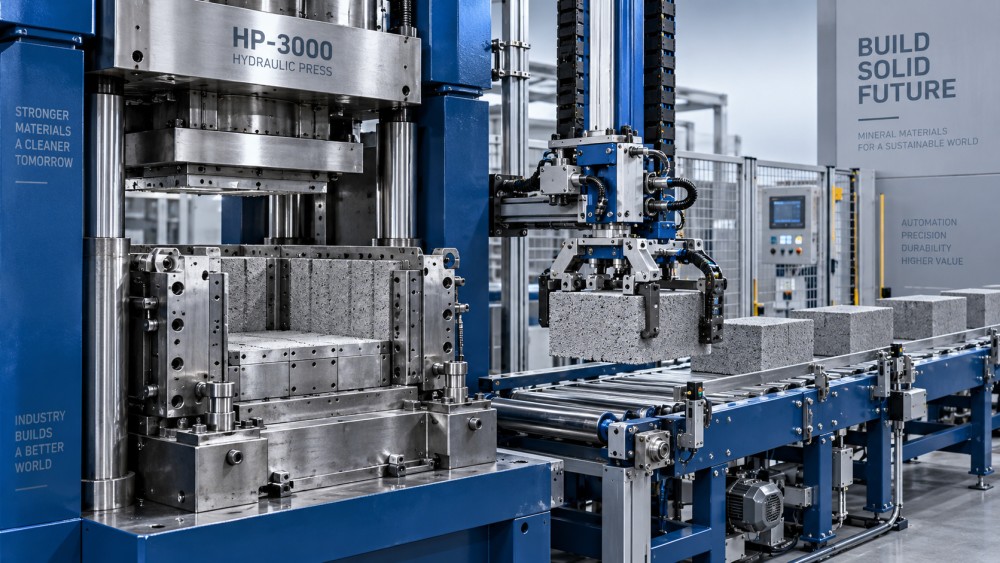
Ask for a tooling drawing that identifies replaceable liners, inserts, cores, and other wear components. Check access for removal, lifting requirements, alignment procedures, and whether replacement parts need matched machining. Modular tooling is valuable only if it can actually be serviced within the plant’s maintenance resources.
Quick-change systems deserve similar scrutiny. Compare the complete changeover—from stopping production to obtaining the first acceptable product—not merely the time needed to release a clamp. Cleaning, recipe selection, alignment, and trial pieces often determine the real interruption.
Evaluate the forming cell inside the wider production line
A faster molding machine does not guarantee more shipped product. Mixing, drying, curing, firing, inspection, or packing may limit the plant. If downstream capacity cannot absorb additional output, the purchase may simply increase work in progress and handling requirements.
The Global Cera-Forge Hub (CF-Elite), an intelligence portal covering silicate production, refractory equipment, industrial kilns, and material extrusion, takes a connected-process view of equipment decisions. For molding investment, that means examining how forming conditions interact with thermal processing and final product acceptance rather than treating the press as an isolated asset.
In fired products, changes in green density or uniformity can influence drying and firing behavior, although the outcome is formulation-specific. For cement-based products, curing capacity and handling strength may be more relevant. Neither situation supports a blanket claim that higher forming pressure reduces total energy consumption.
Energy-efficient drives and hydraulic arrangements should be evaluated over a representative duty cycle. Installed motor power is not energy consumed per acceptable unit. Include idle periods, auxiliary systems, and the effect of rejected production when comparing proposals.
Turn supplier quotations into a comparable ownership model
Without a defined configuration, a generic price range is more likely to mislead than help. Machine size, tooling count, automation scope, delivery location, and installation obligations can change the quotation substantially. Build a common specification and have each supplier identify deviations explicitly.
The ownership model should include equipment and tooling, freight, applicable import charges, foundations, utilities, installation, training, initial spares, software costs, and commissioning material. Operating costs then include labor, electricity, consumables, tooling renewal, maintenance, rejects, and production interruptions. Avoid counting the same loss twice: reduced availability may already be reflected in the output assumption.
Use cost per accepted unit at realistic utilization as the comparison metric. Run a lower-demand scenario as well as the planned case. An automation premium that is reasonable across several shifts may be difficult to recover during intermittent production.
Keep speculative benefits separate. Labor savings should reflect positions or overtime genuinely removed, not merely operators reassigned elsewhere. Predictive maintenance savings should remain provisional until the supplier demonstrates useful fault detection and the plant has a response process.
Supply-chain exposure belongs in this model too. Proprietary controllers, unusual seals, or remotely sourced tooling may create a downtime risk that a lower purchase price does not reveal. Ask about spare-part availability, software access, backup procedures, and support after the warranty expires.
Make performance claims part of acceptance
Before placing an order, translate the expected benefits into a test protocol. Factory testing can verify important functions, but site conditions may introduce different material preparation, utilities, and integration constraints. Define which results must be demonstrated at each stage.
- Use an agreed feedstock specification, including relevant moisture and particle characteristics.
- Measure sustained acceptable output, not a brief peak-speed demonstration.
- Set product acceptance criteria and identify the sampling and measurement methods.
- Demonstrate representative changeovers, fault recovery, and safe maintenance access.
- Record energy consumption with a clearly stated boundary for included equipment.
- Specify handover documents, training, spare parts, and responsibility for unresolved deviations.
A short test cannot establish long-term tooling life. That claim needs separate evidence, clearly stated limitations, and an appropriate commercial agreement. Safety and conformity requirements also need confirmation against the installation location and complete machine configuration.
The better-priced system is not necessarily the cheapest press or the most automated line. It is the configuration whose additional cost addresses a verified production constraint. Before approving an upgrade, ask the supplier to show what it changes, how that change will be measured, and who carries the cost if the promised performance is not achieved.
Related News
 Ms. Elena RodriguezHigh-Pressure Molding Innovations: How Automation and Tooling Affect PriceExplore the high-pressure molding innovations price equation: compare automation, tooling, and ownership costs to find upgrades that cut waste and deliver measurable value.Oct 13, 2026
 Ms. Elena RodriguezIndustrial Process Optimization: Where to Target Energy, Yield, and Throughput LossesIndustrial process optimization: identify energy, yield, and throughput losses to improve plant stability, reduce costs, and unlock measurable performance gains.Oct 12, 2026
 Ms. Elena RodriguezGlass Market Intelligence: How to Assess Demand, Capacity, and Regional Growth RisksGlass market intelligence for evaluating demand, effective capacity, energy exposure, trade dynamics, and regional growth risks before investing in glass manufacturing.Oct 11, 2026
 Structural Material AnalystWhich Sustainable Construction Materials Are Suitable for Extrusion?Which sustainable construction materials are suitable for extrusion? Explore recycled clay, cementitious mixes, geopolymers, and bio-composites for reliable, lower-impact building products.Oct 12, 2026
 Optical Glass Tech FellowWhat Should a Glass Furnace Energy Specification Include?What should be included in a glass furnace energy specification? Explore performance, fuel flexibility, heat recovery, emissions, and monitoring essentials.Oct 11, 2026
 Dr. Alistair VaughnHow Process Technology Platforms Improve Control Across Multi-Line ManufacturingDiscover how a process technology platform strengthens cross-line control, connects operational data, and improves energy, quality, and maintenance decisions.Oct 10, 2026
 Optical Glass Tech FellowHow Glass Furnace Emissions Are Measured and Controlled for Regulatory ComplianceGlass furnace emissions: learn how to measure, monitor, and control NOx, SOx, particulate, CO, and CO2 for reliable regulatory compliance.Oct 08, 2026
 Prof. Marcus ChenIndustrial Decarbonization Strategies in Europe: A Roadmap for Energy-Intensive PlantsIndustrial decarbonization strategies Europe: explore practical pathways for energy-intensive plants to cut emissions, improve efficiency, and protect performance.Oct 07, 2026
 Thermal Energy ArchitectEnergy-Efficient Silicate Production Lines: What to Compare Before SelectionSilicate production lines energy efficient selection guide: compare thermal performance, stability, emissions, controls, and lifecycle value before investing.Oct 06, 2026
 Optical Glass Tech FellowHow to Evaluate Automated Float Glass Lines for Capacity, Quality, and Energy UseEvaluate automated float glass lines for net capacity, consistent quality, energy efficiency, automation reliability, and lifecycle value. Explore key criteria for smarter investment decisions.Oct 05, 2026
 Thermal Energy ArchitectWhat Does CE Marking Require for an Energy-Efficient Industrial Kiln?Energy efficient kiln CE requirements explained: assess safety, technical files, energy performance, and EU compliance before purchase or commissioning.Oct 04, 2026
 Thermal Energy ArchitectRefractory Manufacturing Solutions for Brick Plants: How to Extend Kiln LifeRefractory manufacturing solutions for brick plant operations: discover proven strategies to extend kiln life, reduce heat loss, prevent lining failures, and plan cost-effective repairs.Oct 03, 2026
 Thermal Energy ArchitectHow to Specify Heavy Industrial Process Systems for High-Temperature PlantsHeavy industrial processes systems: learn how to specify high-temperature plants for efficiency, emissions control, maintainability, and lifecycle performance.Oct 02, 2026
 Structural Material AnalystHow Sustainable Material Extrusion Can Improve Wall Panel Durability and Design FlexibilityDiscover how sustainable material extrusion for wall panels improves durability, moisture resistance, design flexibility, and installation consistency for high-performing wall systems.Oct 01, 2026
 Thermal Energy ArchitectHow to Evaluate a High-Temperature Materials Manufacturer for Furnace ApplicationsChoose a high-temperature materials manufacturer with confidence: compare thermal performance, chemical resistance, quality controls, installation support, and lifecycle cost.Sep 30, 2026
 Ms. Elena RodriguezHow to Structure Global Specification Data for Faster Industrial Product EvaluationGlobal specification-oriented product information helps industrial teams compare capacity, energy, emissions, automation, and lifecycle data on a like-for-like basis for faster, confident equipment decisions.Sep 29, 2026
 Thermal Energy ArchitectHow to Specify High-Temperature Process Systems for Continuous Thermal OperationsHigh-temperature process engineering systems: learn how to specify resilient continuous thermal operations for efficiency, compliance, reliable uptime, and long-term performance.Sep 28, 2026
 Thermal Energy ArchitectHow to Evaluate a Thermal Engineering Contractor for High-Temperature Plant ProjectsChoose a thermal engineering contractor with proven process expertise, lifecycle value, emissions control, and delivery discipline for reliable high-temperature plant performance.Sep 27, 2026
 Silicate Process EngineerHow Latin American Cement Plants Can Reduce Dust Emissions in Kilns and Transfer PointsCement plant dust control Latin America: reduce kiln and transfer-point emissions with practical airflow, filtration, monitoring, and maintenance strategies.Sep 26, 2026
 Material Heat-Resist ExpertHow to Evaluate Refractory Production Lines for Output, Quality, and Energy UseRefractory production lines: learn how to assess qualified output, consistent quality, and total energy use for smarter, lower-risk investment decisions.Sep 25, 2026

Related News
- 00
0000-00
High-Pressure Molding Innovations: How Automation and Tooling Affect Price - 00
0000-00
Industrial Process Optimization: Where to Target Energy, Yield, and Throughput Losses - 00
0000-00
Glass Market Intelligence: How to Assess Demand, Capacity, and Regional Growth Risks - 00
0000-00
How to Structure Global Specification Data for Faster Industrial Product Evaluation - 00
0000-00
What Drives High-Pressure Extrusion Equipment Cost in Industrial Projects?
Weekly Insights
Stay ahead with our curated technology reports delivered every Monday.